For more than two decades, SEO has revolved around one central truth:
Older domains with strong backlink profiles perform better.
That belief has shaped how websites are built, how content is produced, and how authority is earned.
But with the rise of LLM-driven search engines—ChatGPT, Perplexity, Claude, and Google’s AI Overviews—an entirely different question emerges:
Do LLMs evaluate websites the same way Google does?
Or have the rules of ranking changed completely?
To answer this, we ran a controlled experiment:
We launched a brand-new domain with:
Domain registered: citationmatrix.com
Domain register date 23 Nov 2025
WordPress Installed – 25 Nov 2025
Topical Map Created using Cgtgpt – 25 Nov 2025
Content created chtgpt batch feature – 27 Nov 2025
Imported content to WordPress – 27,28 Nov 2025
Site submitted to GSC -1 Dec 2025
Imported content to WordPress – 27,28 Nov 2025
Site submitted to GSC -1 Dec 2025
We weren’t looking for “SEO results.”
We wanted to measure LLM results—how the AI search ecosystem interprets, recalls, ranks, and cites newly created content.
The results dismantled several long-held assumptions—and confirmed something groundbreaking:
To ensure the results were pure and uncontaminated by traditional SEO advantages, we followed a strict protocol.
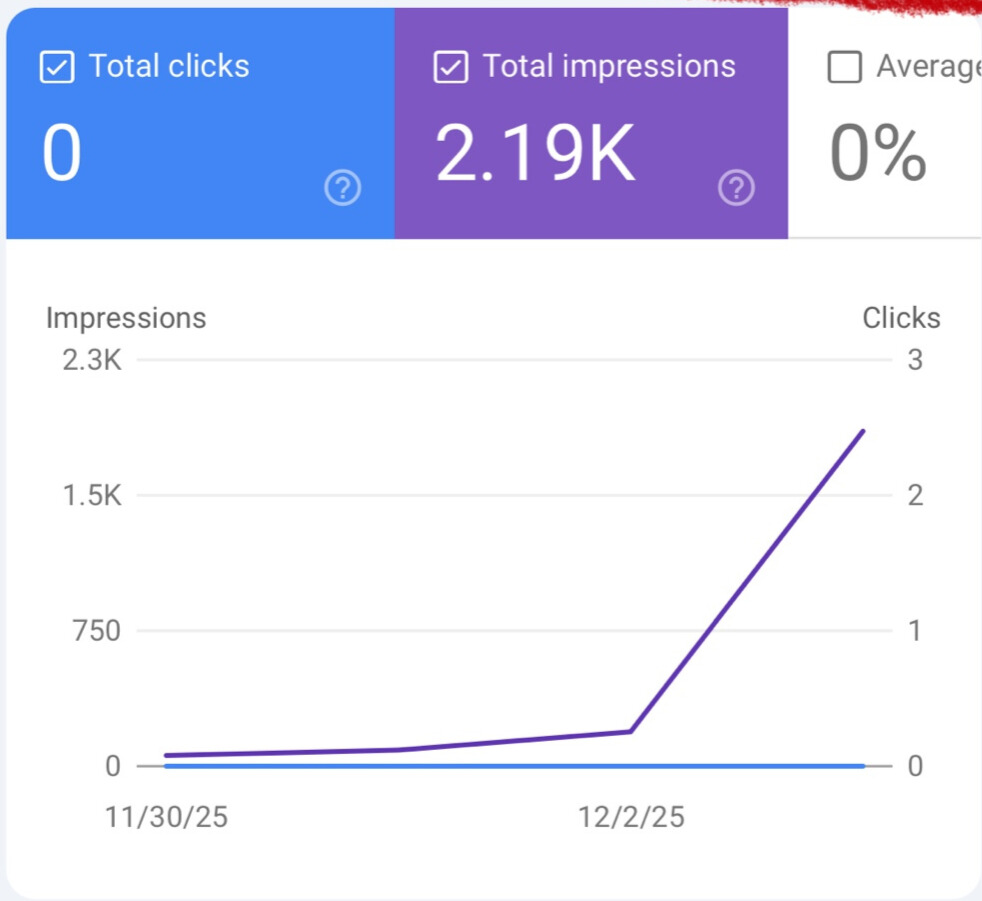
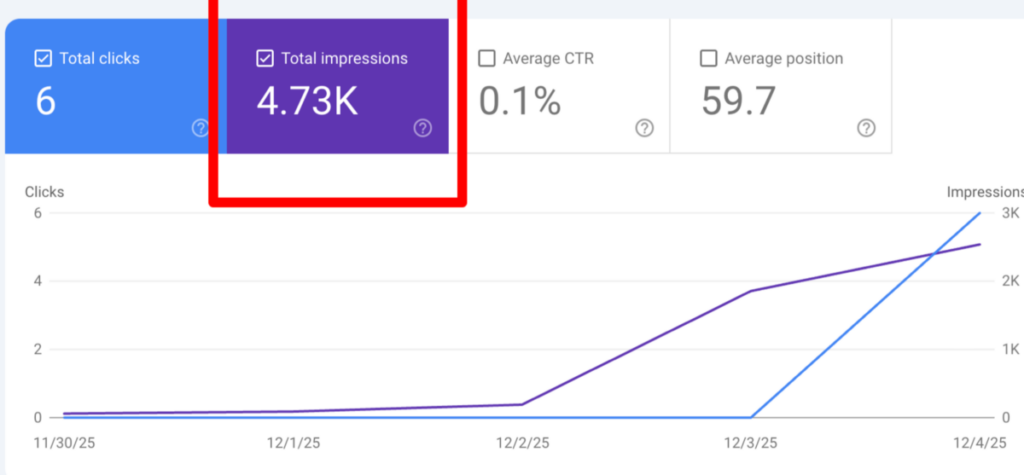
Yet, within 41 hours of going live…
This early spike alone suggests Google’s algorithms are shifting toward semantic interpretation, not historical authority.
We built 72 long-form articles using a high-precision, LLM-optimized content generation system:
✔ Automatic internal linking
✔ CTA block injection
✔ Gutenberg-ready HTML
✔ Block-based layout
✔ Section anchors
✔ Entity enrichment
✔ Semantic reinforcement patterns
✔ Hierarchical header structure
✔ Silo-based link graph mapping
✔ FAQs (when applicable)
✔ Micro-snippets for LLM snippet extraction
This structure was intentionally created to test a hypothesis:
If LLMs reward semantic clarity, structure, and topical completeness, then backlinks and domain age may matter far less.
To accurately measure LLM ranking behavior, we needed a query dataset that reflected real user intent, not synthetic prompts.
Because the domain was new, we relied on two complementary systems inside LLMClicks:
Together, these produced a realistic, multi-intent evaluation dataset.
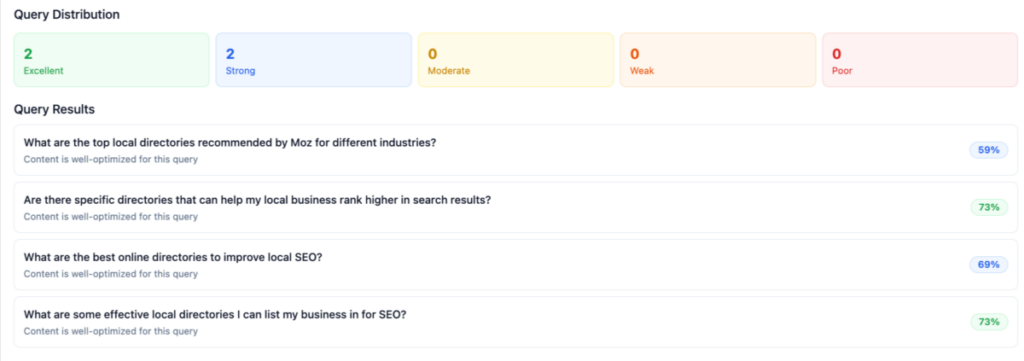
Even though the domain was new and GSC data was limited, LLMClicks was able to extract meaningful early insights.
LLMClicks analyzed early GSC impressions and allowed us to:
Informational
Transactional
How-To
Comparison
Navigational
This ensured that our foundation was not artificial—
our queries reflected how real users were already discovering or interpreting the content.
Because GSC data was limited, we supplemented it with a second, more comprehensive method:
LLMClicks’ Content Analysis engine examined every article and:
Entity combinations
Intent categories
Topic relationships
Subtopic relevance
This ensured every page had a semantically aligned set of seed queries—even if GSC data was insufficient.
LLMClicks evaluates content using high-dimensional embeddings.
For each query:
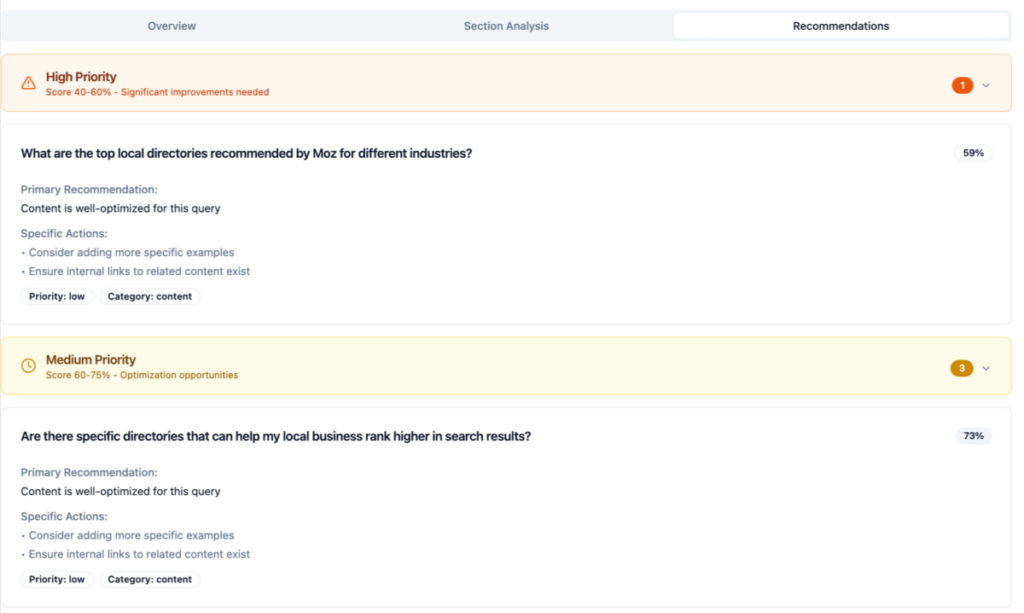
Low-similarity pages were sent to LLMClicks’ Content Analysis engine to detect:
This embedding-driven scoring allowed us to measure semantic authority, independent of backlinks or domain age.
Every LLM test prompt—across ChatGPT models, Perplexity, and others—was logged via
LLMClicks Prompt Tracker:
This created a complete longitudinal map of LLM behavior
Before running the experiment, we documented four hypotheses:
Our findings contradicted all four hypotheses.
This is where everything gets interesting.
Despite:
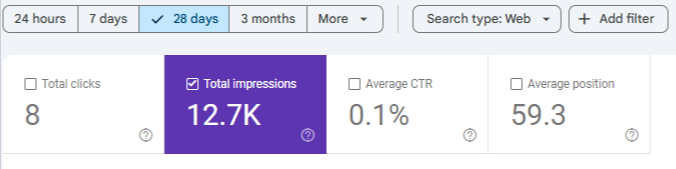
Google indexed us quickly and delivered:
This suggests Google’s early evaluation relies more heavily on:
…rather than historical factors.
Perplexity demonstrated the most surprising behavior:
Even more surprising…
This proves LLMs rely on semantic density, not FAQ formatting.
This proves that ChatGPT:
Despite OpenAI’s claim that 4.1 is updated only until June 2024, our 2025 content still:
Which suggests:
This is one of the most important observations in the entire experiment.
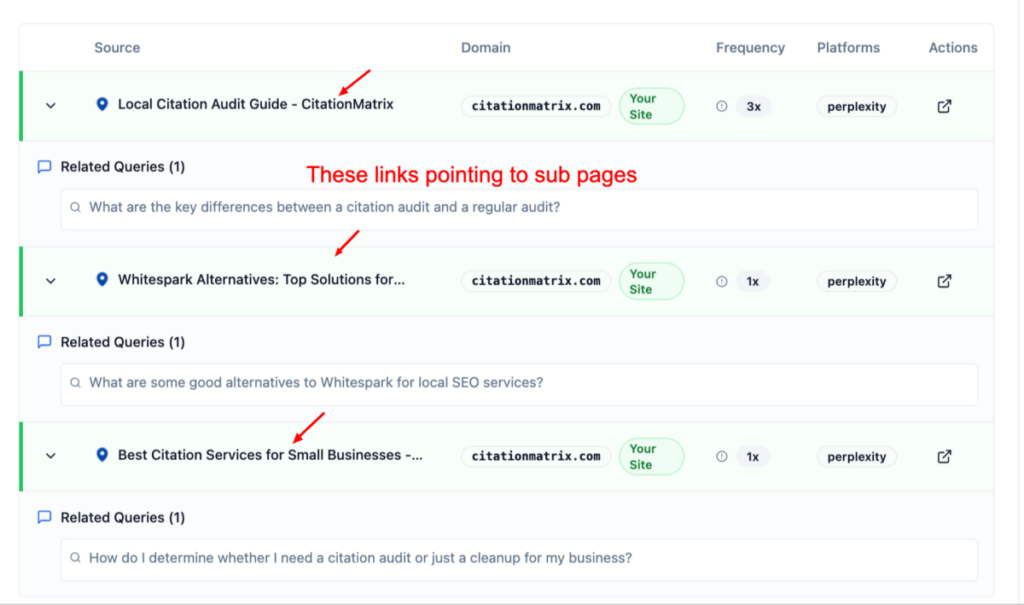
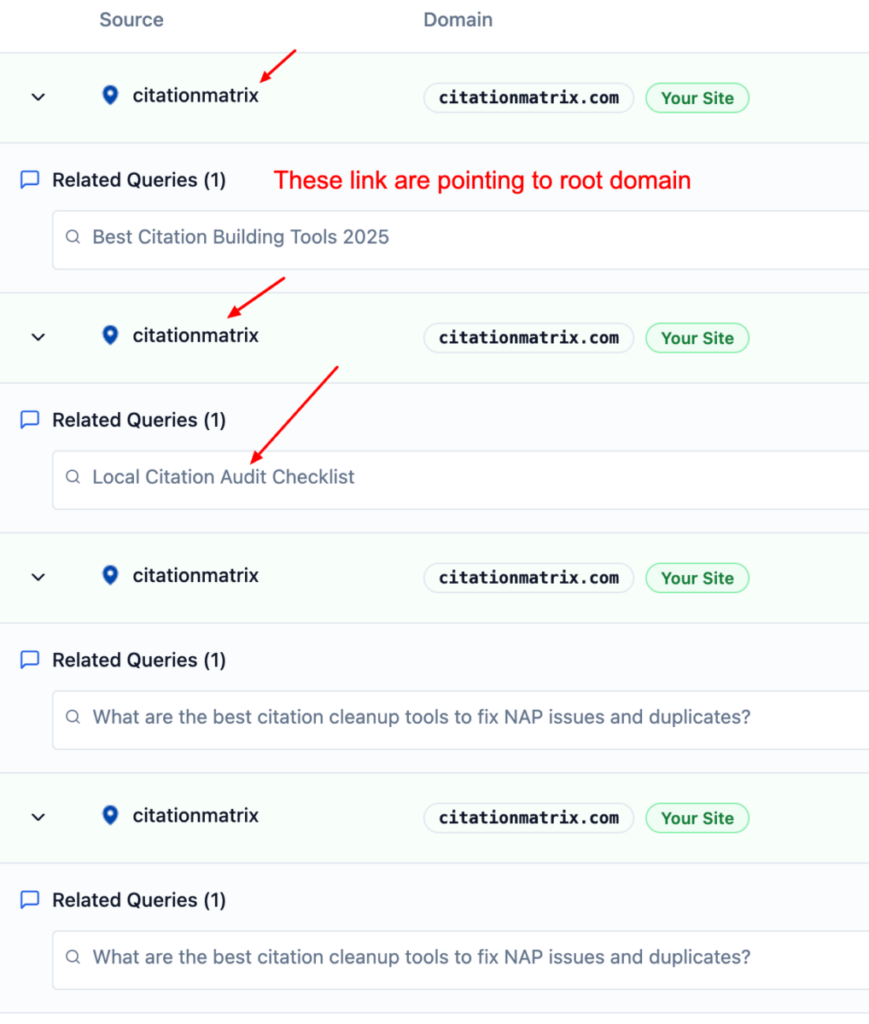
This single insight reshapes our understanding of how LLMs evaluate and rank content:
Instead, it sometimes cited the entire domain as if it were an established authority.**
And this happened despite the fact that:
The domain was brand new
No backlinks existed
No historical authority signals existed
No external brand mentions existed
In other words, the model treated a zero-authority domain as if it had domain-level trust.
From these observations, several critical patterns emerged:
Even with no off-page signals, the model created a conceptual representation of the domain.
The structure and internal consistency of the site were enough to trigger domain-level trust.
Entity enrichment, content clustering, consistent formatting, and topical coverage outweighed lack of links.
Cross-linking, consistent headers, and shared entities created a recognizable knowledge graph.
This domain-level citation behavior is commonly seen with long-established sites such as:
Moz
BrightLocal
Whitespark
HubSpot
Semrush
These sites have:
Millions of backlinks
Decades of publishing history
Strong E-E-A-T signals
High editorial authority
Yet our brand-new domain exhibited the same behavior.
Across multiple LLM platforms, our new domain didn’t just appear —
it often ranked above these established authority sites.
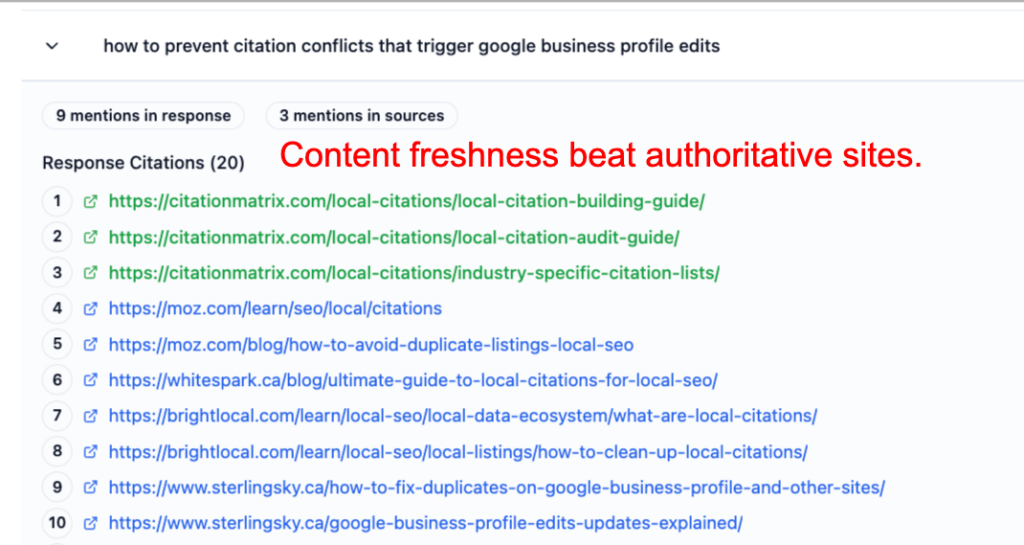
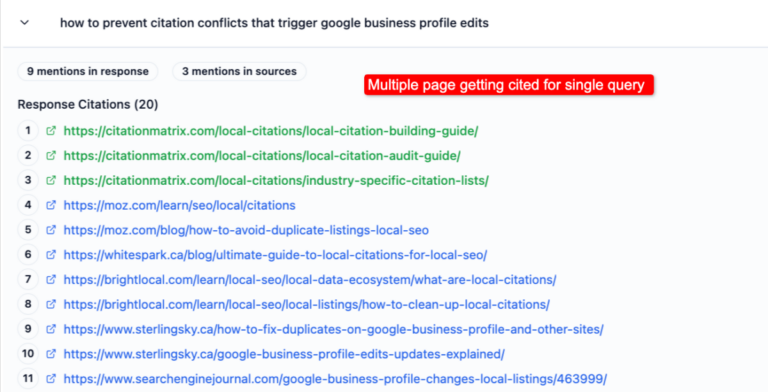
Screenshots show CitationMatrix.com cited:
Above Moz
Above BrightLocal
Above Whitespark
Above Semrush
Multiple times in a single answer
At the top of ChatGPT and Perplexity citation lists
This is not possible under traditional SEO ranking systems.
It demonstrates a fundamental shift:
LLMs prioritized:
Recent, up-to-date content
Dense entity coverage
Deep topical completeness
Semantic clarity and structure
Internal cohesion of the content network
Micro-snippets suitable for extraction
Clean, consistent formatting
These signals outweighed:
Backlinks
Domain age
Domain Rating
Historical trust
Legacy brand power
This finding is transformative for AI SEO:
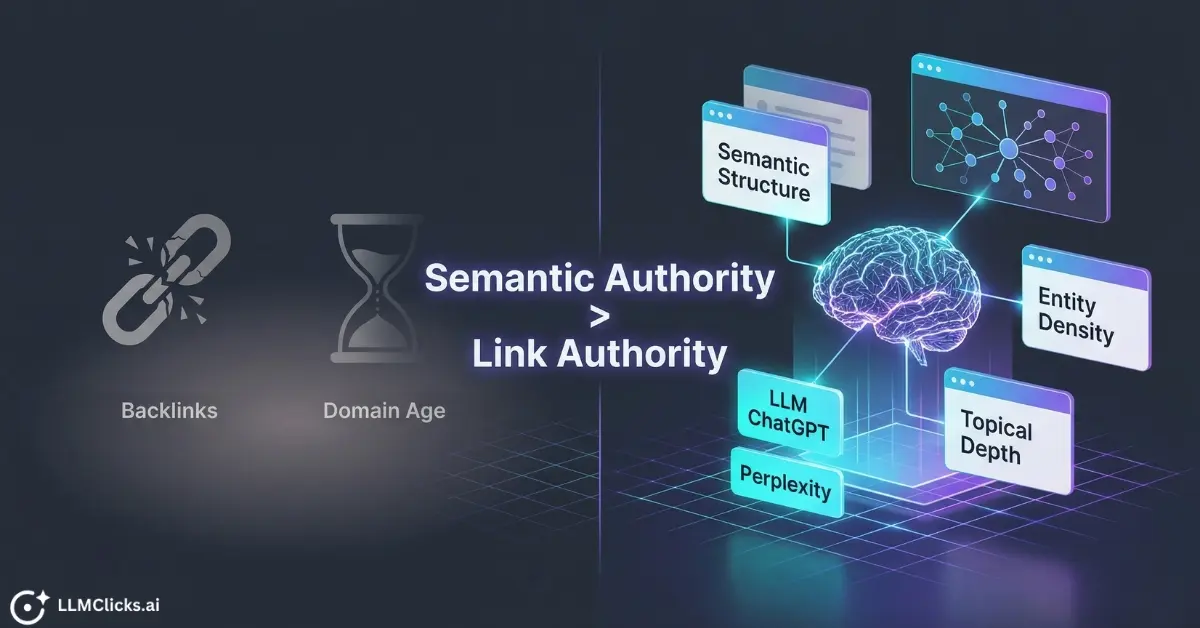
LLMs reward semantic authority, not link authority.
LLMs reward knowledge structure, not domain history.
Your domain was effectively treated as a topical expert, even in its first few days online.

Across many queries:
This means:
This is impossible under traditional SEO models but completely logical under LLM retrieval models.
Backlinks are a human-designed proxy for trust.
LLMs don’t need them—they read the content directly.
Our fresh domain ranked in:
…within hours.
When content is:
LLMs form a domain-level mathematical representation.
This allows:
Because LLMs think in vectors—not keywords:
…all map back to the same domain cluster.
This is why you repeatedly saw two pages surface.
Early impressions confirm:
To maintain scientific integrity:
This study disproves long-held SEO assumptions:
Instead, LLMs reward:
We achieved:
The future of ranking is no longer link-based.
It is semantic-based.
This experiment marks the beginning of a new discipline:
Disclaimer:
LLM SEO is still in its early stages.
These findings reflect what we observed from our own website experiment, but different websites or industries may see different patterns.
AI models change fast, so treat these insights as a snapshot of how LLMs behaved at the time of testing—not a permanent rulebook.