Published on: 6-Jan-2026 | 5800 words | 20-minute read
Search behavior is changing faster than most brands realize. Instead of typing keywords and comparing links, users are increasingly asking questions and trusting the answers generated by AI systems like ChatGPT, Google Gemini, and Perplexity.
When someone asks, “What’s the best tool for X?” or “Which platform should I use for Y?”, the decision is often shaped by a single AI-generated response. In many cases, users never visit a website at all. The brands that appear in those answers gain instant credibility. The brands that don’t are effectively invisible, even if they rank well on Google.
This shift has introduced a new concept that goes beyond traditional SEO: AI visibility. AI visibility is not about where your website ranks. It’s about how AI systems understand, describe, and recommend your brand when generating answers. In practice, that means your product, pricing, features, and positioning may be summarized for users before they ever see your site.
The numbers tell the story. ChatGPT now processes over 100 million daily queries. Perplexity handles 15 million searches per day. Google’s AI Overviews appear in 60% of search results. Meanwhile, research shows that 65% of users now start their product research using AI tools instead of traditional search engines.
For businesses, this creates both opportunity and risk. Strong AI visibility can act as a new acquisition and trust channel. Poor or inaccurate AI visibility can quietly damage perception, misrepresent offerings, or steer potential customers toward competitors, without showing up in traffic or ranking reports.
What You’ll Learn in This Guide
In this guide, we’ll clearly explain what AI visibility is, why it matters in a real business context, and how to measure AI visibility for your brand. You’ll learn:
How AI systems decide which brands to surface in their responses
What signals AI platforms rely on when generating recommendations
Which metrics actually reflect whether AI is helping or hurting your brand
Step-by-step processes to track your visibility across platforms
Proven strategies to improve how AI understands and presents your brand
Now that we understand the shift in user behavior, let’s define exactly what AI visibility means and how it operates.
AI visibility refers to how prominently and accurately a brand, product, or content appears within AI-generated responses across platforms like ChatGPT, Perplexity, Google AI Overviews, Gemini, Claude, and other answer engines.
Unlike traditional search engine optimization, which focused on your position in a list of links, AI visibility measures:
✓ If you’re mentioned when AI answers relevant queries
✓ How AI describes your brand, products, and value proposition
✓ Where you’re positioned relative to competitors in responses
✓ What context surrounds your brand mentions
When users ask AI questions about your industry or product category, AI systems synthesize information from their training data and real-time sources to construct answers. Your AI visibility determines whether you’re part of that answer, and how you’re represented.
This isn’t about appearing in a list of search results. It’s about influencing the conversation itself, becoming part of the direct, synthesized answers that users trust and act upon.
Three Dimensions of AI Visibility
AI visibility isn’t a single metric. It operates across three distinct dimensions that together determine your overall presence in AI-powered search experiences.
1. Brand AI Visibility
This measures how AI systems describe your company identity and understand your value proposition.
Key questions:
When someone asks “What is [your company]?”, does AI know who you are?
Can AI accurately explain what makes your brand different?
Is your value proposition correctly represented in AI responses?
Your brand AI visibility reflects whether artificial intelligence has correctly indexed your identity, mission, and market position.
2. Product AI Visibility
This dimension tracks how AI platforms recommend your products or services in buyer intent queries.
Key questions:
Do you appear when users ask “What’s the best [product type]?”
Are you included in competitive comparisons?
Does AI recommend you for specific use cases?
Your product AI visibility determines whether you appear in the critical moment when prospects are evaluating solutions and forming their shortlist.
3. Content AI Visibility
This reflects how often AI systems cite your content as authoritative sources when answering questions.
Key questions:
Do AI platforms reference your research or data?
Is your expertise cited when answering industry questions?
Are you establishing topical authority in your field?
Content AI visibility establishes whether you’re seen as a trusted source of information that AI systems rely on when constructing their responses.
The measurement frameworks and optimization strategies that worked for traditional SEO don’t translate directly to AI visibility. Here’s how they differ:
Traditional SEO
AI Visibility
Keyword rankings on SERPs
Mention frequency in AI answers
Position in a list of links
Context and positioning within responses
Backlink counts and domain authority
Citation frequency and source quality
Optimizing for search crawlers
Optimizing for language model comprehension
Traffic and click-through rates
Share of voice and recommendation quality
Page-level ranking signals
Entity recognition and semantic relevance
The fundamental shift:
Traditional SEO helped you appear in a list that users could choose from. AI visibility determines whether you’re part of the answer itself that users receive and trust.
Where SEO optimized for crawlers that indexed pages based on keywords and links, AI visibility optimizes for language models that understand semantic meaning, entity relationships, and contextual relevance across vast amounts of information.
This means that strong traditional SEO performance doesn’t automatically translate to strong AI visibility. A brand can rank #1 on Google but be completely absent from ChatGPT recommendations, or worse, be misrepresented in AI-generated answers. Understanding this distinction is the first step toward measuring and improving your AI visibility.
Why AI Visibility Matters for Your Brand
The Business Case for AI Visibility
The market has shifted:
📊 100M+ daily queries on ChatGPT 📊 15M daily searches on Perplexity 📊 60% of searches show Google AI Overviews 📊 65% of users start product research with AI tools
If your brand isn’t visible in AI-generated answers, you’re missing the conversation during the buyer journey’s most critical phase.
Three Real-World Scenarios
Scenario 1: The Invisible Brand
The situation:
B2B software company
#1-3 Google rankings for key terms
Strong SEO, steady traffic
The problem:
ChatGPT never mentioned them in comparisons
Perplexity skipped their brand entirely
Prospects arrived at sales calls convinced competitors were better
The result: 40% market share loss in 12 months despite perfect traditional SEO performance
The result: 25% decline in patient consultation requests before they corrected the AI misinformation.
Scenario 3: The AI-First Winner
The situation:
Marketing technology startup
Launched with AI visibility in mind
The strategy:
Optimized for AI citations from day one
Monitored AI mentions weekly
Created content specifically for AI understanding
The result:
78% mention rate in relevant AI recommendations within 6 months
60% lower customer acquisition cost vs. traditional marketing alone
Five Strategic Reasons AI Visibility is Critical
1. The Funnel Has Collapsed
“With AI search, there are only two funnel stages: educational and transactional. The goal is for the LLM to cite your brand, then people come to your site to buy.” — Patrick Reinhart, VP, Services and Thought Leadership, Conductor
Traditional funnel: Awareness → Consideration → Evaluation → Decision
AI-era funnel: AI Research → Transaction
If you’re not visible during AI research, you never enter consideration.
2. Trust Transfer Effect
Users treat AI recommendations as:
Neutral expert advice (not algorithmic rankings)
Authoritative guidance (not paid placement)
Implicit endorsement (carries more weight than traditional listings)
3. Competitive Narratives at Scale
When AI consistently positions competitors as superior choices:
That narrative reaches millions instantly
Your market position is defined by AI interpretation
You lose control of your brand story
4. Traffic Diversification
The challenge:
Traditional organic traffic is declining
More searches end with AI answers (no clicks to websites)
Google algorithm changes create vulnerability
The solution:
AI visibility creates new referral channels
Reduces dependency on any single platform
Builds multiple paths to customer acquisition
5. Future-Proofing
What’s coming:
Voice search expansion (Alexa, Siri, Google Assistant)
Agentic AI shopping assistants
New AI-first platforms launching monthly
Early AI visibility advantages compound over time
The Cost of AI Invisibility
What you lose:
Market share to AI-visible competitors Brand authority and credibility Organic traffic as users skip websites Control of your brand narrative Ability to influence buyer decisions
Understanding and measuring AI visibility is now foundational to maintaining market relevance in 2026.
Key AI Visibility Metrics You Need to Track
The Essential Measurement Framework
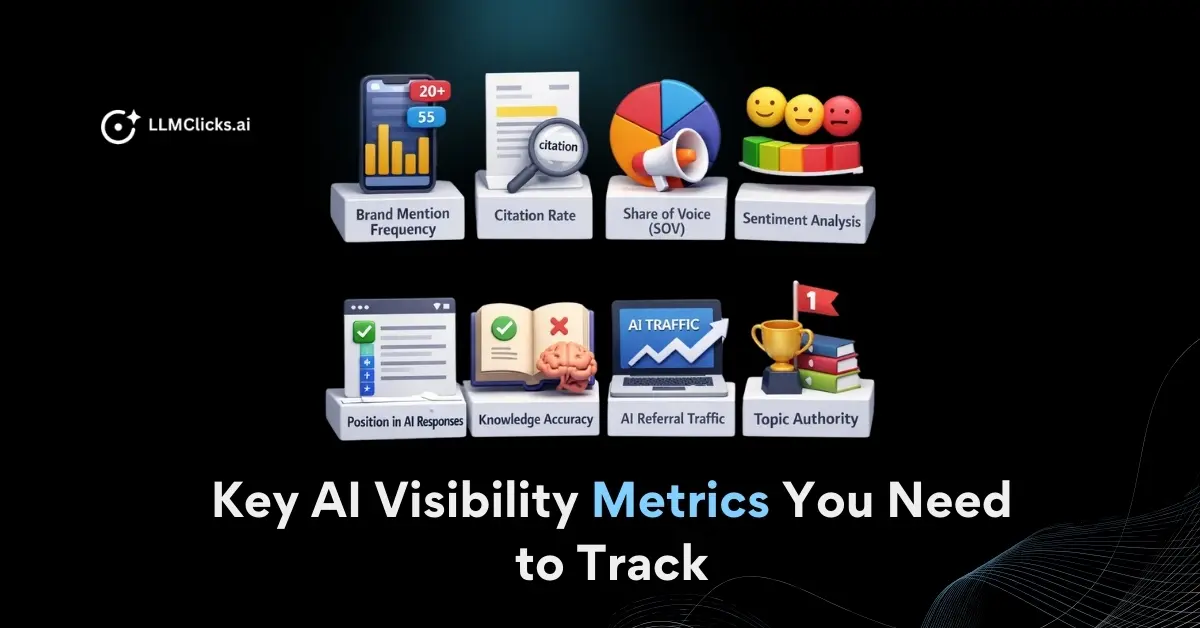
Measuring AI visibility requires tracking multiple data points across platforms. Here are the core metrics that actually matter.
Foundational Metrics
1. Brand Mention Frequency
How often your brand appears in AI responses to relevant queries.
Formula: (Prompts mentioning your brand ÷ Total relevant prompts tested) × 100
Benchmarks:
40-60% = Industry leader
15-25% = Average performance
<10% = Needs improvement
2. Citation Rate
Percentage of mentions that include clickable links to your website.
Formula: (Citations with links ÷ Total mentions) × 100
Why it matters: Citations drive direct traffic and signal authority to AI systems
Benchmarks:
30-50% = Healthy
15-30% = Good
<15% = Needs improvement
3. Share of Voice (SOV)
Your visibility compared to competitors in the same category.
Formula: (Your mentions ÷ Total category mentions including competitors) × 100
Strategic value: Shows competitive positioning in the AI ecosystem
Monitor sentiment trends over time to catch reputation issues early.
5. Position in AI Responses
Where you appear when AI lists multiple options.
Position
Visibility Level
User Attention
#1-3
Premium
80% of attention
#4-7
Moderate
15% of attention
#8+
Low
5% of attention
6. Knowledge Accuracy
Percentage of correct facts AI states about your brand.
What it measures:
Does AI understand your industry?
Is your value proposition accurate?
Are product features correctly described?
Track accuracy scores and identify common errors or “hallucinations”.
7. AI Referral Traffic
Visitors arriving from AI platforms tracked through analytics.
Monitor these sources:
chat.openai.com (ChatGPT)
perplexity.ai (Perplexity)
gemini.google.com (Gemini)
claude.ai (Claude)
Setup tip: Use UTM parameters for accurate tracking
8. Topic Authority
Number of subjects where AI recognizes you as an expert source.
Why it matters: Higher topic authority means AI is more likely to cite your content when answering questions in your domain
The AI Visibility Score
Combine metrics into a single trackable number:
AI Visibility Score =
(Mention Frequency × 0.30) +
(Citation Rate × 0.25) +
(Share of Voice × 0.20) +
(Sentiment Score × 0.15) +
(Average Position × 0.10)
Rather than calculating manually, an automated scoring dashboard tracks these metrics continuously and alerts you to changes.
Score Interpretation:
Score
Status
Action Required
80-100
🏆 Dominant visibility
Maintain & protect
60-79
💪 Strong visibility
Optimize opportunities
40-59
📈 Moderate visibility
Growth focus needed
20-39
⚠️ Low visibility
Urgent action required
0-19
🚨 Minimal visibility
Critical situation
Tracking Frequency
Weekly (15 minutes):
Monitor mention changes
Check for new citations
Note visibility shifts
Monthly (2 hours):
Full competitive benchmarking
Trend analysis
Metric reporting
Quarterly (4 hours):
Strategic review
Connect visibility to business outcomes
Adjust strategy based on data
Key principle: Consistent measurement over time rather than one-time snapshots. AI platforms update continuously, so your visibility can shift quickly.
How to Measure Your Brand's AI Visibility
The Step-by-Step Measurement Process
Measuring AI visibility starts with manual testing before scaling with automated tools. Here’s the proven process.
Phase 1: Foundation Setup ⏱️ Week 1
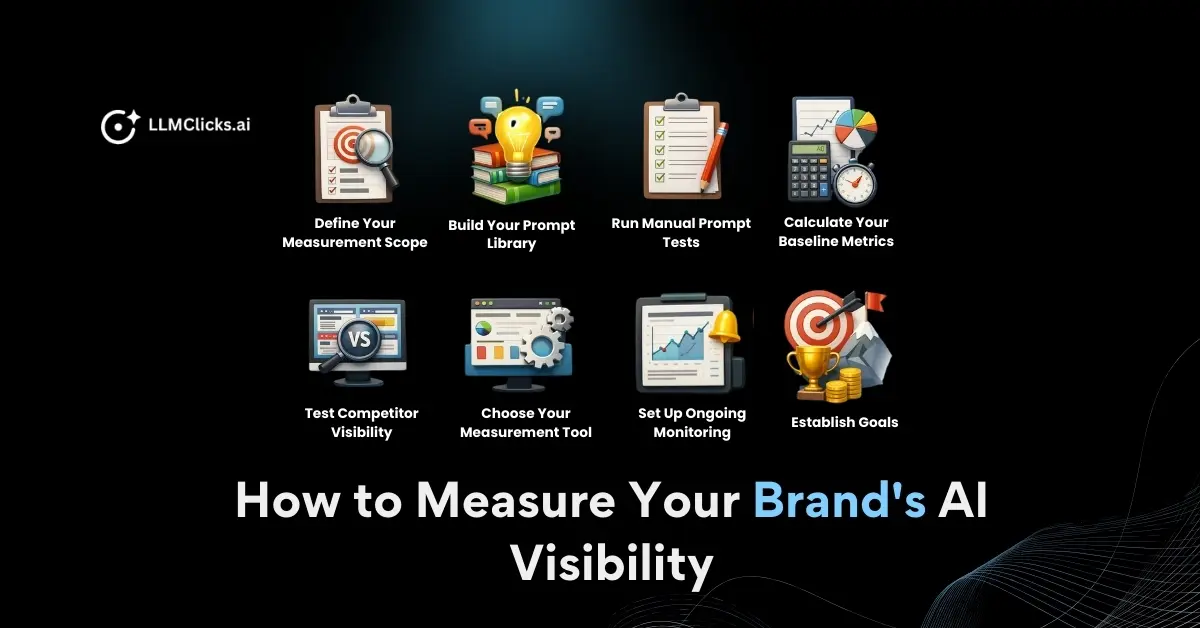
Step 1: Define Your Measurement Scope
Identify your brand entities:
Primary brand name
Common misspellings
Product/service names
Key executive names (if relevant)
Proprietary terminology
Company divisions or sub-brands
Select AI Platforms by Priority:
Priority
Platform
Why It Matters
1
ChatGPT
Largest user base
2
Google AI Overviews
Integrated into search
3
Perplexity
Research-focused audience
4
Gemini
Growing Google integration
5
Claude
Enterprise and technical users
Pro tip: Start with the top 3 platforms and expand as resources allow
Step 2: Build Your Prompt Library
Create 20-50 prompts representing how buyers research your category.
Use four prompt types:
Brand Awareness Prompts:
“What is [Your Brand Name]?”
“Tell me about [Your Company]”
“Who are the leaders in [your industry]?”
Competitive Comparison Prompts:
“Compare [Your Brand] vs [Top Competitor]”
“Best alternatives to [Competitor Name]”
“Top [product category] platforms in 2026”
Buyer Intent Prompts:
“Which [product type] should I choose for [use case]?”
“Best [solution] for [specific business need]”
“How to evaluate [product category]”
Solution-Seeking Prompts:
“How do I solve [problem your product addresses]?”
“What tools help with [pain point]?”
“Recommended solutions for [specific challenge]”
Action: Document all prompts in a spreadsheet for consistent tracking
Phase 2: Manual Baseline Testing ⏱️ Week 1-2
Step 3: Run Manual Prompt Tests
The most accurate initial data comes from direct testing.
Process:
Open ChatGPT, Perplexity, and Google in incognito mode
Clear cache to avoid personalized results
Enter each prompt exactly as written
Record the complete response
Document These Data Points:
Field
What to Record
Date/Time
When you ran the test
Platform
ChatGPT, Perplexity, or Google AI Overview
Brand Mentioned?
Yes/No
Position
1-10 or “Absent”
Citation Included?
Yes/No (with clickable link)
Competitors Mentioned
List all brands mentioned
Sentiment
Positive/Neutral/Negative
Accuracy Score
1-5 scale (how correct is the info?)
Pro tip: Take screenshots or save text of significant responses
Step 4: Calculate Your Baseline Metrics
After testing your full prompt library:
Mention Frequency = (Prompts with your brand ÷ Total prompts) × 100
Citation Rate = (Mentions with links ÷ Total mentions) × 100
Average Position = Sum of all positions ÷ Number of mentions
Share of Voice = Your mentions ÷ (Your + Competitor mentions) × 100
These baseline numbers show your starting point before optimization.
Phase 3: Competitive Benchmarking ⏱️ Week 2
Step 5: Test Competitor Visibility
Repeat the testing process for your 3-5 main competitors using the same prompt library.
This reveals:
Which prompts trigger competitor mentions but not yours
Where competitors rank higher consistently
What citation sources competitors dominate
Topic areas where you lack visibility
Create a comparison table:
Metric
Your Brand
Competitor A
Competitor B
Competitor C
Mention %
Citation %
Avg Position
SOV %
Sentiment
Phase 4: Automated Tracking Setup ⏱️ Week 3-4
Step 6: Choose Your Measurement Tool
Manual testing works for baselines, but sustainable measurement requires tools.
Free/Starter Options:
Manual spreadsheet tracking (update weekly)
Google Analytics for AI referral traffic
Free tiers from AI visibility platforms
Professional Platforms ($100-400/month):
Semrush AI Visibility Toolkit ($99/mo)
Peec AI (€89/mo)
Profound ($99-399/mo)
Tool Selection Criteria:
AI platforms covered (ChatGPT, Perplexity, etc.)
Number of prompts you can monitor
Competitor tracking capabilities
Historical data retention
Sentiment analysis included
Citation vs. mention differentiation
Reporting and export features
Team collaboration tools
Most businesses: Start manual for 1-2 months, then adopt a platform once ROI is validated
Step 7: Set Up Ongoing Monitoring
Configure your tool or spreadsheet with:
All brand name variations
Complete prompt library
Competitor brands for benchmarking
Weekly/monthly tracking schedule
Alerts for significant visibility changes
Step 8: Establish Goals
Based on your baseline data, set 90-day improvement targets:
Metric
Improvement Target
Mention Frequency
14.75
Citation Rate
9.8
Share of Voice
+5-10 percentage points
Average Position
Move up 1-2 spots
Track progress monthly and adjust tactics based on what’s working
Phase 5: Connect to Business Impact ⏱️ Ongoing
Step 9: Track Business Outcomes
AI visibility only matters if it drives business results.
Monitor in Google Analytics:
Traffic from AI platforms
Conversion rates by AI referral source
Assisted conversions from AI traffic
Monitor in your CRM:
Lead quality from AI-sourced visitors
Sales cycle length for AI-aware prospects
Win rates when buyers mention AI research
Gather from sales feedback:
How often prospects mention using AI
Brand awareness levels in discovery calls
Competitive positioning insights
This connects visibility metrics to revenue impact
Common Measurement Mistakes to Avoid
Identified by brands tracking AI visibility:
Testing too few prompts (<20 = unreliable data)
Only using one AI platform (misses the full picture)
Not testing in incognito mode (personalized results skew data)
Skipping competitor benchmarking (no context for scores)
Testing once and stopping (visibility changes constantly)
Ignoring sentiment and context (mentions without context are meaningless)
Not connecting to business outcomes (can’t justify investment)
Best practice: Consistent measurement over 3-6 months reveals true trends and validates optimization efforts
Best Tools for AI Visibility Measurement
Platforms Across Different Budget Levels
Sustainable AI visibility tracking requires the right tools. Here’s what’s available based on your budget and needs.
Free and Starter Options
LLMClicks.ai Free Audit | RECOMMENDED FOR GETTING STARTED
Cost: Free (50 credits for beta users) Best for: Quick assessment, understanding your current AI visibility status What you get: 120-point AI visibility audit in under 2 minutes
Platforms covered:
ChatGPT
Google AI Overviews
Bing AI
Perplexity
Best feature: Fastest way to understand why competitors show up in AI answers and you don’t
Ideal for: Any business wanting to establish their baseline AI visibility before investing in ongoing monitoring
Cost: Free Best for: Initial testing after your free audit, small businesses Limitations: Time-intensive, no automation Use case: Testing 20-30 prompts monthly to validate audit findings
Google Analytics
Cost: Free Tracks: AI referral traffic from chat.openai.com, perplexity.ai, gemini.google.com Setup: Create custom channel grouping for AI sources Limitations: Only shows traffic, not mentions or citations
Professional Platforms ($50-400/month)
1. LLMClicks.ai Pro | BEST VALUE FOR COMPREHENSIVE TRACKING
Cost: Starting at $49/month (early access pricing)
Platforms covered:
ChatGPT
Google AI Overviews
Bing AI
Perplexity
Additional platforms in development
Best features:
120-point AI visibility audit with actionable recommendations
Continuous mention tracking across major AI platforms
Citation analysis showing where you’re referenced
Competitor visibility comparison
Agency-friendly dashboard for client reporting
Unique advantage: Only platform that shows you why competitors appear in AI answers with specific optimization roadmap
Best for:
Agencies managing multiple clients
In-house teams needing comprehensive AI visibility insights
Businesses serious about improving AI presence quickly
Why choose this: Built specifically for AI visibility optimization, not adapted from traditional SEO tools. Users report doubled mentions in Perplexity within 4 weeks
2. Semrush AI Visibility Toolkit
Cost: $99/month (add-on to Semrush plans starting at $140/mo)
Platforms covered:
ChatGPT
Google AI Overviews
AI Mode
Gemini
Best feature: AI Strategic Opportunities with prioritized recommendations.
Best for: Existing Semrush users, teams with established SEO workflows
Limitation: Doesn’t track Perplexity or Claude; requires existing Semrush subscription
3. Peec AI
Cost:
Starter: €89/month
Pro: €199/month
Platforms covered (Pro plan):
ChatGPT
Perplexity
AI Overviews
Gemini
Claude
Best feature: Simple sentiment analysis and citation gap identification
Best for: Budget-conscious SMBs needing straightforward visibility tracking
Limitation: Actions feature still in beta, fewer strategic insights
4. Profound
Cost:
Starter: $99/month
Growth: $399/month
Platforms covered:
ChatGPT
Perplexity
Copilot
Meta AI
Grok
And 3+ more
Best feature: Most comprehensive platform coverage, shopping integration
Best for: Enterprise teams, agencies managing multiple clients with large budgets
Limitation: Most expensive option, data-heavy interface
5. Brantial
Cost: $49/month (Starter)
Platforms covered:
OpenAI
Google
Perplexity
Grok
Mistral
Best feature: Hallucination detection
Best for: Startups testing basic AI visibility strategies
Limitation: Limited prompts on lower tiers, fewer actionable insights
Choosing the Right Tool
Consider these factors:
Factor
Why It Matters
AI platforms your audience uses
Prioritize ChatGPT, Perplexity, Google AI Overviews
Speed of insights
LLMClicks.ai provides 2-minute audit vs. weeks of manual testing
Number of prompts to monitor
Start with 30-50, scale to 100+
Competitor tracking needs
3-5 competitors minimum for context
Budget constraints
Start with free audit, upgrade as ROI proves out
Team size
Collaboration features matter for larger teams
Actionability
Look for tools that explain why changes are needed, not just data
Recommended Path:
Week 1: Run a free LLMClicks.ai audit to understand your current state Weeks 2-4: Manual tracking using audit insights (20-30 key prompts) Month 2+: Upgrade to LLMClicks.ai Pro or an alternative platform once you’ve validated business impact
Most businesses: Start with the free audit to see exactly where you stand, then invest in continuous monitoring once they understand which metrics matter most for their business
Pro tip: The agencies seeing the fastest results (doubled AI mentions within 4 weeks) combine the LLMClicks.ai roadmap with weekly prompt testing to validate improvements
How to Improve Your AI Visibility
Proven Strategies to Increase Brand Visibility
Measurement identifies the gap. These strategies close it.
Strategy 1: Optimize Content Structure for AI
AI platforms prioritize content that’s easy to parse and synthesize.
Create AI-Friendly Formats:
FAQ sections answering specific questions
Comparison tables for competitive positioning
Step-by-step guides with numbered lists
Definition sections for key concepts
Bullet points over dense paragraphs
Use Conversational Language Patterns:
“How to [solve problem]” headlines
“What is [topic]” explainers
“Best [category] for [use case]” comparisons
“Why [approach]” reasoning content
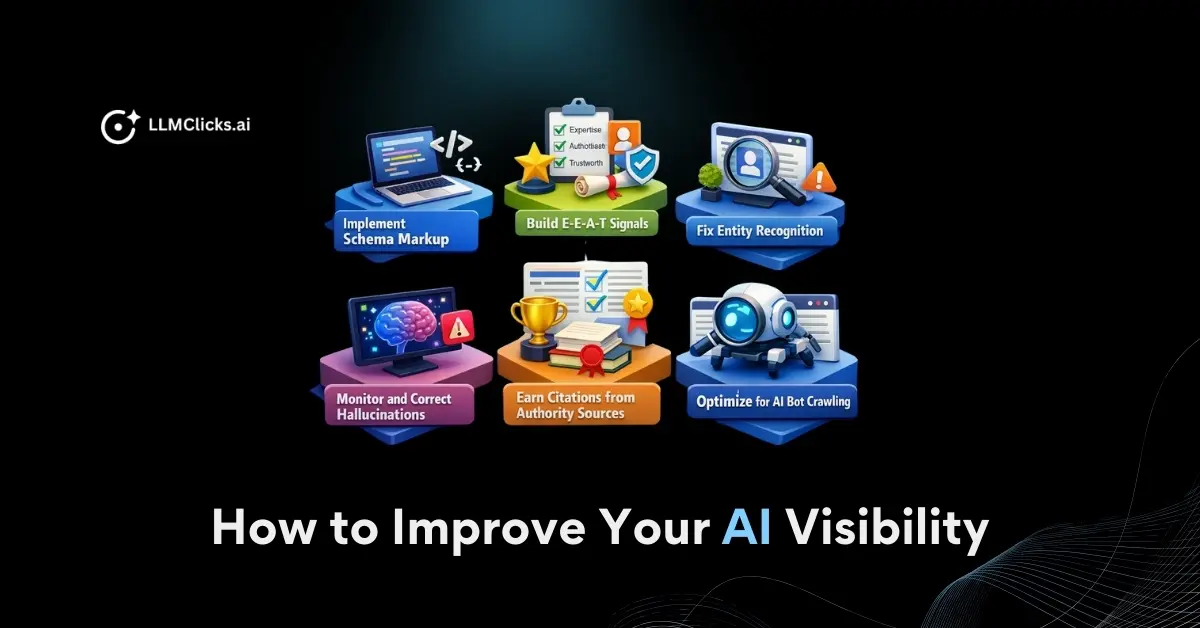
Strategy 2: Implement Schema Markup
Structured data helps AI systems understand your content context.
Priority Schema Types:
Schema Type
What It Defines
Impact
Organization
Brand identity, contact info
Entity recognition
Product
Attributes, pricing, reviews
Product visibility
FAQ
Question-answer pairs
Direct answer optimization
Article
Content type, author, date
Content credibility
Review
Customer feedback, ratings
Social proof signals
Important: Schema doesn’t guarantee citations, but it significantly improves AI comprehension
Strategy 3: Build E-E-A-T Signals
AI platforms favor authoritative sources with demonstrated expertise.
Strengthen Expertise Signals:
Author bylines with credentials and experience
Original research and proprietary data
Case studies with measurable outcomes
Industry awards and recognition
Expert quotes from credentialed professionals
Improve Trustworthiness:
Clear “About Us” information
Updated contact details and locations
Customer reviews and testimonials
Press mentions and media coverage
Transparent sourcing and citations
Strategy 4: Fix Entity Recognition
AI must understand who you are before it can recommend you.
Ensure Consistent Brand Information:
NAP Consistency (Name, Address, Phone):
Identical across all platforms
Uniform brand descriptions on social profiles
Complete LinkedIn company page
Updated Wikipedia entry (if applicable)
Accurate Crunchbase and directory listings
Strengthen Entity Relationships:
Co-mentions with industry leaders
Partnerships highlighted in content
Category associations clearly stated
Product relationships explicitly defined
Strategy 5: Monitor and Correct Hallucinations
AI will fabricate information when data is unclear or contradictory.
Detection Methods:
Weekly prompt testing for accuracy
AI visibility platform alerts
Customer feedback about misinformation
Sales team reports of incorrect details
Correction Process:
Document the specific hallucination
Identify conflicting information sources
Publish authoritative correction content
Update outdated pages and listings
Monitor for improvement over 30-60 days
Common hallucination triggers:
Similar competitor names
Outdated indexed content
Incomplete entity data
Strategy 6: Earn Citations from Authority Sources
AI platforms cite content from sources they trust.
Target High-Authority Publishers:
Industry publications (TechCrunch, VentureBeat)
Academic journals and research institutions
Major news outlets (Forbes, Bloomberg, WSJ)
Government and official sources
Industry associations and trade groups
Create Citation-Worthy Content:
Original research reports with data
Industry benchmark studies
Comprehensive guides (5,000+ words)
Expert commentary on trends
Visual assets (infographics, data visualizations)
Strategy 7: Optimize for AI Bot Crawling
AI platforms send bots to crawl and index content
Technical Optimization:
Don’t block GPTBot, Claude-Web, PerplexityBot in robots.txt
Fast page speeds (under 3 seconds)
Fix broken links and 404 errors
Use clean, semantic HTML structure
Maintain XML sitemap freshness
Strategic Optimization:
Monitor which pages AI bots visit most
Prioritize optimization for high-bot-traffic pages
Authority building (research, digital PR outreach)
20-30% visibility improvement
Months 5-6
Measurement, refinement based on data
30-50% visibility improvement
Most brands see measurable visibility improvements within 90-120 days of consistent optimization.
Overcoming Common Challenges
Challenge 1: “We’re a new brand with no existing visibility”
Solution:
Focus on niche, long-tail queries with lower competition
Create highly specific, expert-level content
Partner with established brands for co-mentions
Invest in original research for citation-worthy data
Be patient: AI visibility builds over 6-12 months
Challenge 2: “AI keeps confusing us with a competitor”
Solution:
Strengthen entity differentiation through explicit comparison content
Ensure consistent branding across all platforms
Create disambiguation content on your website
Optimize knowledge graph entries and directory listings
Challenge 3: “We have good mentions but zero citations”
Solution:
Add more specific, factual content AI can reference
Include statistics, data, and research findings
Improve page authority through backlinks from trusted sites
Ensure pages are crawlable by AI bots (check robots.txt)
Add schema markup to citation-worthy content
Challenge 4: “Our AI visibility suddenly dropped”
Diagnostic steps:
Check if competitors published superior content
Review for technical issues blocking AI crawlers
Update outdated content
Test if your pages are still accessible to AI bots
Compare current vs. previous mentions to identify changes
Challenge 5: “We have a limited budget for tools and optimization”
Bootstrapping strategy:
Use manual tracking with spreadsheets (20-30 key prompts monthly)
Focus optimization on 5-10 high-impact pages
Leverage free tools like Google Analytics for AI referral tracking
Invest time rather than money in early stages
Start with quick wins (FAQ sections, basic schema)
Conclusion: Taking Control of Your Brand's AI Visibility
Your Path Forward
AI visibility has become foundational to digital marketing success. With over 60% of purchase research now happening through AI platforms, brands absent from these conversations are losing market share to AI-visible competitors.
The measurement frameworks that worked for traditional SEO don’t capture AI visibility. You need new metrics: mention frequency, citation rates, share of voice, sentiment analysis, and position tracking across platforms like ChatGPT, Perplexity, and Google AI Overviews.
Want to know where you stand? Run a free AI visibility audit to discover your current presence across ChatGPT, Perplexity, and Google AI.
Your 30-Day Action Plan
Week 1: Baseline Assessment
Set up free bot tracking or manual testing
Test 20-30 key prompts manually
Document current visibility state
Identify 3-5 key competitors to monitor
Week 2: Content Audit
Review top 10 pages for AI-friendliness
Check robots.txt for AI bot access
Identify content gaps where competitors appear
List hallucinations or errors to fix
Week 3: Quick Wins
Add FAQ sections to key pages
Implement basic schema markup
Fix entity consistency across platforms
Create one comparison or “best of” guide
Week 4: Monitoring Setup
Choose AI visibility platform for ongoing tracking
Set up weekly check-in routine
Create monthly reporting template
Define 90-day improvement goals
The Future Belongs to AI-Visible Brands
“People need to start paying attention to how LLM bots access their site through log file analysis. To optimize, it’s going to be really important to understand how LLM bots access your site and content.” – Patrick Reinhart, VP, Services and Thought Leadership, Conductor
The brands that will win in 2026 and beyond aren’t those with the best Google rankings. They’re the ones AI platforms trust, cite, and recommend when buyers are researching solutions.
Every day you wait to measure and improve your AI visibility, competitors gain ground in the algorithms shaping purchase decisions.
Take Action Today
The conversation about your brand is happening right now in AI platforms. The question is whether you’re part of it or absent from it.
Start measuring your AI visibility today, because being invisible in AI search means being invisible to your next customers.
FAQs for AI Visibility
Q1. What is AI visibility?
Ans: AI visibility is how prominently your brand appears in AI-generated answers from ChatGPT, Perplexity, Google AI Overviews, and Gemini. It measures whether AI mentions you when users ask questions about your industry, how accurately AI describes your brand, and where you rank compared to competitors. With 65% of users now researching products through AI tools instead of Google, AI visibility determines whether potential customers see your brand during their decision-making process.
Q 2. How do I measure AI visibility for my brand?
Ans: Create 20-50 prompts that represent buyer questions in your industry, then test them on ChatGPT, Perplexity, and Google AI. Track four key metrics: mention frequency (how often you appear), citation rate (when AI links to your site), share of voice (mentions vs. competitors), and position (where you rank in responses). Start with manual testing using a spreadsheet, then use tools like LLMClicks.ai for automated tracking once you understand the basics.
Q3. What is the difference between AI visibility and SEO?
Ans: SEO gets you ranked in a list of links. AI visibility gets you mentioned in the answer itself. Traditional SEO focuses on keyword rankings and backlinks. AI visibility focuses on whether ChatGPT or Perplexity mention your brand, how they describe you, and if they cite your website. You can rank #1 on Google but be invisible in AI responses, which matters because 60% of searches now show AI-generated answers.
Q4. Why does AI visibility matter for businesses?
Ans: Users trust AI recommendations like expert advice, not ads. If your brand doesn’t appear when someone asks AI “What’s the best [product]?”, you lose that customer. With ChatGPT handling 100 million+ daily queries and Google showing AI Overviews in 60% of searches, AI visibility directly impacts customer acquisition. Businesses with strong AI visibility report 35-60% more qualified leads, while those invisible to AI quietly lose market share to competitors.
Q5. What tools can measure AI visibility?
Ans: Free options: LLMClicks.ai offers a free 120-point audit covering ChatGPT, Perplexity, and Google AI. Google Analytics tracks AI referral traffic.
Paid platforms: LLMClicks.ai Pro ($49/mo), Semrush AI Toolkit ($99/mo), Peec AI (€89/mo), and Profound ($99-399/mo) provide ongoing monitoring. Start with a free audit to understand your baseline, then upgrade to automated tracking once you see business impact. Most agencies see doubled AI mentions within 4 weeks using these tools.
Shripad Deshmukh
Shripad Deshmukh is the Founder of LLMClicks.ai and a veteran SaaS entrepreneur with over 15 years of experience in SEO and digital growth. He has founded four companies and built industry-leading platforms like GMB Briefcase, Citation Builder Pro, and Agency Simplifier. Today, Shripad focuses on Generative Engine Optimization (GEO). He helps brands build technical visibility across AI search engines like ChatGPT, Perplexity, and Gemini.
Leveraging cutting-edge AI technologies into your workflow, driving efficiency, innovation, and growth.