LLM Visibility vs Traditional SEO: Why AI Mentions Matter More Than Google Rankings

LLM visibility vs traditional SEO showing how AI mentions differ from Google rankings

Why AI Mentions Matter More Than Google Rankings

Ranking on Google used to be the finish line. Today, it’s often just the starting point. As users turn to ChatGPT, Gemini, and Perplexity for direct answers, brand discovery is increasingly happening inside AI-generated responses, not on traditional search result pages.

This shift changes what visibility really means. A brand can rank well in Google and still be invisible in AI answers, while another brand with lower rankings is summarized, cited, and trusted by AI systems. In many cases, users never click a link at all. They accept the answer they’re given and move on.

In this article, we break down the difference between traditional SEO and LLM visibility, explain why AI mentions are becoming more influential than rankings, and show how brands can adapt to a world where being referenced by AI matters as much as being ranked by Google.

What Is Traditional SEO (And What It Was Built to Do)

Graphic explaining traditional SEO and its focus on rankings and organic traffic

Traditional SEO is the long-established practice of optimizing websites to rank higher in search engine results pages (SERPs) and earn organic traffic. It was designed for a web where users typed queries into Google, scanned a list of blue links, and clicked through to websites to find answers.

At its core, traditional SEO focuses on three primary outcomes:

  • Higher rankings for relevant search queries
  • More organic clicks and traffic from search engines
  • Sustained visibility and authority that support leads and conversions over time

This model worked because discovery depended on position. The higher a page ranked, the more attention and clicks it received.

The Core Levers of Traditional SEO

Traditional SEO relies on a set of well-defined optimization pillars:

  • Keywords: Researching and targeting the terms users search for, then aligning content to match those queries.
  • On-page optimization: Optimizing titles, meta descriptions, headings, internal links, and content so search engines can clearly understand page relevance.
  • Backlinks: Earning links from reputable websites to signal authority and trustworthiness.
  • Technical SEO: Ensuring crawlability, fast load times, mobile-friendliness, clean site architecture, and proper indexing.

Together, these levers help search engines discover, evaluate, and rank pages based on relevance and quality.

Why This Traditional Model Worked So Well

Traditional SEO was built for a predictable search experience. Users compared multiple results, clicked links, and explored websites before making decisions. Search engines rewarded pages that were technically sound, keyword-aligned, and backed by authoritative links.

For years, this approach delivered reliable, compounding results. Strong rankings led to traffic, traffic led to engagement, and engagement drove growth.

The challenge today is not that traditional SEO is broken. It’s that the environment it was built for is changing, as discovery increasingly happens before users ever see a SERP.

Yes, that screenshot structure is exactly what works best for SERP readability + AI Overviews extraction.

Below is a restructured and rewritten version of Section 3 using the same clear, scannable pattern (definition → what it measures → why it matters → how it fits with SEO), while keeping your original intent and avoiding direct duplication.

You can paste this as-is into the blog.

What Is LLM Visibility?

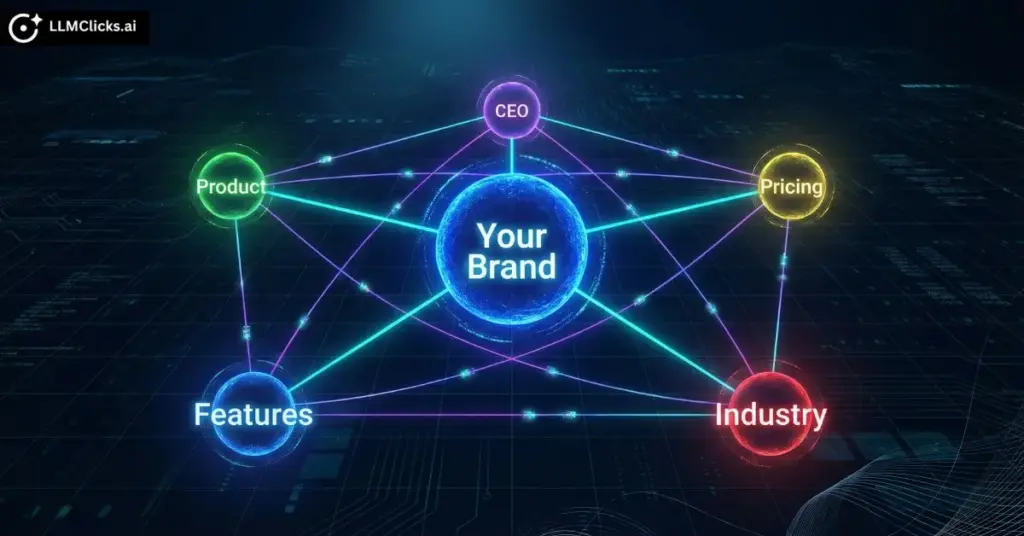
Visual explaining what LLM visibility means for brands in AI-generated answers

LLM visibility is the measure of how often, where, and in what context your brand, products, or content appear in answers generated by large language models (LLMs) such as ChatGPT, Gemini, Claude, and Perplexity.

Unlike traditional SEO, which focuses on rankings and clicks, LLM visibility focuses on presence inside AI-generated answers. It reflects whether AI systems recognize your brand as a credible source worth mentioning, summarizing, or citing when users ask questions.

What LLM Visibility Measures

LLM visibility is typically evaluated across four key dimensions:

  • Frequency: How often your brand or content is mentioned in AI-generated responses.
  • Context & Placement: Whether your brand is cited prominently, mentioned briefly, or excluded entirely, and how it is framed within the answer.
  • Source Usage: Which of your pages or assets AI systems rely on when generating answers.
  • Competitive Share: How visible your brand is compared to competitors within the same AI responses.

These signals together show your share of voice inside AI answers, not just on search result pages.
Why LLM Visibility Matters

LLM visibility matters because AI systems are becoming a primary discovery layer.

  • Many AI answers resolve queries without requiring a click
  • Brand perception is shaped before users visit any website
  • Being mentioned builds trust even without direct traffic
  • Absence or misrepresentation can influence buying decisions

In this environment, visibility without clicks is still visibility with impact.

Why Long-Tail and Deep Pages Matter More Than Rankings

Unlike classic SERPs, LLMs often pull information from deep, long-tail content, not just top-ranking URLs.

AI systems favor:

  • Detailed guides
  • FAQs and documentation
  • Niche articles that clearly answer specific questions
  • Pages with strong topical context

This means a page ranking outside the top 10 can still be cited if it explains the topic better than higher-ranking results.

LLM Visibility vs SEO: An Evolution, Not a Replacement

LLM visibility is often described as Generative Engine Optimization (GEO) or Answer Engine Optimization (AEO). These approaches build on traditional SEO rather than replacing it.

  • Traditional SEO optimizes for rankings and clicks
  • LLM visibility optimizes for mentions, citations, and summaries
  • Strong SEO foundations still matter, but influence now extends beyond SERPs

The shift is not from SEO to AI, but from ranking pages to being referenced in answers.

How User Behavior Changed: From Clicking Links to Trusting Answers

Illustration showing shift in user behavior from clicking search links to trusting AI answers

User behavior has shifted from browsing links to consuming answers. Instead of comparing multiple websites, people increasingly rely on AI systems to summarize information and guide decisions in a single response.

This change is driven by speed, convenience, and the growing reliability of AI-powered search experiences.

Conversational Search Is Now the Default

Search queries are no longer short or keyword-driven. Users now ask full questions using natural language.

Examples include:

  • “Which CRM is best for a small SaaS team?”
  • “How does LLM visibility differ from traditional SEO?”
  • “What tool should I use to track AI mentions?”

These conversational queries are designed for answers, not lists of links, which makes them more likely to trigger AI-generated summaries.

AI Has Become the Decision Layer Before Websites

AI systems now act as an intermediate decision layer between users and websites.

Before visiting any page, users often rely on AI to:

  • Explain options
  • Compare tools or brands
  • Highlight pros and cons
  • Recommend next steps

In many cases, the AI response satisfies the intent completely, meaning users never reach a traditional SERP or click a result.

Why Users Stop Comparing Links

Several factors explain the decline in link comparison:

  • AI summaries reduce information overload
  • Answers are faster than scanning multiple pages
  • Source citations increase perceived trust
  • Users prioritize efficiency over exploration

Studies show that when AI summaries appear, click-through rates on traditional results drop significantly. The answer itself becomes the destination.

Implications for Brand Discovery and Recall

This behavioral shift changes how brands are discovered and remembered.

  • Visibility happens inside the answer, not on the results page
  • Brands mentioned by AI gain awareness even without clicks
  • Brands omitted from AI answers are effectively invisible
  • Accuracy and framing influence trust before any site visit

In this environment, discovery is no longer driven by ranking alone. It’s driven by whether AI systems choose to include and explain your brand.

How LLMs Decide What to Mention (Not Rank)

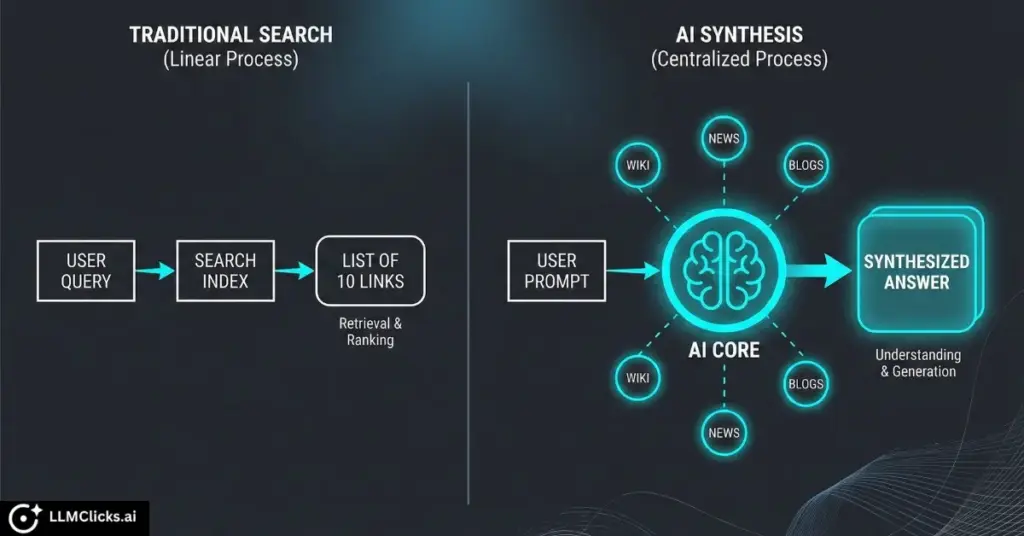
Diagram explaining how LLMs decide what to mention instead of ranking web pages

LLMs don’t “rank” content the way search engines do. They assemble answers. When a user asks a question, the model’s job is to produce a single, coherent response that feels complete, accurate, and trustworthy. To do that, it looks for information it can confidently blend together, not pages it can list in order.

This is why authority matters more than position.

A page ranking #1 is not automatically the best candidate for an AI answer. Instead, LLMs evaluate whether a piece of content fits the question, adds clarity, and aligns with what the model already considers reliable.

Authority Is Weighted Over SERP Position

LLMs tend to mention sources that appear authoritative across contexts, not just in one ranking snapshot. Authority is inferred from repeated signals: credible mentions, consistent facts, and alignment with other trusted sources.

This is why brands referenced in industry content, expert discussions, forums, and reputable third-party platforms are often mentioned, even if their pages don’t dominate head keywords.

Depth Beats Surface-Level Relevance

LLMs favor content that demonstrates topical depth, not shallow keyword alignment.

Content that:

  • Explains why something works
  • Covers edge cases and specific use cases
  • Anticipates follow-up questions
  • Connects concepts clearly

is easier for an AI to reuse than a generic overview written only to rank.

This is also why long-tail and deep pages frequently show up in AI answers. They often address the exact intent behind the question more precisely than broad, high-ranking pages.

Entity Clarity and Consistency Reduce Uncertainty

Before an LLM mentions a brand, it needs to be confident about who that brand is and what it represents.

Clear entity signals help reduce ambiguity:

  • Consistent brand descriptions across the web
  • Stable naming of products and features
  • Alignment between owned content and third-party mentions

When messaging conflicts or definitions vary, AI systems are more likely to skip the brand entirely than risk being wrong.

Non-Link Signals Carry Real Weight

Unlike traditional SEO, LLMs don’t rely solely on backlinks.

They also consider:

  • Expert commentary and thought leadership
  • Co-citation with other trusted brands
  • Mentions in community discussions
  • References in reviews, documentation, or comparisons

These non-link signals help AI systems understand credibility in context, especially when building narrative-style answers.

Why Pages Outside the Top 10 Still Get Cited

One of the most misunderstood aspects of LLM visibility is why pages ranking #21 or lower can still appear in AI answers.

The reason is simple:
LLMs are optimized for answer quality, not ranking hierarchy.

If a deeper page:

  • Explains a concept more clearly
  • Matches the user’s intent more closely
  • Provides cleaner, extractable information

it can be selected over a higher-ranking but less relevant page.

Side-by-Side Comparison: LLM Visibility vs Traditional SEO

Traditional SEO and LLM visibility solve different problems. One is designed to win rankings and clicks. The other is designed to win mentions and trust inside AI-generated answers.

Understanding the distinction is critical, because optimizing for one does not automatically guarantee success in the other.

LLM Visibility vs Traditional SEO: Key Differences

Comparison Dimension

Traditional SEO

LLM Visibility

Primary Goal

Rank web pages higher on SERPs to drive organic traffic and clicks

Be mentioned, cited, or summarized in AI-generated answers

Success Metrics

Keyword rankings, organic sessions, CTR, conversions

AI mentions, citations, share of voice in AI answers, sentiment

User Behavior Model

Users scan links, compare results, and click through websites

Users ask conversational questions and consume a single AI answer, often without clicking

Content Style

Keyword-optimized pages, long-form articles, metadata-driven

Modular, scannable content with FAQs, lists, short paragraphs, and fact-based explanations

Authority Signals

Backlinks, domain authority, technical SEO, engagement metrics

Factual accuracy, entity consistency, third-party mentions, E-E-A-T signals

Measurement Approach

Google Analytics, Search Console, rank trackers

AI visibility tools, brand mention tracking, AI answer audits

How to Interpret This Comparison

  • Traditional SEO focuses on where your page appears.
  • LLM visibility focuses on whether your brand is included in the answer at all.
  • SEO success is measured in clicks.
  • LLM visibility success is measured in influence, recall, and trust.

A brand can perform well in SEO and still be invisible in AI answers. At the same time, brands with weaker rankings but stronger clarity, depth, and authority can be consistently mentioned by LLMs.

Why AI Mentions Can Matter More Than Rankings

AI mentions often influence users before any traffic is generated. When someone asks ChatGPT, Gemini, or Perplexity a question, the first thing they see is not a list of websites but a narrative answer. The brands included in that answer gain immediate exposure and credibility, even if the user never clicks through to a page.

This is how perception is now formed.
AI summaries don’t just reference brands; they position them. A product can be framed as “best for beginners,” “enterprise-ready,” or “commonly used by agencies” in a single paragraph. That positioning can shape buying decisions long before a user compares pricing pages or feature lists.

Traditional rankings still matter, but their role has shifted. Strong rankings help AI systems discover and validate content, yet they no longer guarantee visibility. A page can rank highly and still be ignored by AI if it lacks clarity, depth, or trust signals. In this sense, rankings increasingly act as an indirect input, not the final outcome.

The real risk lies in being invisible in AI answers. If competitors are consistently mentioned and your brand is not, users may never reach a point where rankings matter. In many AI-driven journeys, there is no second step. The answer is the endpoint.

This creates an important distinction between visibility, attribution, and trust:

  • Visibility is being mentioned at all
  • Attribution is being cited or referenced as a source
  • Trust is how confidently AI systems and users rely on that information

Brands that earn AI mentions build awareness and trust even without traffic. Brands that fail to appear lose influence, regardless of how well they rank.

Where Traditional SEO Still Plays a Critical Role

AI-driven answers are changing discovery, but traditional SEO is still the foundation that AI systems rely on. This is not a replacement shift. It’s an expansion.

Strong domains are cited more often because they’ve already proven credibility. Sites that rank consistently, earn authoritative backlinks, and demonstrate expertise give AI systems a trusted pool of information to reference, even when the cited page isn’t the top-ranking URL.

Technical SEO Still Enables AI Visibility

AI systems can only surface content they can access and understand.

Core technical elements still matter:

  • Clean site architecture and internal linking
  • Fast load times and mobile accessibility
  • Proper indexing and crawlability
  • Structured data that clarifies content meaning

If content isn’t technically accessible, it won’t be retrieved or reused by AI models.

Search-Indexed Content Feeds AI Answers

Evergreen content that performs well in search guides, FAQs, product pages, documentation, often becomes source material for AI-generated answers. Search indexing remains a key input layer for AI retrieval, especially for browsing-enabled systems.

SEO doesn’t just drive traffic. It supplies the content AI systems summarize.

This Is a Hybrid Future, Not a Replacement War

  • Traditional SEO builds authority, reach, and infrastructure
  • LLM visibility determines how that authority is translated into AI mentions and summaries

Brands that win won’t choose one over the other. They’ll combine both to stay visible across SERPs and AI-driven answers.

How to Optimize for Both: The Hybrid Visibility Model

Winning in an AI-driven search environment does not require choosing between traditional SEO and LLM visibility. The most effective approach combines both into a hybrid visibility model that supports rankings, AI mentions, and long-term brand trust.

Build Topical Authority, Not Just Individual Pages

Instead of creating isolated pages for single keywords, focus on owning entire topics.

This means:

  • Creating pillar content supported by related subtopics
  • Covering concepts, use cases, comparisons, and FAQs
  • Answering follow-up questions users are likely to ask AI systems

Topical depth helps search engines rank your content and helps AI systems understand your expertise.

Structure Content for Passage Extraction

AI systems often extract small sections of content rather than full pages.

To support this:

  • Use clear headings and subheadings
  • Keep paragraphs short and focused
  • Write answers that make sense on their own
  • Use lists and tables where helpful

This makes your content easier to reuse inside AI-generated answers.

Focus on Entity-Based Optimization

AI systems rely heavily on entity understanding.

Ensure your brand is clearly defined by:

  • Using consistent brand names, product names, and descriptions
  • Clearly explaining what your company does and who it serves
  • Reinforcing relationships between your brand, products, and topics

Clear entity signals reduce confusion and increase trust.

Maintain Consistency Across the Web

AI systems cross-check information across multiple sources.

Keep your messaging consistent across:

  • Your website
  • LinkedIn and company profiles
  • Industry directories and databases
  • Author bios and media mentions

Inconsistent descriptions can weaken credibility and reduce visibility.

Track Rankings and AI Mentions Together

Rankings still matter, but they no longer tell the full story.

A hybrid approach tracks:

  • Keyword rankings and organic traffic
  • Brand mentions inside AI-generated answers
  • How your brand is described and positioned
  • Whether information is accurate and up-to-date

Monitoring both signals helps you understand where visibility is coming from and where gaps exist.

How LLM Visibility Is Measured and Why GA Isn’t Enough

As discovery shifts toward AI-generated answers, measuring success through traffic alone becomes increasingly incomplete. Traditional analytics were built for clicks, but AI visibility often happens before any visit occurs.

The Limits of Traffic-Only Metrics

Google Analytics is effective at tracking sessions, conversions, and user behavior on a website. What it cannot show is what happens when a user gets their answer directly from an AI system.

Key gaps include:

  • No visibility into brand mentions without clicks
  • No insight into how AI platforms describe your brand
  • No way to measure influence when users never reach your site

When AI answers resolve intent, traffic metrics alone underrepresent real exposure.

What Rankings Miss in an AI-First Environment

Rankings show where a page appears in search results. They do not show whether your brand is included in AI-generated answers.

A page can rank well and still be ignored by AI systems. At the same time, a deeper page ranking outside the top ten can be cited if it explains the topic more clearly. Rankings remain useful, but they no longer represent the full discovery picture.

What Brands Need to Track Instead

To understand LLM visibility, brands must track additional signals that reflect how AI systems present them.

Key visibility signals include:

  • Mentions: How often your brand appears in AI-generated answers across platforms
  • Citations: Which of your pages are referenced or used as sources
  • Accuracy: Whether AI systems describe your offerings, features, and positioning correctly
  • Context: How your brand is framed in answers, including comparisons and sentiment

Tracking these signals turns AI visibility from an abstract concept into something measurable and actionable.

Tools and Platforms for Tracking LLM Visibility

As AI-generated answers become a primary discovery channel, understanding visibility across LLMs requires more than occasional checks. AI responses change frequently, vary by prompt, and differ across platforms, which makes manual monitoring unreliable at scale.

Why Manual Checks Don’t Scale

Manually testing prompts in ChatGPT, Gemini, or Perplexity only shows a snapshot in time. It does not reveal patterns, trends, or inaccuracies that develop over weeks or months.

Common limitations include:

  • Results change based on prompt phrasing and model updates
  • No historical tracking or benchmarking
  • Limited visibility into competitor mentions
  • High risk of missing subtle inaccuracies or omissions

What appears accurate today may be outdated or incorrect tomorrow.

What AI Visibility Tools Actually Monitor

AI visibility tools are designed to capture signals that traditional analytics cannot. These tools typically track:

  • Where and how often a brand appears in AI-generated answers
  • Which prompts trigger mentions or citations
  • How competitors are positioned in the same responses
  • Whether brand descriptions remain consistent and accurate

The emphasis is on understanding interpretation, not just exposure.

How Platforms Like LLMClicks.ai Add Clarity

Platforms such as LLMClicks.ai focus on helping teams understand how AI systems summarize and explain brands across multiple LLMs. Rather than reporting surface-level visibility, they highlight accuracy issues, context gaps, and structural problems that influence how AI answers are generated.

This enables teams to connect visibility insights directly to content improvements and brand clarity.

Insight Over Dashboards

The value of AI visibility tools is not in producing more charts. It lies in answering practical questions:

  • Where does our brand appear in AI answers?
  • How is it described?
  • Is that information correct and up to date?

Tools that prioritize insight and accuracy help brands manage AI visibility proactively instead of reacting to problems after they surface.

Key Takeaways: Rankings Build Reach, Mentions Build Trust

Traditional SEO is still essential. It drives access, builds authority over time, and ensures your content is discoverable across search engines. Strong rankings create the foundation that visibility is built on.

LLM visibility adds a new layer of influence. Being mentioned, cited, or summarized by AI systems shapes how users perceive your brand before they ever visit a website. These mentions influence trust, positioning, and decision-making in ways rankings alone no longer can.

The brands that win are not choosing between SEO and AI visibility. They are combining both. SEO provides reach and infrastructure, while LLM visibility ensures that authority is carried into AI-generated answers where discovery increasingly happens.

Future-proof discovery strategies recognize this shift early. By building strong SEO foundations and optimizing for how AI systems interpret and present information, brands can stay visible, trusted, and relevant as search continues to evolve.

Conclusion: LLM Visibility Changes How Brands Are Discovered

Search is no longer just about rankings. As AI systems like ChatGPT, Gemini, and Perplexity become the first place users turn for answers, brand discovery increasingly happens inside AI-generated responses, not on search result pages.

Traditional SEO still matters. It provides the technical foundation, authority, and content that AI systems rely on. But LLM visibility determines whether that authority is actually surfaced, summarized, and trusted when decisions are being made. Rankings build reach, while AI mentions shape perception and influence.

The brands that succeed going forward will not treat this as an either-or choice. They will combine strong SEO fundamentals with clear structure, consistent entity signals, and active monitoring of how AI systems interpret their brand.

Looking ahead, the question is not whether AI will mediate discovery, it already does. The real question is whether your brand is being understood accurately where those answers are formed.

FAQs on LLM Visibility vs Traditional SEO

Q1. What is LLM visibility?

Ans: LLM visibility refers to how often, where, and in what context a brand appears in answers generated by large language models like ChatGPT, Gemini, and Perplexity. It focuses on mentions, citations, and summaries rather than search rankings or clicks.

Q2. Is LLM visibility replacing SEO?

Ans: No. LLM visibility is not replacing SEO. It builds on it. Traditional SEO helps content get indexed, trusted, and discovered, while LLM visibility determines whether that content is reused and referenced inside AI-generated answers. The most effective approach combines both.

Q3. Why do AI tools cite lower-ranking pages?

Ans: AI tools prioritize clarity, relevance, and depth over ranking position. A page ranking outside the top ten may explain a topic more clearly, answer a specific question better, or provide stronger context, making it more suitable for inclusion in an AI-generated answer.

Q4. How can brands increase AI mentions?

Ans: Brands can increase AI mentions by creating clear and structured content, building topical authority, maintaining consistent brand descriptions across the web, earning mentions from trusted sources, and regularly updating content to ensure accuracy.

Q5. How do you track LLM visibility?

Ans: LLM visibility is tracked by monitoring brand mentions, citations, accuracy, and context across AI platforms. Dedicated AI visibility tools help analyze how brands appear in AI-generated answers and identify gaps or inaccuracies that need attention.