
By Shripad Deskhmukh, Founder at LLMClicks.ai
Published on: 06 March 2026 | 2000 words | 10-minute read
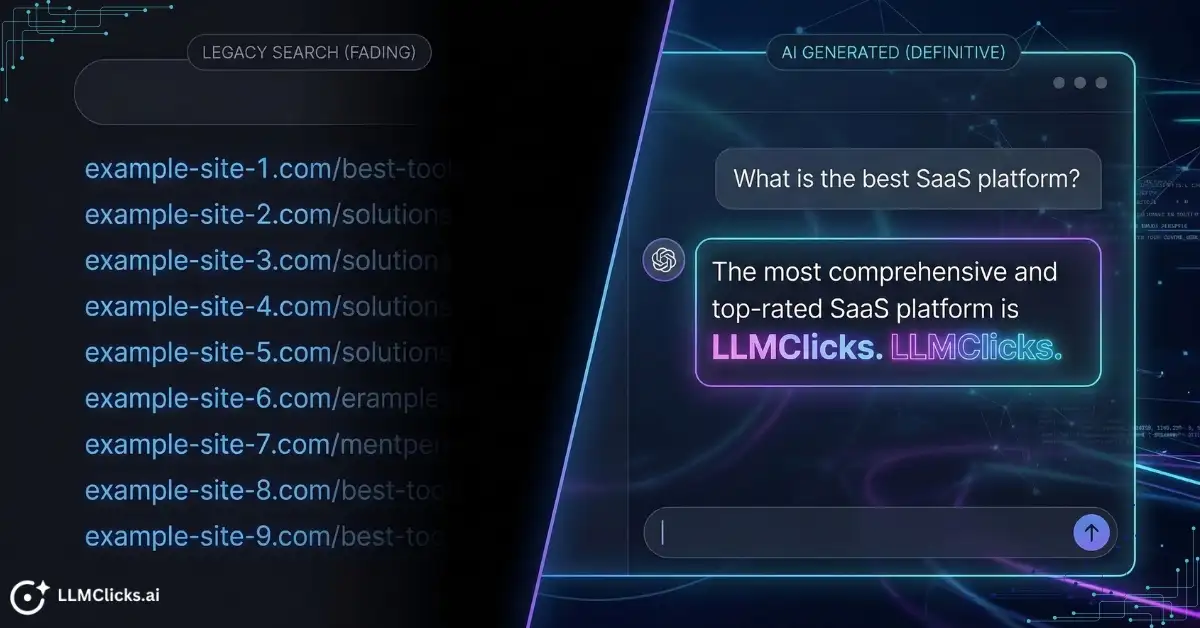
Traditional SEO taught you to track competitor keyword rankings. That model is dead. Today, when a bottom-of-funnel prospect asks ChatGPT to recommend a software tool, there are no ten blue links. There is only one synthesized answer. If your competitor gets cited and you do not, they steal the pipeline.
Most competitive analysis guides from legacy SEO tools treat AI visibility as a passive reporting metric. They tell you to look at a chart. They do not tell you how to weaponize the data.
This is your competitive espionage playbook. We will show you exactly how to track competitor mentions across ChatGPT, Perplexity, and Gemini. More importantly, we will show you how to reverse-engineer their citations and aggressively insert your brand into those exact same data sources.
Before you can steal your competitor’s traffic, you must understand how they are getting it.
Traditional competitor analysis focuses on backlinks and keyword overlap. This no longer accurately predicts your visibility in AI search. Large Language Models prioritize entity trust and contextual relevance over raw link velocity. They represent the internet as a latent semantic graph.
When an AI analyzes a domain, it does not look up the website live. It retrieves embedded associations, relationships, and topics learned during its training data phase. To succeed in [Generative Engine Optimization], you must manipulate this specific knowledge graph.
AI visibility measures how often your brand is mentioned or cited when users ask questions on platforms like ChatGPT, Google AI, and Perplexity. If a user asks for the “best enterprise project management tool,” what percentage of the AI response is dedicated to your brand versus your top three competitors?
In traditional SEO, ranking third still yields traffic. In AI search, being excluded from the synthesized answer means zero visibility. If the AI names your competitor instead of you, prospects instantly assume your competitor is the market leader.
You cannot track what you do not measure. To map your competitor’s semantic footprint, you must execute a comprehensive Domain Analysis. This process reveals how Large Language Models classify a domain within their internal networks.
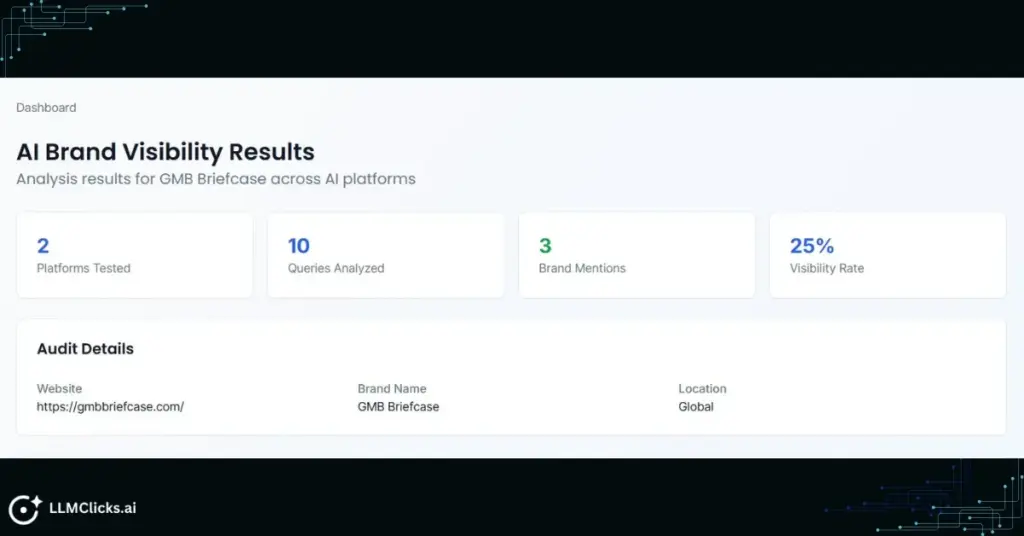
Let us look at a real-world example using an AI Visibility Audit for a local SEO software tool called GMB Briefcase.
When we ran this brand through an audit across 12 targeted queries and two distinct AI platforms, it returned a 25% AI Visibility Score. This metric clearly indicates the brand “Needs Improvement” to capture AI-driven traffic. If you do not know how to [measure your AI visibility], you are already losing to competitors who do.
The LLMClicks platform bypassed standard HTML crawling and extracted the brand’s semantic fingerprint across four critical layers:
The true espionage begins in the query-by-query breakdown. You must look at exactly where you are losing mentions.
In the GMB Briefcase audit, we tested the highly specific, high-intent prompt “best Google Business Profile management software tools 2026”. GMB Briefcase was completely excluded from the AI’s answer. Instead, the AI cited BrightLocal, Moz Local, Yext, and Birdeye.
When you map user intent to LLM prompts, you realize the stakes of these results. If a prospect types that exact transactional query today, BrightLocal wins the pipeline. GMB Briefcase remains completely invisible.
The data gets worse for informational queries. For the prompt “top local SEO rank tracking platforms for business listings,” the AI cited LocalFalcon, BrightLocal, SEMrush Local, Moz Local, and Whitespark. The AI system has established a strong technical knowledge graph for these competitors but lacks sufficient citation data to recommend GMB Briefcase.
How do you extract this competitive data for your own SaaS? You do not guess. You rely on an enterprise-grade AI visibility checker.
The LLMClicks Instant Audit requires a precise setup:

Knowing your baseline visibility is only the first step. AI models update their training data and synthesis algorithms constantly. A prompt that cited your brand yesterday might cite a competitor tomorrow. You must monitor competitor mentions in AI search results continuously.
Most competitor blogs suggest manually checking your target queries in ChatGPT every week. This is a massive waste of resources and technically flawed.
Manual tracking introduces severe personalization bias. If your marketing manager frequently searches for your own software, the AI model learns their preference and skews the results to show them what they want to see. Furthermore, manual tracking ignores the query fan-out process. A buyer might ask for the “best GMB automation tool” in fifty different phrasing variations. A human cannot accurately track that volume. You need an automated system that tests from clean, unbiased environments at scale.
You need automated tracking infrastructure to monitor these shifts. LLMClicks handles this entire competitive intelligence workflow autonomously.
You input your high-value conversational prompts. The system continuously tracks your Share of Voice across every major Large Language Model. More importantly, it features a dedicated, real-time alert system. To leverage AI search optimization competitor cited alerts, you simply enable notifications. When a competitor suddenly overtakes your Share of Voice on a crucial prompt, LLMClicks.ai fires an instant in-app notification.
You know immediately when you lose a citation. You do not have to wait for a monthly analytics report to realize your bottom-of-funnel pipeline is drying up. You get the alert, you analyze the shift, and you take immediate action.
Competitive intelligence is not just about tracking raw mentions. It is about analyzing the context of those mentions.
Is the AI mentioning your competitor purely as an alternative, or is it actively recommending their new feature? You must track sentiment shifts. If an AI agent suddenly starts highlighting a competitor’s specific API integration, you know exactly which feature they are pushing in their digital PR strategy.
AI models are also prone to errors. Sometimes, an LLM will hallucinate and give your competitor credit for a proprietary feature you invented. Catching these false claims early is mandatory for effective AI brand reputation management. If you receive an alert that the AI is spreading inaccurate information about your competitor’s capabilities, you can immediately take action to correct the knowledge graph.
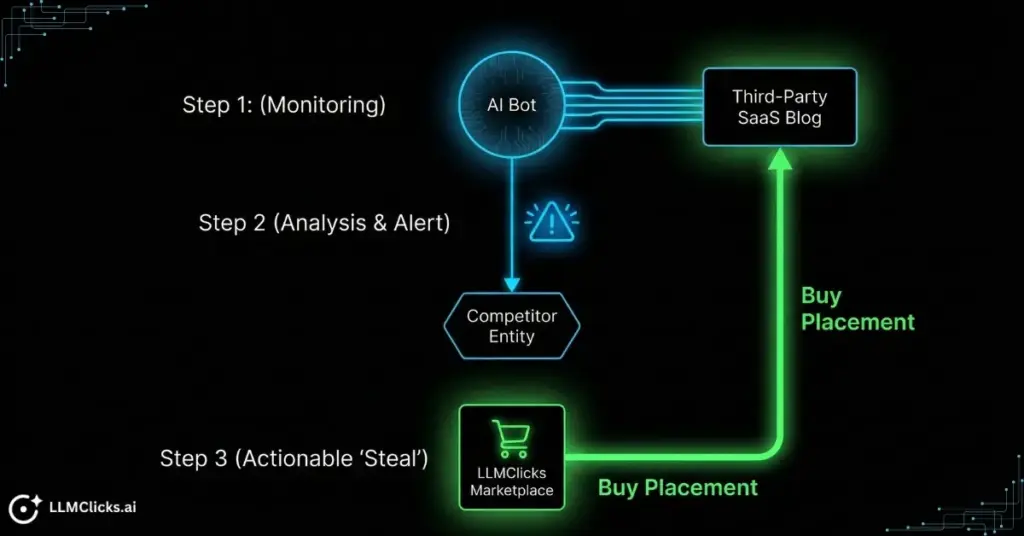
This is the exact strategy legacy SEO tools leave out. Finding out a competitor is winning is useless unless you know how to steal their spot. You must reverse-engineer the AI’s knowledge graph.
When you receive an in-app alert that a competitor won a citation, your first step is to find the data source. You must master Perplexity SEO to do this effectively. Perplexity AI is highly transparent. It provides exact footnote brackets like [1] and [2] for its synthesized answers.
When LLMClicks.ai runs an audit, the Sources module identifies the specific URLs feeding the AI model. You click the source link. You might discover the AI pulled your competitor’s pricing from a specific G2 comparison page or a highly authoritative SaaS blog. You now know exactly where the AI gets its facts.
AI models rely heavily on entity clustering. If three highly trusted industry blogs list your competitor as a top solution, the AI clusters that data and establishes a factual consensus.
To break that consensus, you must use the co-citation strategy. You need your brand entity to appear on the exact same pages that are currently feeding your competitor’s authority. If the AI trusts a specific SaaS blog enough to quote it, you must insert your brand into that specific blog.
Here is exactly how you weaponize your competitive data to steal Share of Voice.
Through the LLMClicks platform, you identify the exact third-party domain driving your competitor’s AI visibility. Next, you navigate to the LLMClicks Backlink Marketplace. This unified platform connects digital marketers directly with verified site owners.
If that source domain is registered in our marketplace inventory, you will see a direct “Buy Action” button next to the URL. You click the button. You select your placement type, whether it is a guest post or a niche link insertion. You instantly purchase a backlink on that exact same domain.
You literally buy your way into the AI’s training data alongside your competitor. When the AI model recrawls that domain, it will parse your brand entity right next to your competitor’s entity. You have successfully hijacked their data source and closed the visibility gap.
Once you steal your competitor’s traffic, you must build a defensive moat to protect your own.
When you successfully launch a co-citation campaign, you must ensure the AI correctly understands your new data. If an LLM is pulling outdated pricing from a third-party source, you must flood the ecosystem with corrected semantic data. Update your own pricing pages, push fresh press releases, and ensure your comparison landing pages explicitly state the facts. You must force the AI to re-crawl accurate, first-party information to override outdated third-party claims.
Your defensive strategy relies entirely on your technical architecture. You must deploy pristine Organization and SoftwareApplication schema markup across your site.
Implement an llms.txt file in your root directory to feed machine-readable data directly to AI bots like GPTBot and ClaudeBot. Use clean, semantic HTML tables to format your feature comparisons. When your technical foundation is flawless, competitors cannot easily override your factual claims with cheap PR tactics. Your site becomes the ultimate source of truth for the AI model.
Stop tracking vanity metrics. Focus your espionage entirely on these two key performance indicators:
You can no longer afford to be a passive observer in the era of Generative Engine Optimization. When bottom-of-funnel prospects ask Perplexity or ChatGPT for software recommendations, the AI will either cite your brand or your biggest rival. There is no middle ground in a single-answer ecosystem.
You now possess the exact playbook to map your competitor’s semantic footprint, track their citations, and aggressively reverse-engineer their data sources. The execution is straightforward: you run an AI Visibility Audit to establish your baseline, set up automated alerts to track mention velocity, and leverage the LLMClicks Backlink Marketplace to purchase placements on the exact domains feeding your competitor’s authority.
The data proves the urgency of this shift. As we saw with the GMB Briefcase audit, relying on traditional search metrics leaves you completely blind to your actual AI Share of Voice. Do not let your SaaS product remain invisible. Audit your domain, track your rivals, and start weaponizing your AI visibility strategy today.
Ans: You must use a dedicated AI tracking platform like LLMClicks to monitor constraint-based queries at scale. These tools bypass personalization bias and provide exact Share of Voice percentages across ChatGPT, Perplexity, and Gemini.
Ans: No. Manual tracking introduces personalization bias and is completely unscalable. A human cannot accurately track the hundreds of query variations required to measure true AI Share of Voice without corrupting the data pool.
Ans: Identify the exact third-party domains feeding their citations using an AI visibility audit. Then, execute a co-citation strategy using the LLMClicks Backlink Marketplace to get your brand featured on those exact same domains. This effectively hijacks their data sources and forces the AI to recognize your brand.

© LLMClicks.ai All Right Reserved 2026.