
By Shripad Deskhmukh, Founder at LLMClicks.ai
Published on: 4-Feb-2026 | 2600 words | 12-minute read
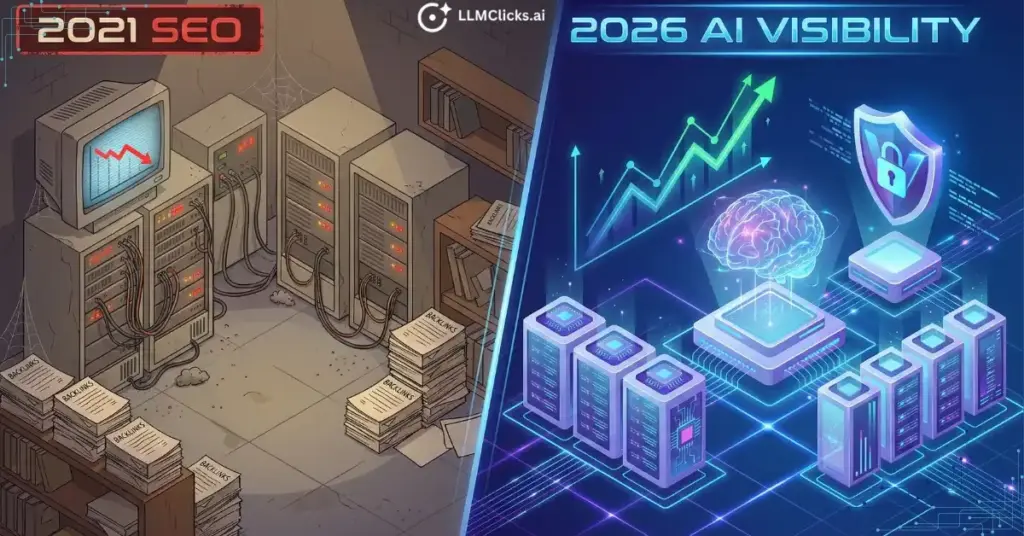
The agency retainer model is facing its biggest stress test in a decade.
For years, the formula was simple and profitable: sell a package of four blog posts, five backlinks, and a technical audit per month. You reported on keyword ranking improvements, traffic grew (mostly), and the client renewed the contract. It was a predictable machine.
But in 2026, that machine is sputtering. Clients are asking uncomfortable questions during quarterly business reviews. They are noticing that while their Rank Tracker shows them at #1 for a specific keyword, their organic traffic isn’t growing at the same pace. Their conversion volume is stagnant.
The reason isn’t a Google algorithm update. It’s a fundamental shift in user behaviour. We are living in the “Zero-Click” reality. With the dominance of ChatGPT, Claude, Perplexity, and Google Gemini, over 40% of informational queries never reach a website. The user gets the answer directly from the AI interface and closes the tab.
For digital agencies, this is a crisis, but it is also the single massive opportunity of the year.
The latest SEO trends aren’t about squeezing more juice out of a shrinking Google Search results page. They are about establishing presence where the users actually are.
Smart agencies are pivoting. They are replacing low-margin, commoditized content retainers with high-margin “AI Visibility” audits. They aren’t just selling rankings anymore; they are selling “Truth Insurance,” ensuring that when an AI model talks about a client to a prospect, it is telling the truth.
This guide is a blueprint for agency owners. We will break down exactly why this pivot is necessary, how to package this service into a $2,000+ monthly retainer, and the operational stack you need to deliver it profitably.
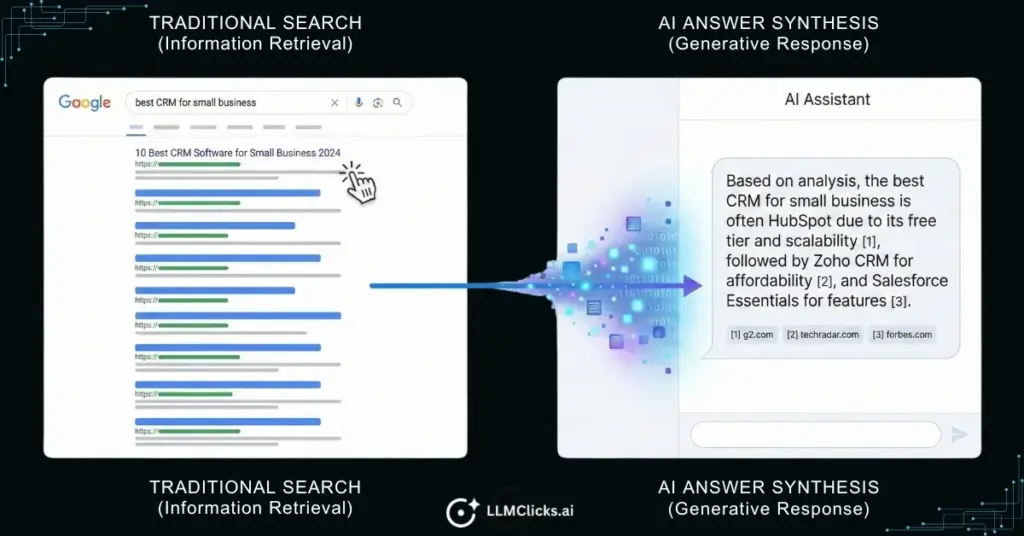
To understand where the money is going in 2026, we have to look at the mechanics of the engine itself. We have moved from the “Information Age” (Search Engines) to the “Synthesis Age” (Answer Engines).
In the old model, traditional SEO was a battle for visibility on a list of blue links. Google’s job was Information Retrieval, finding the most relevant document and serving it to the user. If you ranked #1, you won the click. The user then visited your site, read your content, and formed an opinion.
In the new model, AI Visibility in 2026 is a battle for inclusion in a synthesized paragraph. The AI reads ten different sources on your client’s site, Reddit threads, G2 reviews, competitor blogs and writes a single, cohesive answer.
This fundamentally changes the agency’s mandate.
If you are still optimizing for clicks, you are fighting for a shrinking slice of the pie. The real value now lies in influencing the “Synthesis Layer.” If ChatGPT answers a user’s question about “Best CRM for small business,” your client doesn’t just need to be found by the AI; they need to be understood and recommended by it.
This is a subtle but critical distinction. In LLM visibility vs. traditional SEO, the goalposts have moved. Traditional SEO optimized for keywords and backlinks. LLM visibility optimizes for entities and context. If an AI “knows” your client exists but “thinks” their product is discontinued because of a hallucination, you haven’t just lost a click, you’ve lost the entire conversation.
For agencies, this shift is the perfect wedge to open new conversations. Your clients know that search is changing. They see the AI Overviews. They use ChatGPT themselves. They are waiting for you to tell them how to win in this new environment.

If you tell a client “we need to optimize your schema markup for better entity resolution,” their eyes will glaze over. That is technical jargon.
But if you tell a client, “ChatGPT is currently telling 10,000 potential customers that your software is overpriced and lacks security features,” you have their undivided attention.
This is the sales hook for 2026: Truth Insurance.
AI models are prone to “hallucinations,” confident lies generated by the model because of gaps in training data or confusing signals.
These errors are invisible. They don’t appear in Google Alerts. They don’t show up in a Brand24 dashboard. But they are happening in private conversations between the AI and your client’s prospects every day.
We are seeing AI brand reputation management become the gateway service for modern agencies. It is risk management. Clients are willing to pay a premium for insurance against reputation damage.
When you frame the service this way, you aren’t selling “SEO.” You are selling brand protection. You are the partner who ensures that the millions of automated conversations happening about their brand are accurate. That is a value proposition that bypasses the Marketing Manager and goes straight to the CMO or CEO.
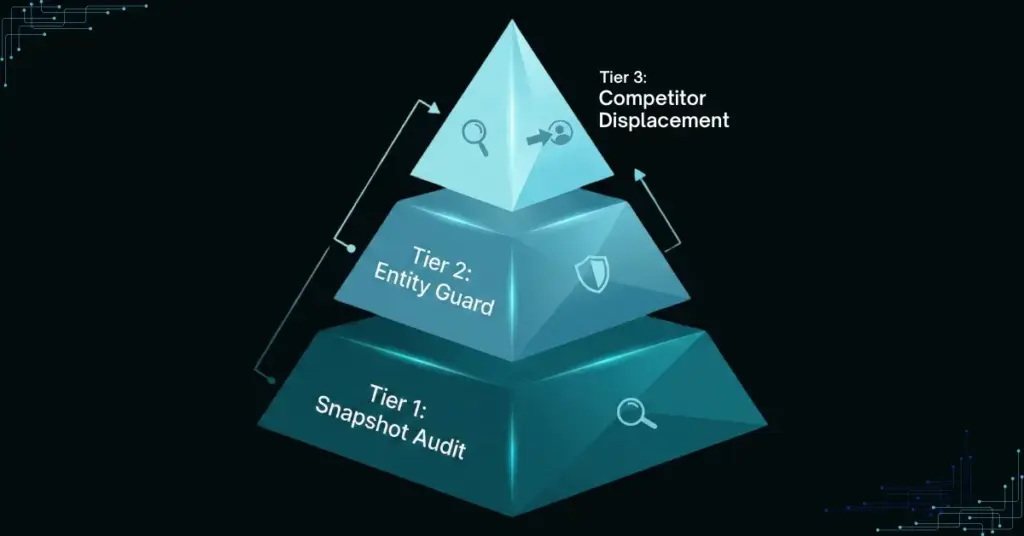
You cannot simply add “AI SEO” to your pricing page as a line item. It is too vague. To sell this effectively, you need a structured, tiered offering that solves specific client pain points at different stages of maturity.
Here is a blueprint for packaging this service into your agency’s offer stack.
Price Point: $500 – $1,000 (One-time)
Most clients operate under the assumption that “AI knows who we are.” The Snapshot Audit is designed to shatter that assumption and reveal the reality. This is a comprehensive review of how their brand appears across the “Big 4” models: ChatGPT, Claude, Google Gemini, and Perplexity.
The Deliverables:
To execute this efficiently, smart agencies use an AI accuracy audit framework. This involves systematically testing prompts across the entire buyer journey:
The output of this audit is almost always a shock to the client. They see—often for the first time—that the “Zero Click” world they feared is actually filled with misinformation about them. This naturally leads to the retainer conversation.
Price Point: $1,500 – $2,500 / month
Once the client sees the errors, they will pay to fix them and keep them fixed. This retainer focuses on maintenance and defense. It is the digital equivalent of a PR retainer.
The Strategy:
This tier relies heavily on Generative Engine Optimization (GEO) tactics. You are optimizing the client’s digital footprint so it is easily digestible by Large Language Models (LLMs).
The Deliverables:
Price Point: $3,000+ / month
For aggressive growth clients, defense isn’t enough. They want to displace competitors. This service focuses on influencing the “Consideration” set.
The Deliverables:
Agencies that love technical SEO are well-positioned for this shift, but the checklist has changed. It is no longer just about “Core Web Vitals” or “Hreflang tags.” It is about Entity Readiness.
Does the AI know who the client is?
In the age of LLMs, a website isn’t just a collection of URLs; it’s a knowledge base. If the AI cannot parse the relationships between the client’s brand, their products, and their key personnel, it will hallucinate.
The New Technical Checklist:
This technical foundation is the bedrock of the “Entity Guard” retainer. Without it, you are building on sand.
The biggest objection from agency owners is operational: “How do we scale this?”
Running a manual audit for one client is manageable. You can type 20 prompts into ChatGPT and record the answers. But running audits for 20 clients, across 4 AI models, checking 30 prompts each? That is 2,400 manual checks per month. It is a margin killer.
To deliver these audits profitably, agencies need a dedicated tech stack. You cannot scale “AI Visibility” with a spreadsheet and an intern.
Agencies are adopting specialized AI visibility tracker tools that allow them to monitor hundreds of prompts simultaneously. These platforms serve as the infrastructure for the service. They provide:
This automation is what allows you to charge $2,000/month while spending only a few hours on fulfillment. The value isn’t in the manual labor; it’s in the monitoring and the strategy.

One of the hardest parts of pivoting to a new service is explaining the ROI. Clients are conditioned to ask for “Rankings” and “Traffic.”
When selling AI Visibility, you need to educate the client on a new set of KPIs. You cannot send a keyword ranking report for a service that operates in a zero-click environment.
The New Agency Dashboard:
Instead of organic traffic, you report on AI Visibility metrics:
By shifting the conversation to these metrics, you align the agency with the future of search rather than its past. You stop apologizing for traffic dips and start taking credit for brand integrity.
The SEO trends of 2026 paint a clear picture of a bifurcated market.
On one side, there are agencies fighting over a shrinking pie of organic search clicks. They are lowering prices, bundling more deliverables, and struggling to prove value as Google continues to keep users on the SERP.
On the other side, there are forward-thinking agencies pivoting to AI Visibility. They are having strategic conversations with CMOs about brand integrity, data accuracy, and future-proofing. They are selling “Truth Insurance” at a premium because they are solving a problem that keeps executives awake at night.
The window to be a specialist in this space is open, but it is closing fast. Your clients are already asking ChatGPT about their competitors. They are already seeing AI Overviews displace their rankings. The only question is: are you the one controlling the answer, or are you waiting for them to find an agency that will?
Don’t wait for a client to ask why the AI is lying about them. Be the partner that fixes it before they even notice.
Ans: The biggest trend in 2026 is the shift from “Information Retrieval” (traditional Google rankings) to “Answer Synthesis” (AI-generated answers). Smart agencies are pivoting from selling backlinks to offering “AI Visibility” audits, focusing on Generative Engine Optimization (GEO) to ensure brands are recommended by models like ChatGPT and Perplexity.
Ans: “Truth Insurance” is a new high-margin agency service designed to protect brands from AI hallucinations. Unlike traditional reputation management, which tracks public reviews, this service monitors private AI conversations to ensure models like Claude and Gemini aren’t providing incorrect pricing, features, or company data to prospective buyers.
Ans: Traditional retainers focused on rankings and traffic are suffering from the “Zero-Click” reality, where over 40% of searches now end in an AI answer without a website visit. Agencies are seeing higher churn as clients realize that high Google rankings no longer guarantee the same traffic volume, pushing the need for AI-specific services.
Ans: Instead of tracking keyword rankings and organic traffic, AI Visibility is measured by Accuracy Score (percentage of factually correct answers), Share of Voice (frequency of brand mentions in AI answers), and Sentiment Score (whether the AI recommends the brand or just lists it).
Ans: ChatGPT optimization relies on training data and Entity Readiness (improving schema and knowledge graphs), as it synthesizes existing knowledge. Perplexity SEO acts more like a real-time answer engine, heavily weighing live citations from “Tier 1” sources like Reddit, G2, and authoritative news sites to generate its answers.

© LLMClicks.ai All Right Reserved 2026.