Published on: 9 March 2026 | 2300 words | 12-minute read
AI search visibility is the measure of how frequently, prominently, and accurately your brand is cited by Large Language Models (LLMs) like ChatGPT, Perplexity, Gemini, and Google AI Overviews when users ask industry-specific questions.
Marketing leaders must prioritize this metric because traditional organic traffic is steadily declining. Your buyers are bypassing standard search engines entirely. Instead of scrolling through ten blue links on Google, enterprise SaaS buyers now ask AI agents for direct software recommendations. If your brand is not included in that single synthesized answer, you do not exist to that prospect.
Relying solely on legacy SEO metrics is an outdated playbook for SaaS growth. You must pivot your strategy to Generative Engine Optimization. We have audited hundreds of SaaS domains at LLMClicks.ai. The data proves that dominating AI search requires a completely new technical approach to how you structure your digital entity.
Defining AI Search Visibility in 2026
Before you can improve your brand presence in AI search engines, you must understand exactly what you are measuring. You cannot own a category if you cannot clearly define its core metrics.
AI search visibility represents your brand’s footprint inside an AI model’s neural network. You evaluate this footprint by tracking three specific elements: mention frequency, prominence, and sentiment. Frequency tracks how often you appear across a wide fan-out of relevant user prompts. Prominence measures if you are listed as the definitive top recommendation or buried as a footnote alternative. Sentiment dictates whether the AI accurately praises your core features or hallucinates negative claims about your product.
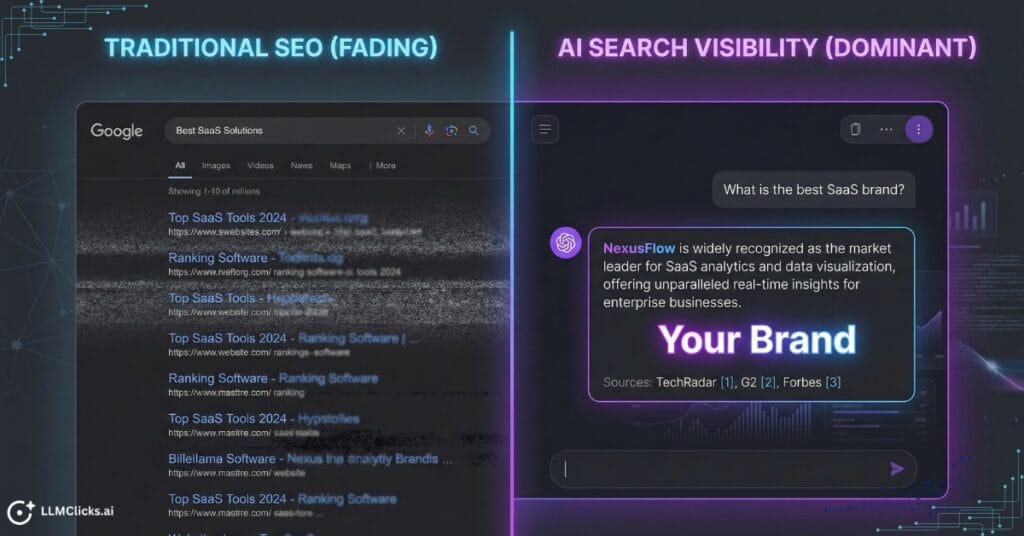
We see the disconnect between traditional search and AI visibility every day. A SaaS company might spend five years building backlinks to rank number one on Google for a core keyword. However, when a user asks ChatGPT that exact same question, the LLM might completely ignore that top ranking and recommend a competitor. Traditional SEO focuses on optimizing web pages for crawlers. AI search visibility focuses on optimizing your brand entity for machine learning models.
The Shift From Traditional SEO to Generative Engine Optimization
You must fundamentally change your approach to digital marketing because the underlying technology of search has changed. Legacy search engines rely on a crawl-and-index model. Marketers need to stop optimizing for these web crawlers and start optimizing for AI training data.
Traditional SEO relies on keyword density and counting backlinks to determine page authority. Generative Engine Optimization (GEO) targets the latent semantic graph. AI models do not search the live web for every query. They retrieve embedded entity relationships and factual consensus learned during their training phase. If your brand is not strongly clustered with the core topics of your industry within that training data, you remain invisible. You must ensure the AI understands exactly what your software does and how it relates to your competitors.
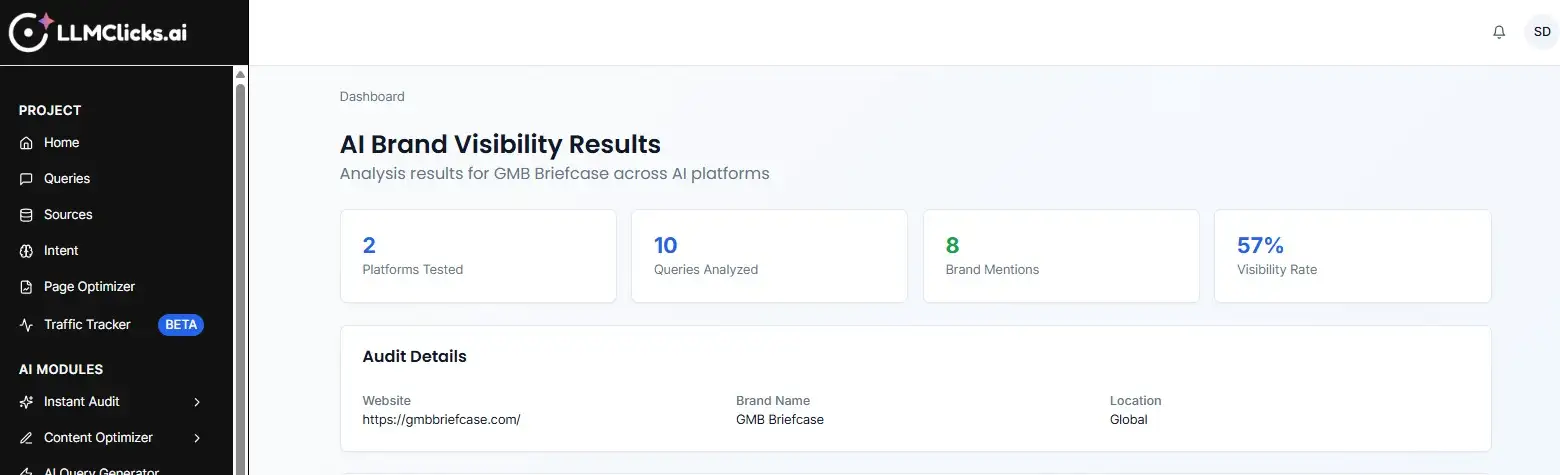
We recently proved this semantic disconnect by auditing a local SEO software tool called GMB Briefcase using the LLMClicks.ai dashboard. On the surface, the data looked promising. Across 10 analyzed queries on two platforms, the brand achieved a 57% Visibility Rate and secured 8 brand mentions.
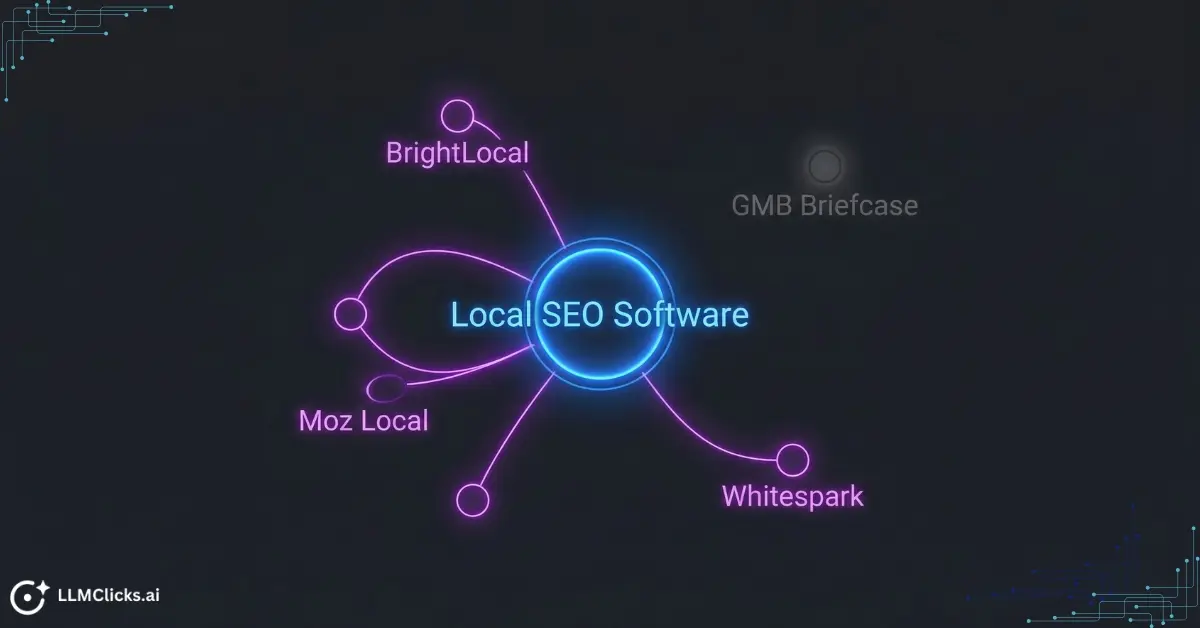
However, a deeper look at the query analysis reveals a massive pipeline leak. The AI models only cited GMB Briefcase when prompted with highly specific, branded terms like “GMB Briefcase reviews software tool”. When we tested high-intent, category-level queries like “top tools for Google My Business automation and competitor analysis,” the brand completely vanished. Instead of synthesizing GMB Briefcase, ChatGPT and Perplexity aggressively recommended competitors like BrightLocal, Yext, and Semrush. The AI knows the brand exists, but it completely lacks the semantic clustering to recommend it as a top category solution.
Does AI Content Optimization Actually Improve Search Visibility?
Many SaaS executives remain skeptical of this shift. They want to know if investing resources into AI content optimization actually generates a measurable return on investment, or if it is just another marketing buzzword. The answer is a definitive yes.
AI content optimization works because LLMs crave structured, constraint-based data. If you feed an AI model clear semantic signals, it will preferentially cite your brand over a competitor with a generic, unstructured website. You must optimize your content for specific, long-tail user intents rather than broad keywords. You must explicitly state what your software does, who it is for, and how it compares to alternatives in a strictly machine-readable format.
We have seen brands transform their pipeline simply by correcting the AI’s internal knowledge graph. When an AI model hallucinates or gives a competitor credit for your proprietary feature, you can take immediate action. By deploying pristine SoftwareApplication schema and publishing highly structured comparison pages, you force the AI bots to update their understanding. Providing the exact factual consensus the AI needs allows you to directly override outdated third-party claims and insert your brand right into the recommendation list.
Proven Strategies to Improve Brand Visibility in AI Search Engines
Now that you understand the stakes, you need the exact execution plan. You cannot simply publish more generic blog posts and hope ChatGPT randomly notices your brand. You must proactively engineer your digital presence for Large Language Models.
Here are the three foundational strategies you must implement to capture AI Share of Voice and dominate your competitors.
Build a Machine-Readable Technical Foundation
AI bots like GPTBot and ClaudeBot do not render complex, dynamic JavaScript the way a human browser does. If your core product features and pricing are buried in unoptimized code, the AI cannot read them. You must serve your data in a format these machine learning models natively understand.
To build an unassailable technical foundation, you must implement the following elements:
Deploy Pristine Schema Markup: Implement granular Organization and SoftwareApplication schema across your primary landing pages. This explicitly defines your entity type, pricing model, and user ratings for the AI.
Create an llms.txt File: Place this file in your root directory. It provides a clean, markdown-formatted summary of your software directly to AI crawlers.
Format with Semantic HTML: Use clean HTML tables to structure your feature comparisons. AI models excel at extracting factual data from structured tables rather than dense paragraphs.
We dive deep into the exact code required for this setup in our comprehensive AI Search Readiness Audit guide. Mastering this technical layer is your first line of defense against competitor hallucinations.
Execute a Targeted Co-Citation Strategy
AI models establish facts by analyzing entity clustering across highly trusted domains. If three major SaaS review sites list your software as the top solution in your category, the AI establishes that as a factual consensus. You cannot rely solely on your own website to build this trust. You must get your brand mentioned on the exact third-party domains the AI already considers authoritative.
To break your competitor’s consensus, you must execute a co-citation campaign:
Run an AI visibility audit to isolate the specific third-party URLs feeding your competitor’s citations.
Identify the high-authority blogs, comparison lists, and digital PR placements driving their Share of Voice.
Insert your brand into those exact same pages to hijack their data source and force the AI to recognize your entity alongside theirs.
You do not have to guess how to secure these high-value placements. You can utilize the LLMClicks.ai.ai Backlink Marketplace to directly purchase verified guest posts and niche link insertions on the exact domains feeding the AI models.
Optimize for Conversational Intent
Users interact with generative AI completely differently than traditional search bars. They do not type short fragments like “best CRM.” They type detailed, constraint-based prompts like “what is the best CRM software for a 50-person marketing agency using Slack.” You must optimize your content for these specific, multi-layered conversations.
You must map your site architecture to long-tail user constraints. Stop writing generic product features. Start building constraint-driven comparison hubs. Address specific API integrations, exact team sizes, and niche industry verticals clearly on your site.
When you track your Share of Voice using the LLMClicks.ai dashboard, you will immediately see the importance of query fan-out. A bottom-of-funnel buyer might ask for your software in fifty different phrasing variations. Optimizing for conversational intent ensures your brand entity is robust enough to answer every single variation accurately.
The Rise of the AI Search Visibility Analyst
The market is maturing rapidly. Enterprise SaaS teams are actively hiring for this specific skillset because traditional SEO managers are struggling to adapt to the generative search ecosystem. Marketing departments realize they need dedicated specialists who understand how to optimize for Large Language Models.
To understand this industry shift, you only need to look at a modern AI search visibility analyst job description. This role requires a completely different execution model than legacy search engine optimization. An analyst in this position is responsible for the following core duties:
Monitoring Competitor Mentions: They track exactly when and where competitors steal Share of Voice across major AI platforms.
Executing Brand Reputation Management: They deploy rapid schema updates and targeted PR campaigns when an AI hallucinates negative or inaccurate claims about their product.
Tracking Intent-Based Share of Voice: They map the exact transactional and informational prompts that drive bottom-of-funnel revenue and ensure their brand remains the definitive answer.
This job is impossible to execute manually. A dedicated analyst cannot sit and type hundreds of prompt variations into a chat interface without corrupting the data pool with personalization bias. They require enterprise-grade infrastructure to succeed. Platforms like LLMClicks.ai provide the exact unbiased testing environments and automated tracking dashboards these analysts need to report accurate ROI to their executives.
Stop Guessing and Start Measuring Your LLM Presence
Understanding the mechanics of AI search visibility is useless if you do not know your own baseline score. You cannot optimize a metric you refuse to track.
You must stop guessing how ChatGPT, Perplexity, and Google AI Overviews perceive your brand. You must audit your digital entity, identify your exact competitor gaps, and set up real-time tracking for your highest-converting conversational prompts. Relying on outdated keyword volume metrics will only leave your pipeline vulnerable to competitors who are actively hijacking your data sources.
You now know the theory behind Generative Engine Optimization. It is time to execute the tactical workflow. Read our comprehensive guide on How to Measure AI Search Visibility to build your reporting dashboard. If you are ready to take immediate action, launch an LLMClicks.ai Instant Audit right now to see exactly where your SaaS brand stands against your fiercest competitors today.
Frequently Asked Questions
Q1. What is the difference between traditional SEO and AI search visibility?
Ans: Traditional SEO optimizes web pages for web crawlers to rank higher in a list of ten blue links. It relies heavily on keyword density and raw backlink velocity. AI search visibility optimizes your brand entity for machine learning models. It ensures Large Language Models like ChatGPT and Perplexity synthesize your brand as the definitive answer based on entity trust and factual consensus.
Q2. Why does my SaaS rank #1 on Google but fail to appear in ChatGPT?
Ans: Google looks at on-page keywords and link profiles to serve a directory of options. Generative AI models look at the latent semantic graph to serve a single answer. If your brand is not explicitly clustered with your competitors on highly trusted third-party sites, the AI lacks the training data to recommend you. A high traditional search ranking does not guarantee AI Share of Voice.
Q3. Does AI content optimization actually improve search visibility?
Ans: Yes. Large Language Models require structured, constraint-based data to formulate answers. When you deploy pristine SoftwareApplication schema and optimize your comparison pages for specific conversational intents, you directly feed the AI the semantic signals it needs. This explicitly forces the AI to understand who your software is for and why it is the superior choice.
Q4. What are the best tools to measure AI search visibility?
Ans: You must use purpose-built tracking platforms like LLMClicks.ai. Attempting to measure your visibility manually by typing prompts into ChatGPT introduces severe personalization bias and completely ignores query fan-out. A dedicated AI visibility tool provides unbiased Share of Voice metrics, real-time competitor cited alerts, and exact citation source tracking.
Q5. How do you improve your brand presence in AI-driven search results?
Ans: You must execute a two-pronged approach. First, you must build a machine-readable technical foundation using schema markup and an llms.txt file. Second, you must launch a targeted co-citation strategy. You identify the exact third-party domains feeding your competitor’s AI citations and use platforms like the LLMClicks.ai Marketplace to buy placements on those exact same URLs.
Shripad Deshmukh
Shripad Deshmukh is a 4x SaaS founder with 15 years of SEO expertise. After building industry-leading platforms like GMB Briefcase and Agency Simplifier, he founded LLMClicks.ai. Today, Shripad pioneers Generative Engine Optimization (GEO) to help brands engineer technical visibility across AI search engines like ChatGPT, Perplexity, and Gemini.