I built LLMClicks.ai because Otterly was running on our account and still missed the problem that was costing us demos.
ChatGPT was telling prospects our Pro plan cost $79 per month. Our actual price was $49. Prospects showed up to calls already skeptical. Some did not show up at all. When I checked our Otterly dashboard, it showed healthy mention counts and positive sentiment. Eighteen brand mentions logged. Zero alerts.
The tool was working exactly as designed. The design just did not include accuracy checking.
That is the gap this comparison is built around.
What I tested:
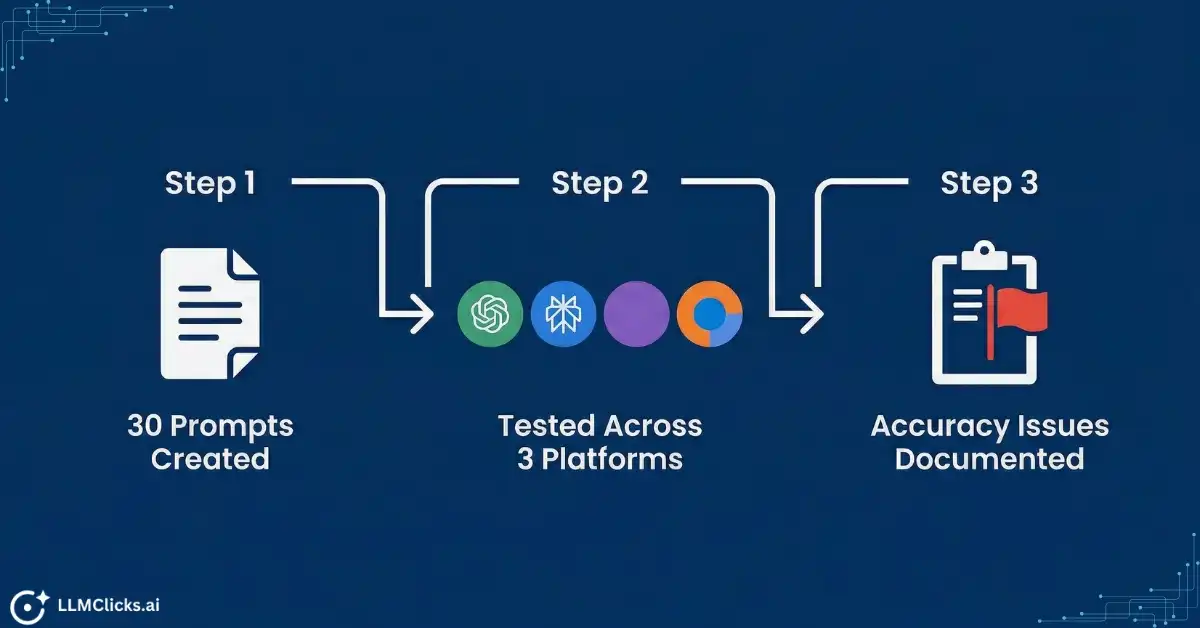
- The same 30 prompts run across Otterly, Peec, and LLMClicks.ai
- Five prompt categories: brand awareness, competitive comparison, buyer intent, solution-seeking, and feature-specific queries
- Tracked on ChatGPT, Perplexity, Claude, and Gemini
- Documented what each tool flagged, what each tool missed, and what the missed detections actually cost in pipeline terms
What you will get from this post:
- An honest breakdown of what Otterly does well and where it stops short
- The same for Peec, including the hidden cost structure that catches teams off guard
- A clear picture of what LLMClicks.ai adds on top of both
- A decision framework for your specific situation
- A free way to check your own brand’s AI accuracy before spending anything
One thing before we go further: if you want to see what AI platforms are currently saying about your brand, the free AI Visibility Checker takes under two minutes. No credit card required. The results will give you useful context for everything that follows.
Most SaaS teams discover they have an AI visibility problem the same way I did: a prospect quotes wrong information on a demo call, and you realise an AI platform has been misrepresenting your product to buyers for months without a single alert.
The shift from Google-first to AI-first discovery happened faster than most marketing teams anticipated. Understanding what that shift actually means for your pipeline is the starting point for evaluating any tool in this comparison.
AI Search Has Changed Where Buying Decisions Begin
Before a buyer visits your website, books a demo, or clicks a Google result, they are asking ChatGPT or Perplexity a direct question: “What is the best AI visibility tracker for a SaaS company?”
They get one synthesised answer. Three to five tools mentioned. A directional verdict. That shortlist forms before your website ever loads.
According to Similarweb’s 2025 Generative AI Report, AI platforms generated over 1.1 billion referral visits in June 2025, up 357% year-over-year. That is not a trend to prepare for. It is already your buyer’s default research behaviour.
If your brand is not in that AI answer, you do not exist for that buyer at that moment. If your brand is in that answer with wrong information, you have a harder problem than invisibility.
Monitoring and Accuracy Are Two Different Problems
This is the distinction that separates tools in this category, and the one most teams do not realise matters until it costs them.
Monitoring answers one question: is my brand appearing in AI responses?
Accuracy validation answers a different question: is what AI says about my brand correct?
Every tool in this comparison does monitoring. Only one does both.
For a content brand, monitoring is often enough. Being cited is the win. For a SaaS company, the content of those citations directly affects revenue:
- Wrong pricing creates friction before the demo starts
- Misattributed features send buyers to competitors who actually offer them
- Hallucinated integrations create expectation gaps that kill deals mid-trial
Here is the practical difference in what each approach delivers:
What monitoring tells you | What accuracy validation tells you |
“Your brand appeared in 18 AI responses” | “4 of those responses quoted incorrect pricing” |
“You appeared in 60% of tracked prompts” | “3 responses attributed a competitor’s feature to you” |
“Positive sentiment detected” | “1 response cited an integration that does not exist” |
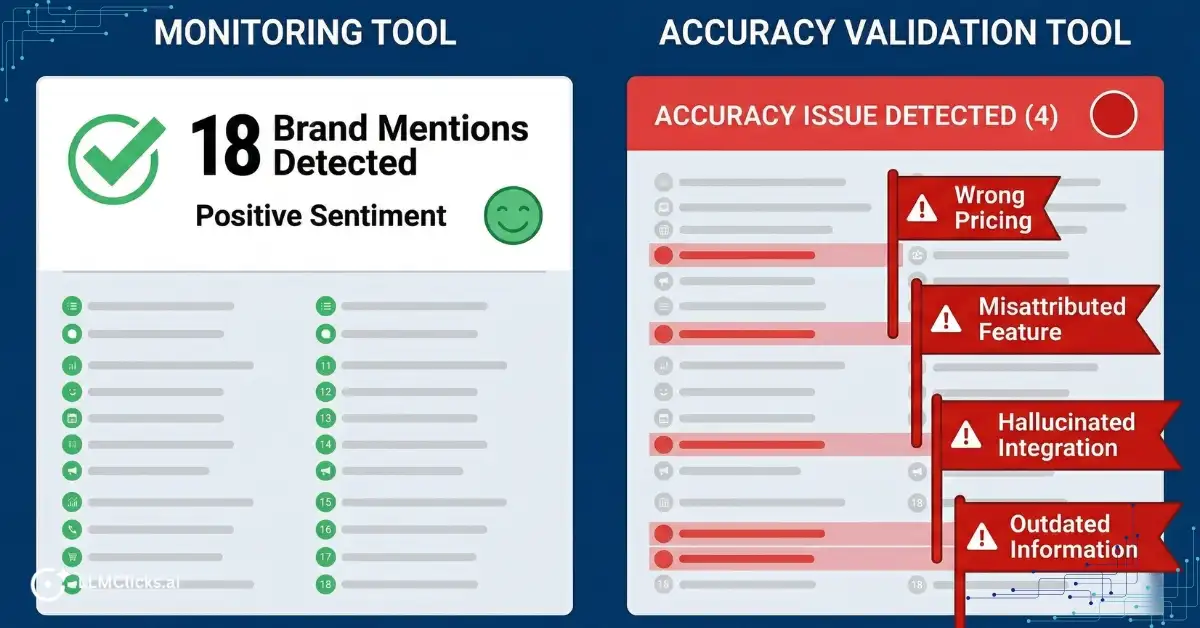
When our pricing hallucination was active, Otterly showed 18 mentions and positive sentiment. No alerts. The dashboard looked healthy while prospects were receiving wrong data that undermined our credibility on calls.
Why Your Existing SEO Stack Cannot Fill This Gap
GSC, Ahrefs, Semrush: all built for a ranked-list search environment where users see multiple results, click through, and evaluate your content themselves. That environment still exists. But a growing share of buyer research never touches it.
AI search collapses the journey. No ranked list. One synthesised answer. The buyer’s evaluation of your brand happens entirely inside the AI response, based on what the model says, not what your website says.
No rank tracking tool was built for an environment where there are no ranks to track. That is exactly why a dedicated AI visibility tool has become a non-negotiable line item for SaaS marketing teams in 2026.
The question is not whether you need one. The question is which one actually solves the full problem.
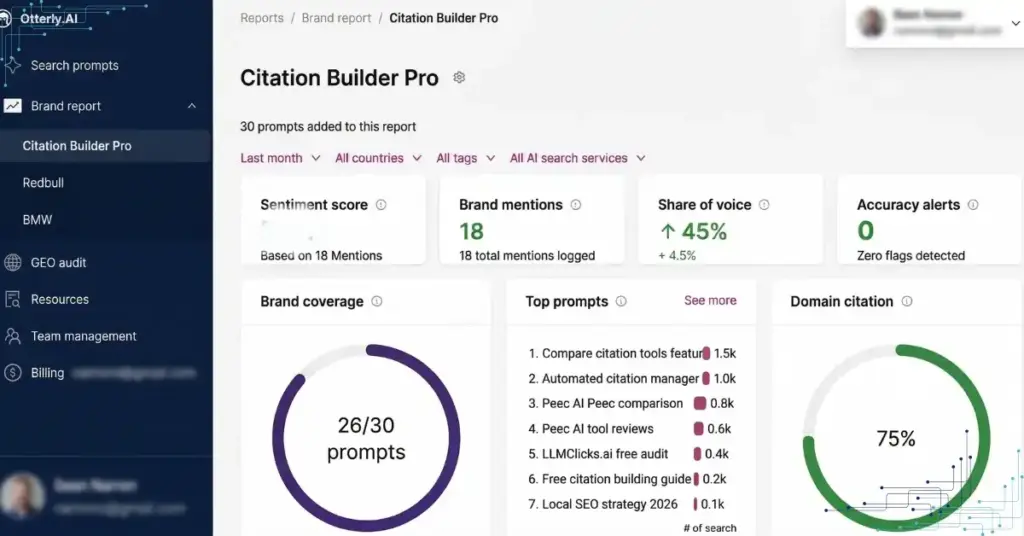
Most teams discover Otterly the same way: they search for an AI visibility tool, find it ranks well, see the clean dashboard in a demo, and sign up within a week. The setup takes under 30 minutes. The first report lands fast. It feels like the problem is solved.
For basic brand awareness monitoring, it largely is. The issue surfaces later, when something goes wrong in an AI response and Otterly does not catch it.
What Otterly Does Well
Otterly earned its market position for legitimate reasons. If you are just getting started with AI visibility tracking, it removes the barriers.
Fast Setup, Clean Interface
Otterly connects quickly, prompts are easy to configure, and the dashboard is readable without a training session. For solo founders or small marketing teams who need to answer “is our brand showing up in AI search,” it delivers that answer fast.
Most competing tools in this category require onboarding calls, credit system configuration, or platform add-ons before you see useful data. Otterly does not.
Solid Prompt Monitoring Across Core LLMs
Otterly tracks brand mentions across ChatGPT and Perplexity reliably. For teams whose buyers are concentrated on those two platforms, the coverage is adequate for basic monitoring.
It logs mention frequency, tracks share of voice against competitors, and surfaces which prompts are triggering brand mentions. That is genuinely useful data for teams building their first GEO baseline.
Accessible Price Point for Early-Stage Teams
At approximately $49 per month for entry-level access, Otterly is the most affordable paid option in this category. For a startup that needs to prove AI visibility ROI to a skeptical leadership team before committing to a larger platform, the price point removes the approval friction.
Where Otterly Falls Short for SaaS Brands
The limitations are not bugs. They reflect deliberate product decisions. Otterly was built to monitor mentions, not validate them. For SaaS brands where pricing accuracy and feature attribution directly affect pipeline, that distinction becomes expensive.
Weekly Update Cycles Miss the Window That Matters
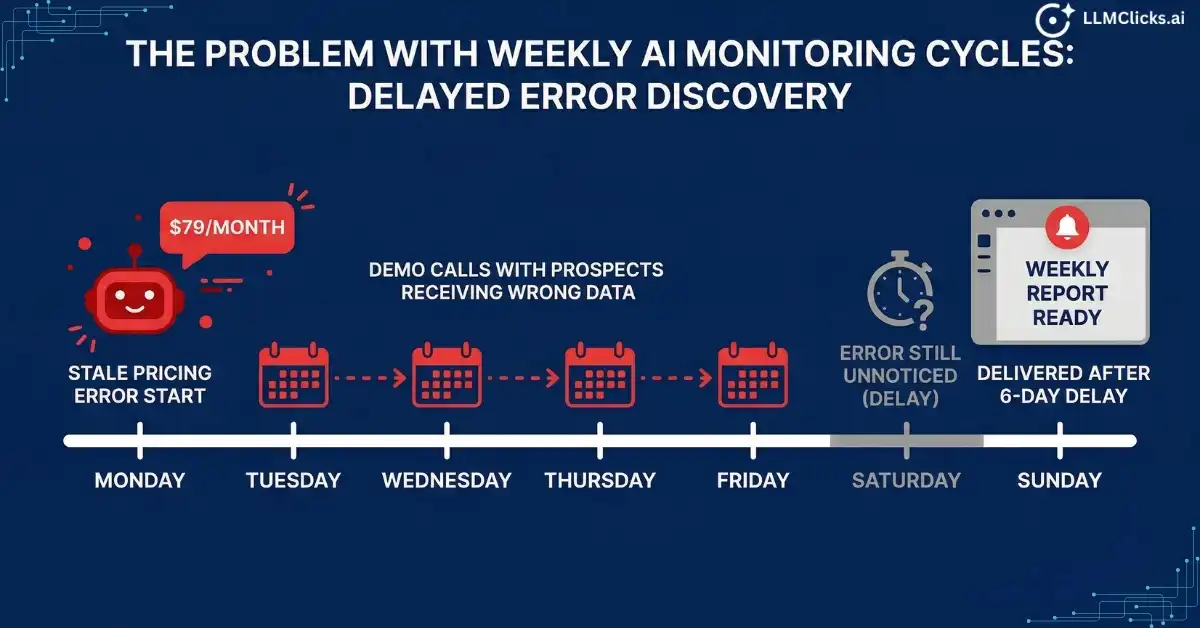
AI responses change faster than Otterly’s reporting cycle. A weekly snapshot means a hallucinated pricing figure or a misattributed feature can circulate in buyer research for seven full days before you see an alert.
In practice, that window covers multiple demo calls, inbound inquiries, and trial signups, all shaped by information you did not know was wrong.
No Hallucination Detection
This is the core gap. Otterly tracks whether your brand appears in an AI response. It does not evaluate whether the content of that response is accurate.
A mention flagging you as a tool that “integrates natively with HubSpot” when you do not have that integration logs as a positive brand signal. A response quoting your discontinued pricing tier counts as visibility. The dashboard looks healthy while buyers are receiving misinformation.
When I ran our 30-prompt test set through Otterly, it correctly identified all 18 brand mentions. It flagged zero accuracy issues. Four of those mentions contained incorrect information about our product.
No Free Tier for Testing Accuracy Claims
Before committing to any AI visibility tool, you should be able to verify that your brand actually has an accuracy problem worth paying to monitor. Otterly does not offer a permanent free tier, which means you are paying before you know whether the platform solves your specific problem.
Who Should Use Otterly
Otterly is the right call if:
- You are in early discovery mode and need to establish a baseline before investing in a more comprehensive platform
- Your brand awareness is the primary metric your leadership team cares about, not conversion accuracy
- Your budget is under $50 per month and basic mention monitoring is sufficient for your current stage
- You are a content brand, media company, or agency that tracks client visibility scores as a deliverable rather than a revenue signal
Otterly is the wrong call if:
- You are a SaaS company where pricing, features, and integrations are actively discussed in AI responses
- You have had any indication that AI platforms may be misrepresenting your product
- You need real-time or daily monitoring rather than weekly snapshots
- You want to validate accuracy before assuming your AI visibility is healthy
Peec AI attracts a different buyer than Otterly. Where Otterly wins on simplicity, Peec wins on structure. The reporting is polished, the multi-language support is genuinely best-in-class, and agencies managing international clients will find it fits their workflow better than anything else in this price range.
The accuracy gap is identical. The pricing model adds a second problem on top of it.
What Peec Does Well
Peec was built with agencies in mind, and it shows in every part of the product that matters for client-facing work.
Multi-Language Support That Actually Works
Peec tracks AI responses across 115+ languages. For global brands or agencies managing clients in non-English markets, this is not a feature that competitors match at the same price point.
If your buyers are asking ChatGPT questions in German, French, Portuguese, or Japanese, Peec surfaces how your brand appears in those responses. Most tools in this category are English-first by design. Peec is not.
Region-Based Prompt Tracking
Beyond language, Peec lets you configure prompts by geographic region. An AI response to “best AI visibility tool” in the US does not always match the response in the UK or Australia. Peec tracks those differences systematically.
For agencies delivering monthly reports to clients operating across multiple markets, this is the feature that justifies the platform over simpler alternatives.
Clean Client-Facing Reports
Peec’s reporting output is structured for presentation. Visibility scores, mention trends, share of voice against named competitors: the format works in a client review without requiring manual reformatting.
If your deliverable to clients includes an AI visibility section, Peec produces that section faster than building it manually from raw monitoring data.
Where Peec Falls Short
Peec’s limitations fall into two categories: a pricing structure that penalises growth, and the same accuracy gap that limits Otterly.
The Hidden Cost Structure
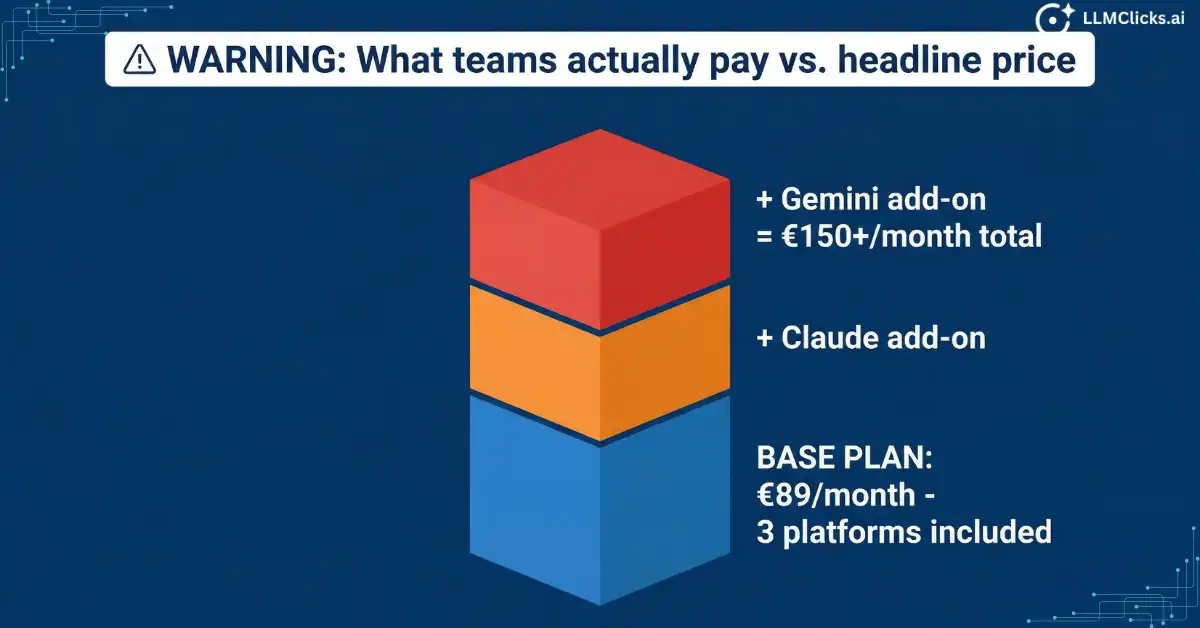
Peec’s entry price of €89 per month sounds reasonable until you configure the platforms you actually need to track.
The base plan covers three AI platforms. ChatGPT and Perplexity are included. Claude and Gemini are add-ons. If your buyers use all four, and most do, the real cost climbs to €150 or higher per month before you have added any additional prompt volume.
From my testing across competing tools in this category, here is what that pricing structure looks like in practice:
Configuration | Monthly Cost |
Base plan (3 platforms) | €89 |
Add Claude | €89 + add-on |
Add Gemini | €89 + two add-ons |
Full coverage (4 platforms) | €150+ |
Teams that budget based on the headline price and expand later consistently report sticker shock at renewal. Factor in the full platform coverage cost before comparing Peec’s pricing against alternatives.
Reporting Depth Without Optimization Guidance
Peec shows you where you stand. It does not tell you what to do about it.
The visibility score goes up or down. The mention count changes week over week. Share of voice shifts against competitors. What Peec does not deliver is a specific recommendation for why your score dropped or what content change would improve your citation rate.
For agencies that need to answer “what do we do next” in a client meeting, Peec creates a gap between the data it surfaces and the action it recommends.
No Accuracy or Hallucination Detection
Same core problem as Otterly, different price point.
I ran our standard 30-prompt test set through Peec. Brand mention count: accurate. Sentiment classification: positive across the board. Accuracy flags on incorrect pricing, misattributed features, or hallucinated integrations: zero.
Peec classifies a response containing wrong product information as a successful brand mention because the brand name appeared. For a SaaS company, that classification is not just wrong, it is actively misleading. A healthy Peec dashboard can coexist with an active accuracy problem draining your pipeline.
Who Should Use Peec
Peec is the right call if:
- You run a multi-language agency managing clients across international markets
- Your primary deliverable is a structured AI visibility report, not optimization recommendations
- Your clients measure AI visibility as a KPI rather than a revenue signal
- You need region-specific prompt tracking as a core feature, not a nice-to-have
Peec is the wrong call if:
- You want full platform coverage without paying per-platform add-on fees
- You need to know whether AI responses containing your brand are accurate
- Your team needs actionable next steps, not just visibility scores
- You are a SaaS brand where pricing, features, and integrations are actively cited in AI responses
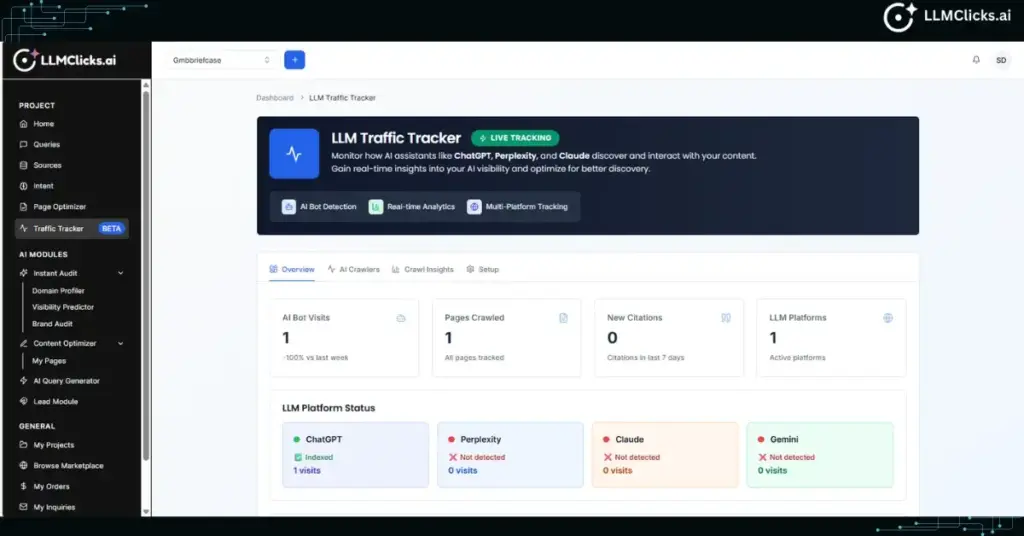
Choosing the wrong AI visibility tool does not just waste budget. It creates a false sense of security. Your dashboard looks healthy while an accuracy problem quietly works through your pipeline.
The table below is the most complete side-by-side comparison of these three tools available. Every data point was verified through direct platform testing, not pulled from marketing pages.
Head-to-Head Feature Breakdown
Feature | Otterly AI | Peec AI | |
Hallucination detection | No | No | Yes |
Pricing accuracy monitoring | No | No | Yes |
Feature misattribution detection | No | No | Yes |
LLM platforms covered | ChatGPT, Perplexity | 3 base + paid add-ons | ChatGPT, Perplexity, Claude, Gemini |
Claude tracking | No | Paid add-on | Yes |
Gemini tracking | No | Paid add-on | Yes |
Update frequency | Weekly | Daily | Real-time |
Free permanent tier | No | No | Yes |
Free trial | Limited | 7 days | Permanent free tools |
Region-based tracking | Limited | Yes, 115+ languages | Yes |
Agency reporting | Basic | Strong | Yes |
AI referral traffic tracking | No | No | Yes |
Query fan-out mapping | No | No | Yes |
Prompt-level tracking | Basic | Yes | Yes |
Competitor benchmarking | Yes | Yes | Yes |
Optimization recommendations | No | No | Yes |
Starting price | ~$49/mo | €89/mo (3 platforms) | Free tier available |
Full platform coverage cost | ~$49/mo | €150+/mo | Included in paid plan |
Best for | Early-stage monitoring | Global agency reporting | Accuracy validation and GEO |
What the Numbers Actually Mean
Three data points from this table deserve direct attention because they change how you evaluate the price difference between these tools.
Update frequency: Otterly’s weekly cycle means a hallucinated response can circulate in buyer research for up to seven days before you see it. For a SaaS company running 10 demos per week, that is a full week of prospects arriving with wrong information. Real-time monitoring is not a premium feature. For revenue-sensitive teams, it is a baseline requirement.
Full platform coverage cost: Peec’s €89 headline price covers three platforms. The moment you add Claude and Gemini, which represent a significant and growing share of AI search queries, the real cost jumps to €150 or higher. LLMClicks.ai includes all four platforms in a single plan. Over a 12-month period, the apparent price advantage of Peec disappears for any team needing complete coverage.
Free permanent tier: Neither Otterly nor Peec lets you verify your brand’s current AI accuracy before paying. LLMClicks.ai’s free AI Visibility Checker and AI Readiness Analyzer give you real data on your current situation in under two minutes. For teams building an internal business case, that is the difference between a speculative spend and a data-backed decision.
Accuracy Testing Results: What Each Tool Caught
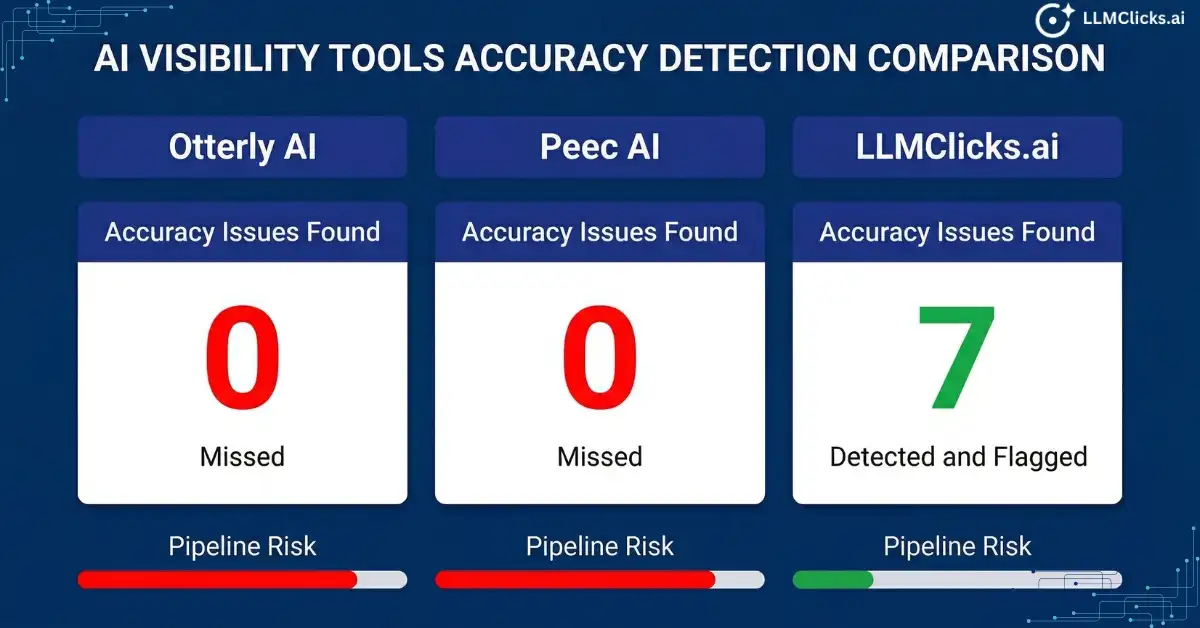
This is where the comparison stops being theoretical.
I ran the same 30-prompt test set across all three platforms using LLMClicks.ai as the benchmark for detected accuracy issues. Here is what each tool returned:
Test Metric | Otterly AI | Peec AI | |
Total brand mentions detected | €18 | 18 | 18 |
Incorrect pricing flagged | 0 | 0 | 4 |
Misattributed features flagged | 0 | 0 | 3 |
Hallucinated integrations flagged | 0 | 0 | 1 |
Outdated product information flagged | 0 | 0 | 2 |
Overall accuracy issues surfaced | 0 | 0 | 7 |
Dashboard sentiment | Positive | Positive | 7 issues requiring action |
Otterly and Peec returned identical results: 18 healthy mentions, positive sentiment, no alerts. LLMClicks.ai returned the same 18 mentions and surfaced 7 accuracy issues across 4 responses.
The 4 responses containing pricing errors had been running through our demo pipeline for months. Both competing tools classified them as positive brand signals every single week.
That is not a failure of those tools. It is a failure of the problem they were designed to solve. Monitoring and accuracy are different jobs. This test shows exactly where the line sits between them.
Most tool comparisons end with a ranking. This one ends with a question: what is the specific problem you are trying to solve?
Otterly, Peec, and LLMClicks.ai are not competing for the same buyer. Each tool solves a real problem for a real use case. Choosing the wrong one does not just waste budget. It gives you a dashboard that looks healthy while the actual problem continues unchecked.
Here are four buyer scenarios based on the most common situations teams are in when they start evaluating this category.
Scenario 1: “I just need to know if my brand shows up in ChatGPT.”
The right tool: Otterly
If your goal is basic brand awareness monitoring and you are not yet at the stage where AI accuracy directly affects revenue, Otterly is the most efficient path to that data.
Fast setup. Clean interface. Affordable entry point. For a founder or small marketing team establishing a first AI visibility baseline, it removes the friction without over-engineering the solution.
Do not over-invest at this stage. Get the baseline data, validate that AI visibility is worth tracking for your specific business, then reassess in 90 days.
When to move on from Otterly: The moment a prospect references AI-generated information about your product on a demo call, you have outgrown it.
Scenario 2: “I run an agency and need polished AI visibility reports for clients.”
The right tool: Peec AI
Peec’s structured reporting format, multi-language support, and region-based prompt tracking are purpose-built for agency workflows. If your deliverable is a monthly AI visibility report that a client can review without interpretation, Peec produces that output faster than any other tool in this comparison.
Two things to do before signing up. First, calculate the real cost with full platform coverage including Claude and Gemini add-ons. Budget for €150 per month, not €89. Second, be transparent with clients that Peec tracks visibility scores, not accuracy. If a client asks whether their AI mentions are factually correct, Peec cannot answer that question.
When to move on from Peec: When clients start asking about AI accuracy, not just AI visibility. That question is coming. The category is maturing fast.
Scenario 3: “My SaaS brand is being mentioned in AI but I don’t know if the information is accurate.”
The right tool: LLMClicks.ai
This is the use case LLMClicks.ai was built for. If you have any signal that AI platforms may be misrepresenting your product, wrong pricing quoted on a call, a competitor’s feature attributed to you, a prospect referencing an integration you do not have, you already have an accuracy problem that monitoring tools will not surface.
Start with the free AI Visibility Checker before touching the paid platform. Run your brand through it right now. If it returns accuracy issues, you have a concrete data point to take to your leadership team. If it returns clean results, you have a baseline worth monitoring over time.
The paid platform makes sense the moment accuracy issues appear in your free audit results or in your sales conversations. At that point, the question is not whether LLMClicks.ai is worth the investment. It is how many deals the accuracy problem has already cost you.
Scenario 4: “I want to test AI visibility tracking before committing to any paid plan.”
The right tool: LLMClicks.ai free tier
Run the free AI Readiness Analyzer and AI Visibility Checker before evaluating any paid platform in this category. Both tools are permanent, require no credit card, and return real data on your brand’s current AI accuracy situation in under two minutes.
The free audit answers three questions that should inform every other purchase decision in this comparison:
- Is your brand currently appearing in AI responses?
- Is the information in those responses accurate?
- How well is your content structured for AI citation?
If the free audit returns clean results and basic monitoring is your only requirement, Otterly at $49 per month may be all you need. If the free audit surfaces accuracy issues, you have your business case for LLMClicks.ai already built.
Do not pay for a tool before you know which problem you are actually solving. The free audit removes that guesswork entirely.
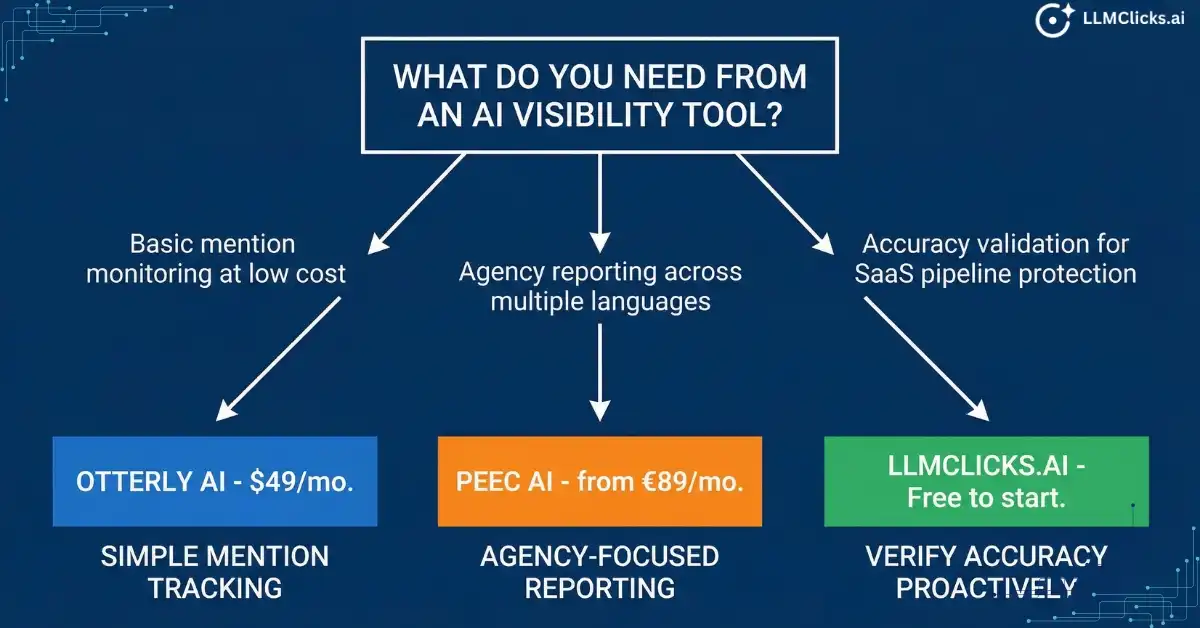
The Decision at a Glance
Your situation | Start here |
Need basic mention monitoring at lowest cost | Otterly |
Run an agency with international clients needing structured reports | Peec AI |
SaaS brand needing accuracy validation, not just monitoring | |
Not sure yet, want to see real data before spending anything | LLMClicks.ai free tools |