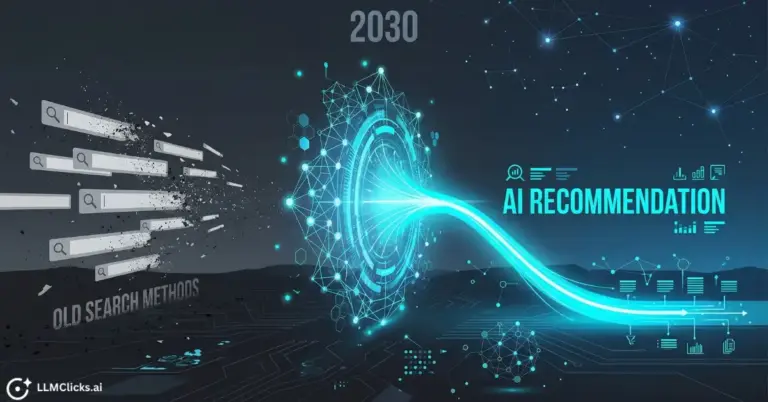
Ranking on Google used to be the finish line. Today, it’s often just the starting point.
As users turn to ChatGPT, Gemini, Claude, and Perplexity for direct answers, brand discovery is increasingly happening inside AI-generated responses, not on traditional search result pages (SERPs).
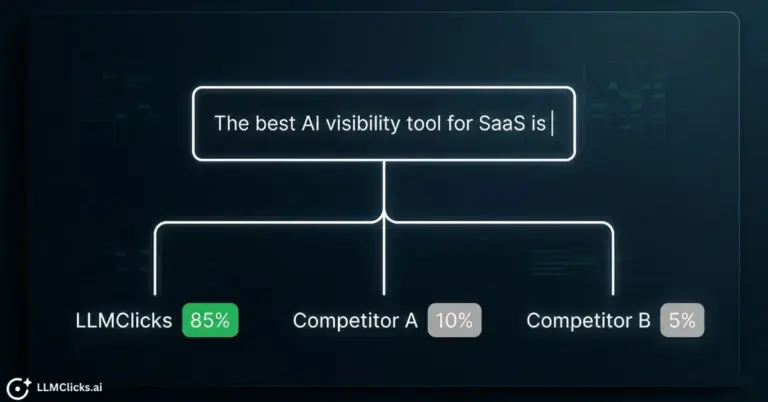
This shift changes what “visibility” really means. A brand can rank #1 in Google and still be invisible in an AI answer. Conversely, a brand with lower traditional rankings might be the primary recommendation in ChatGPT because it is “trusted” by the model’s training data.
In many cases, users never click a link at all. They accept the answer they’re given and move on.
In this article, we break down the critical difference between Traditional SEO (optimizing for retrieval) and LLM SEO (optimizing for synthesis). We explain why AI mentions are becoming more influential than rankings, and show how brands can adapt to a world where being referenced by AI matters as much as being ranked by Google.
What Is Traditional SEO? (The Retrieval Model)
Traditional SEO is the long-established practice of optimizing websites to rank higher in search engine results pages (SERPs) and earn organic traffic. It was designed for a Retrieval Model: users typed queries into Google, scanned a list of blue links, and clicked through to websites to find answers.
At its core, traditional SEO focuses on three primary outcomes:
- Higher rankings for relevant search queries.
- More organic clicks and traffic from search engines.
- Sustained visibility and authority that support leads and conversions over time.
The Core Levers of Traditional SEO
Traditional SEO relies on a set of well-defined optimization pillars:
- Keywords: Researching and targeting the terms users search for, then aligning content to match those queries.
- On-page optimization: Optimizing titles, meta descriptions, headings, internal links, and content so search engines can clearly understand page relevance.
- Backlinks: Earning links from reputable websites to signal authority and trustworthiness.
- Technical SEO: Ensuring crawlability, fast load times, mobile-friendliness, clean site architecture, and proper indexing.
Together, these levers help search engines discover, evaluate, and rank pages based on relevance and quality.
What Is LLM SEO? (The Synthesis Model)
LLM SEO (often referred to as LLM Visibility or Generative Engine Optimization) is the measure of how often, where, and in what context your brand, products, or content appear in answers generated by large language models (LLMs) such as ChatGPT, Gemini, Claude, and Perplexity.
Unlike traditional SEO, which operates on a retrieval model (finding the best link), LLM SEO operates on a Synthesis Model. The AI analyzes its vast training data and live search results, then synthesizes a single, direct answer.
In this model, there are no “rankings” in the traditional sense. There is only inclusion or exclusion. If your brand isn’t mentioned in the answer, you are effectively invisible to the user.
What LLM SEO Measures
LLM visibility is typically evaluated across four key dimensions:
- Frequency: How often your brand or content is mentioned in AI-generated responses.
- Context & Placement: Whether your brand is cited prominently, mentioned briefly, or excluded entirely, and how it is framed within the answer.
- Source Usage: Which of your pages or assets AI systems rely on when generating answers.
- Competitive Share: How visible your brand is compared to competitors within the same AI responses.
These signals together show your Share of Voice inside AI answers, not just on search result pages.
LLM SEO vs Traditional SEO: The Core Differences
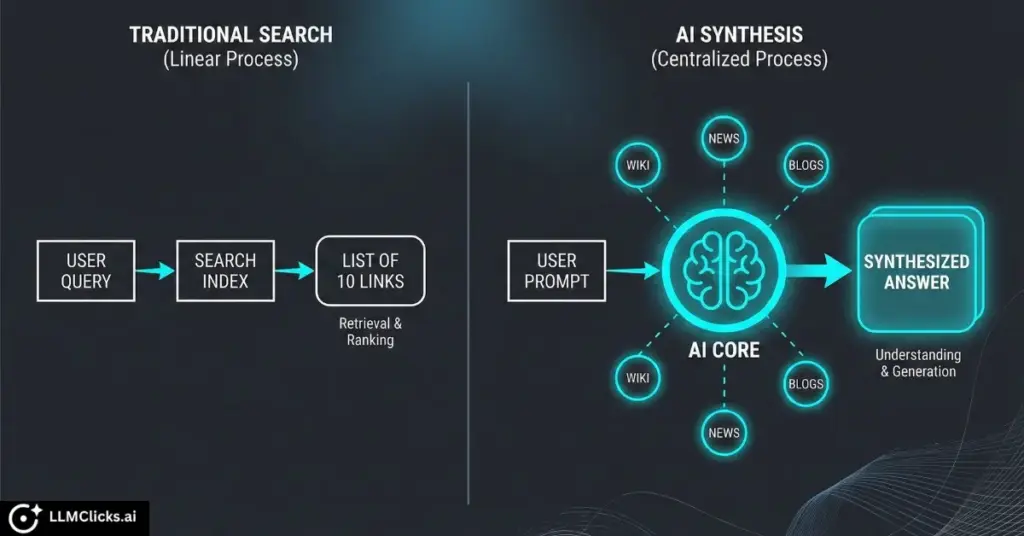
The shift from “Search” to “Answer” requires a completely different mindset. Traditional SEO and LLM SEO solve different problems. One is designed to win rankings and clicks. The other is designed to win mentions and trust inside AI-generated answers.
Understanding the distinction is critical because optimizing for one does not automatically guarantee success in the other.
Here is how the two strategies compare side-by-side:
Feature | Traditional SEO | LLM SEO (AI Optimization) |
Primary Goal | Rank #1 on a list of links | Be cited/mentioned in the answer |
User Interaction | User clicks a link to read | User reads the answer directly (Zero-Click) |
Core Metric | Organic Traffic & CTR | LLM Visibility & Share of Voice |
Content Focus | Keywords & Word Count | Entities, Context & Facts |
Authority Signal | Backlinks (Quantity/Quality) | Citations & Semantic Proximity |
Competition | Fighting for pixels on Page 1 | Fighting for a sentence in the answer |
1. The Goal: Retrieval vs. Synthesis
Traditional SEO focuses on where your page appears. LLM SEO focuses on whether your brand is included in the answer at all .
- Traditional: You win if you are retrievable. The search engine’s job is to find the best document.
- LLM SEO: You win if you are synthesized. The AI’s job is to create the best answer. It looks for information it can confidently blend together, not just pages it can list in order.
2. User Behavior: Exploring vs. Consuming
User behavior has shifted from browsing links to consuming answers. Instead of comparing multiple websites, people increasingly rely on AI systems to summarize information and guide decisions in a single response.
- The Link Explorer: In traditional search, users scan, click, and compare.
- The Answer Consumer: In AI search, the answer itself becomes the destination. Studies show that when AI summaries appear, click-through rates on traditional results drop significantly.
3. Authority Signals: Backlinks vs. Entity Confidence
Traditional SEO relies heavily on backlinks as a proxy for trust. LLM SEO relies on Entity Confidence does the AI know who you are?
- Backlinks: A page ranking #1 is not automatically the best candidate for an AI answer.
- Entity Signals: LLMs mention sources that appear authoritative across contexts, not just in one ranking snapshot. They look for consistent brand descriptions, expert commentary, and alignment with other trusted sources like Wikipedia or G2.
4. Content Depth: Keywords vs. Context
LLMs favor content that demonstrates topical depth, not shallow keyword alignment.
- Keyword Matching: Traditional SEO targets specific query strings.
- Contextual Depth: LLM SEO targets the intent behind the question. Content that explains “why,” covers edge cases, and connects concepts is easier for an AI to reuse than a generic overview written only to rank. This is why a page ranking #21 can still be cited if it explains the topic better than the #1 result.
The Psychology of the “Zero-Click” User
To understand why LLM SEO is urgent, we must understand the fundamental shift in user psychology. We are moving from an era of “Search & Sort” to an era of “Ask & Trust.”
In the traditional search model, the user burden was high. A user searching for “best project management software” had to:
- Scan 4-5 ad headlines.
- Scroll past the “People Also Ask” box.
- Click 3-4 different organic links (G2, Capterra, a blog post).
- Mentally synthesize that information to make a decision.
This “comparison fatigue” is exactly what AI solves. When a user asks ChatGPT the same question, the AI does the heavy lifting. It aggregates the data, filters out the noise, and presents a synthesized recommendation.
Why Users Are Stop Clicking Links
The decline in click-through rates (CTR) isn’t just about Google hiding links; it’s about efficiency.
- Cognitive Load Reduction: Reading one summarized paragraph is easier than reading five different blog posts.
- Perceived Objectivity: Users often trust AI summaries more than individual brand blogs, which they view as biased marketing.
- Speed: Getting an immediate answer allows the user to move to the next task instantly.
For brands, this is terrifying but critical. If your marketing strategy relies on users visiting your site to read your “About Us” page, you are optimizing for a behavior that is disappearing. You need to ensure your “About Us” value proposition is delivered inside the AI answer, because that might be the only interaction the user has with your brand.
Why AI Mentions Can Matter More Than Rankings
In this new environment, discovery is no longer driven by ranking alone. It’s driven by whether AI systems choose to include and explain your brand .
1. The “First Impression” Happens Inside the Chat
AI mentions often influence users before any traffic is generated. When someone asks ChatGPT, Gemini, or Perplexity a question, the first thing they see is not a list of websites but a narrative answer. The brands included in that answer gain immediate exposure and credibility, even if the user never clicks through to a page.
2. Positioning Power: AI Shapes Perception
AI summaries don’t just reference brands; they position them. A product can be framed as “best for beginners,” “enterprise-ready,” or “commonly used by agencies” in a single paragraph. That positioning can shape buying decisions long before a user compares pricing pages or feature lists.
3. The Risk of the “Invisible” Brand
The real risk lies in being invisible in AI answers. A brand can perform well in SEO and still be invisible in AI answers. If competitors are consistently mentioned and your brand is not, users may never reach a point where rankings matter. In many AI-driven journeys, there is no second step. The answer is the endpoint.
The Hybrid Future: Why Traditional SEO Still Matters
Is LLM SEO replacing Traditional SEO? No.
They are two sides of the same coin. In fact, most AI models today use a process called Retrieval-Augmented Generation (RAG). They first retrieve information from a search index (like Bing or Google) and then generate an answer.
This means Traditional SEO is still the foundation. You cannot be synthesized if you are not indexed.
1. Strong Domains Feed the AI
AI models prioritize “Tier 1” sources—sites that rank consistently, earn authoritative backlinks, and demonstrate expertise. A strong domain authority (DA) is still a primary signal that tells the AI, “This source is safe to cite.”
2. Technical SEO Enables Retrieval
If your content isn’t technically accessible, it won’t be retrieved by the RAG process. Core elements like clean site architecture, fast load times, and proper indexing are just as critical for AI bots as they are for Google crawlers.
3. Search Data Feeds AI Training
Evergreen content that performs well in search guides, FAQs, and documentation often becomes the “Ground Truth” for AI models. SEO doesn’t just drive traffic; it supplies the raw material that AI systems summarize.
How to Optimize for LLM SEO (Generative Engine Optimization)
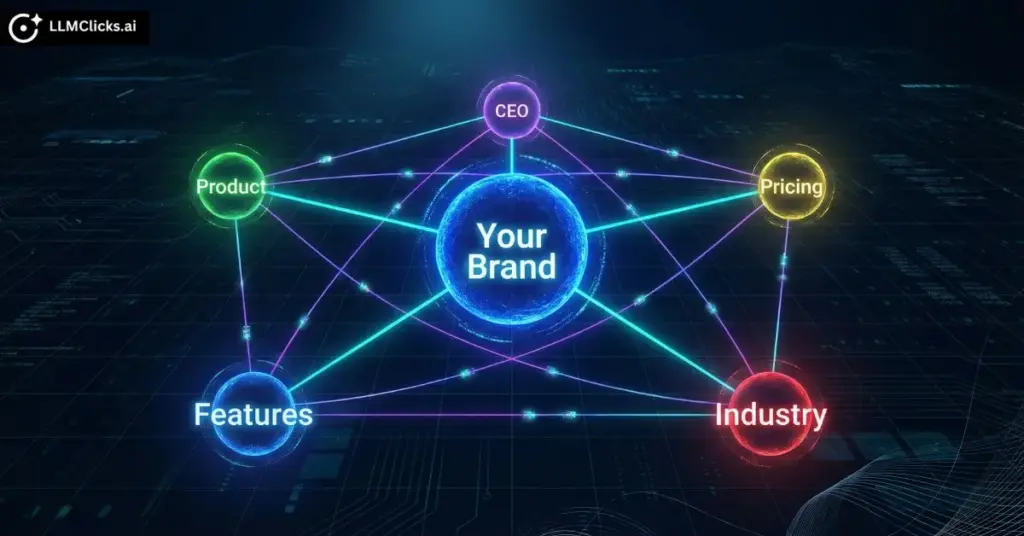
Winning in an AI-driven environment requires a shift in strategy. You aren’t just writing for humans anymore; you are formatting for machine inference .
1. Shift from Keywords to Entities
LLMs understand the world through “Entities” (people, places, concepts) and the relationships between them.
- Traditional: Optimize for “best CRM software.”
- LLM SEO: Ensure the AI understands the relationship between [Your Brand] and [CRM Software]. Use consistent natural language to define who you are: “Brand X is a CRM platform designed for small businesses.”
2. Format for “Inference” (Tables & Lists)
AI models love structure. They often extract small sections of content called “passages” rather than full pages. To increase your chances of being cited:
- Use Comparison Tables: AI models frequently cite tables when answering “vs” questions.
- Use Bullet Points: Break down complex features into lists.
- Direct Answers: Place a direct, 40-50 word definition immediately after a heading (e.g., “What is LLM SEO?”). This makes it easy for the model to grab the definition.
3. Build “Contextual Authority” (Digital PR)
LLMs rely on “Co-Citation.” If your brand is frequently mentioned alongside industry leaders in trusted publications, the AI infers that you belong in that peer group.
Strategy: Get mentioned in “Tier 1” data sources like Reddit, Wikipedia, G2, and authoritative industry news. A mention in a highly-cited Reddit thread can be worth more for Perplexity SEO than a standard backlink.
How LLMs Actually "Read" Your Website (RAG vs. Training)
Most marketers think LLMs just “know” things. In reality, LLM SEO requires optimizing for two very different retrieval methods: Training Data and RAG (Retrieval-Augmented Generation).
1. The “Long-Term Memory” (Training Data)
This is the information the AI learned during its initial training (e.g., GPT-4’s knowledge cutoff).
- How to Influence It: This is a long game. You need high-volume, consistent brand mentions across the web over years.
- The Tactic: “Entity Density.” You must ensure your brand is consistently described the same way on Wikipedia, Crunchbase, LinkedIn, and your homepage. If your homepage says you are an “AI Agency” but your LinkedIn says “Digital Marketing Firm,” the AI gets confused and may hallucinate or ignore you.
2. The “Short-Term Memory” (RAG / Live Search)
This is how Perplexity, Bing Chat, and Gemini work. They search the live web right now to answer a question.
- How to Influence It: This is closer to traditional SEO but faster.
- The Tactic: “Passage Optimization.” These engines look for short, clear paragraphs that answer specific sub-questions. If your content is buried in a 40-minute video or a PDF, the live crawler might miss it .
3. The “Context Window” (User Uploads)
Users now upload PDFs and URLs directly to ChatGPT to “summarize this.”
- The Tactic: “Document Structure.” Use clear H1s, H2s, and bullet points. If your whitepaper is a messy design-heavy PDF that a bot can’t parse, you lose visibility in these private analysis sessions.
Optimization Strategies by Platform
Not all Answer Engines are the same. A strategy that works for ChatGPT might fail for Perplexity. Here is the nuance:
- Optimizing for Perplexity (The “Citation Engine”) Perplexity is essentially a citation machine. It heavily weights Academic & Data Sources.
- Strategy: Publish original data studies. If you publish a “2026 Industry Report” with unique statistics, Perplexity is highly likely to cite you when answering questions about trends.
- Format: Use data tables. Perplexity’s crawler loves extracting rows and columns to build its own summary tables.
- Optimizing for ChatGPT (The “Logic Engine”) ChatGPT relies more on logic and consensus. It looks for patterns in its training data.
- Strategy: “Consensus Marketing.” You need to appear in the “Best of” listicles on third-party sites. If 10 different high-authority blogs list your tool as a “Top 5 CRM,” ChatGPT identifies that pattern as a fact.
- Format: Clear definitions. Start your blog posts with “What is [Topic]? [Topic] is…” This definitional structure feeds the logic model.
- Optimizing for Google Gemini (The “Ecosystem Engine”) Gemini has a unique advantage: it can read Google Maps, YouTube, and Google Flight data.
- Strategy: “Multimodal SEO.” You must optimize your YouTube video transcripts and Google Business Profile. Gemini will often pull a YouTube video to answer a “How-to” question where ChatGPT would write text.
Format: Video Chapters. distinct timestamps in your YouTube videos allow Gemini to jump to the exact second that answers the query.
Measuring Success: SEO Metrics vs. LLM Metrics
You can’t manage what you don’t measure. As you pivot to LLM SEO, your KPI dashboard needs to evolve beyond Google Analytics.
Traffic-only metrics are insufficient because they don’t capture the “Zero-Click” influence of an AI answer.
The New KPI Dashboard

To understand your true visibility, you need to track:
- Share of Voice (SoV): In a set of 50 prompts related to your industry, how many times is your brand mentioned?
- Sentiment Analysis: When the AI mentions you, is it positive (“highly recommended”), neutral (“an option”), or negative (“users report bugs”)?
- Accuracy Rate: Is the AI describing your pricing and features correctly, or is it hallucinating outdated info?
- Citation Frequency: How often are your links provided as a footnote in Perplexity or Bing Chat?
Manual vs. Automated Tracking
You can manually test prompts in ChatGPT, but it doesn’t scale. Results change based on user history and model updates. For reliable data, brands use AI visibility tools (like LLMClicks.ai) to automate the testing of hundreds of prompts daily, providing a consistent benchmark of performance .
Why “Sentiment” Is the New “Click-Through Rate”
In Traditional SEO, a high ranking was enough. In LLM SEO, how you are ranked matters more.
Imagine a user asks, “Is [Your Brand] worth the price?”
- Scenario A: The AI says, “Yes, [Your Brand] is expensive but offers market-leading security features.” -> Sentiment: Positive/Justified.
- Scenario B: The AI says, “Users often complain that [Your Brand] is expensive for the features provided.” -> Sentiment: Negative.
Both answers might reference your pricing page (same visibility), but Scenario B kills the sale immediately.
How to audit Sentiment:
- The “Adversarial Prompt” Test: Don’t just ask “What is [Brand]?” Ask “What are the downsides of [Brand]?” or “Why should I NOT buy [Brand]?”.
- The Competitor Pivot: Ask “Why is [Competitor] better than [Brand]?” The AI’s answer will reveal your perceived weaknesses (e.g., “Competitor X is better because it has a mobile app”).
- The Fix: You cannot edit the AI. You must edit the source. If the AI says you lack a mobile app (and you recently launched one), you need to update your App Store listing, issue a press release, and update your “Features” schema to explicitly state “Mobile App: Available.”
This shift from “ranking” to “reputation management” is why we call it LLM Visibility, it’s about being seen correctly, not just being seen.
Conclusion: The Hybrid Future
Is LLM SEO replacing Traditional SEO? No. It’s an expansion.
Traditional SEO builds the infrastructure: the authority, the technical health, and the reach. LLM SEO ensures that authority is translated into the new language of AI mentions, citations, and trust.
The brands that win in 2026 won’t choose one over the other. They will combine both to stay visible across SERPs and AI-driven answers.
The question isn’t whether AI will mediate discovery, it already does. The real question is whether your brand is being understood accurately where those answers are formed.
Frequently Asked Questions (FAQs)
Q1. What is the difference between LLM SEO and Traditional SEO?
Ans: Traditional SEO focuses on ranking web pages in search engines to drive clicks (Retrieval). LLM SEO (or LLM Visibility) focuses on optimizing content so it is cited, summarized, and trusted in direct answers by AI models like ChatGPT (Synthesis).
Q2. Does Traditional SEO still matter for AI visibility?
Ans: Yes. Most AI models use “Retrieval-Augmented Generation” (RAG), meaning they rely on search indexes to find information. Strong Traditional SEO ensures your content is indexed and “retrievable” by the AI before it can be synthesized.
Q3. Why do AI tools cite lower-ranking pages?
Ans: AI tools prioritize “Information Gain,” clarity, and semantic relevance. A page ranking #15 on Google might be cited by ChatGPT because it answers the specific question more directly and concisely than the #1 ranking page .
Q4. How do I audit my brand’s LLM SEO performance?
Ans: To audit visibility, run a series of branded and non-branded prompts across major AI models (ChatGPT, Gemini, Perplexity). Analyze the responses for Frequency (are you there?), Sentiment (is it positive?), and Accuracy (is it true?). Tools like LLMClicks.ai can automate this process.
Q5. How can I improve my LLM Visibility?
Ans: Focus on Entity Density (clear definitions of who you are), Formatting (using tables and lists for easy extraction), and Contextual Authority (getting cited in trusted sources like Reddit and G2).