The Problem: Every prediction about AI search in 2030 tells you the future is agentic, personalized, and LLM-driven. None of them tell you where your brand actually stands today or what to do in the next 90 days to build toward that future.
The Research: This guide covers six validated trends reshaping brand discovery by 2030. We will unpack the 63/37 visibility framework that determines how much of your LLM presence you can actually control. We will also break down a five-step strategy that works right now and compounds toward 2030.
The Payload: By the end of this post, you will know exactly what LLM visibility is, why it will define your brand's discoverability by 2030, and how to start building the technical and content signals that matter before your competitors do.
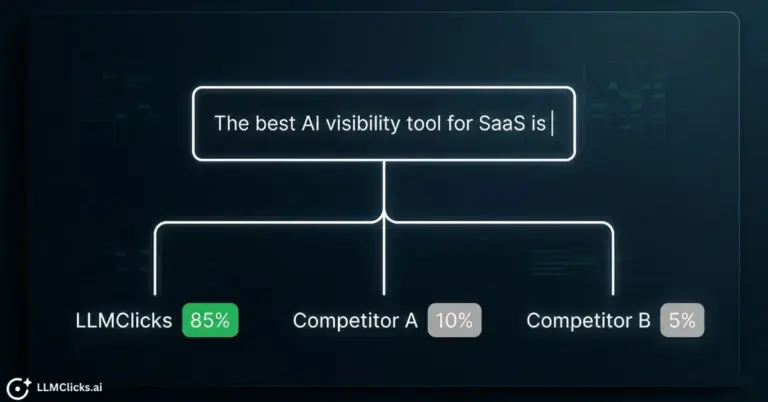
A buyer opens ChatGPT and types a simple prompt: “What is the best AI visibility platform for a SaaS team?”
ChatGPT returns three options. Your brand is not one of them. Your competitor is recommended instead. Why? Because that competitor has been consistently mentioned in AI-cited listicles, review sites, and comparison content for the past 18 months.
That buyer shortlists their tools, books demos, and makes a purchasing decision without ever seeing a Google result. They never typed a search query in the traditional sense. They asked an AI and trusted the answer.
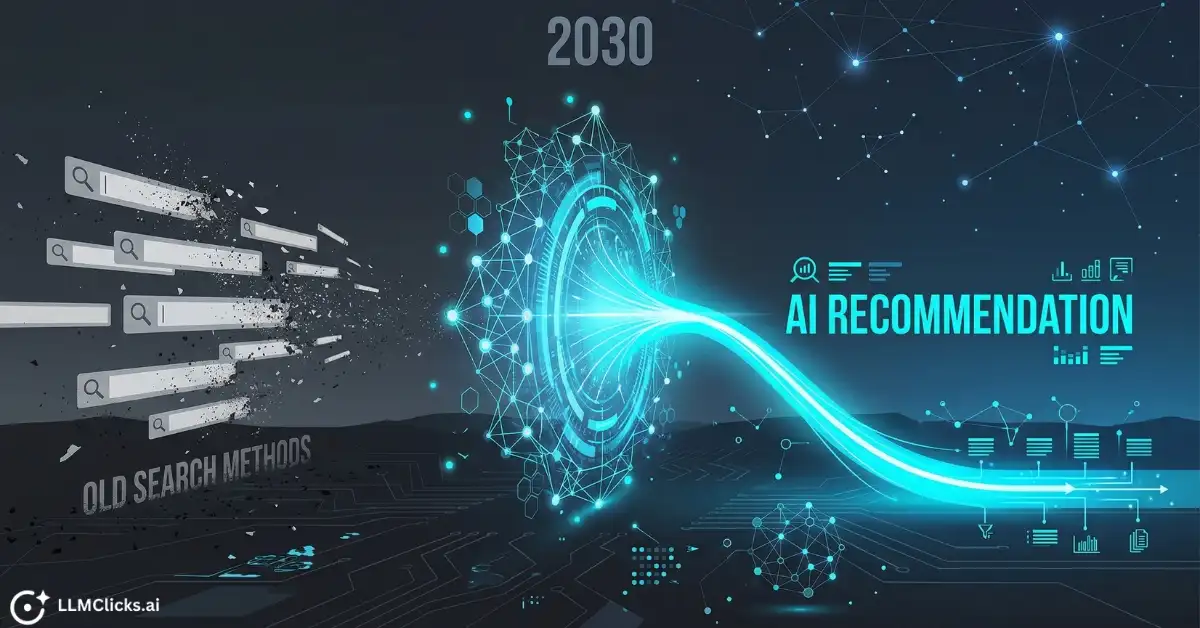
This is not a 2030 prediction. This is happening right now in 2026. What changes by 2030 is the scale, the sophistication, and the permanence of this dynamic.
This guide covers what LLM visibility will look like at the end of the decade. We will look at which trends are already irreversible and what brands and agencies need to start building today to compound into a visibility moat over the next four years.
If you are trying to figure out how to improve brand visibility in AI search engines, you have likely noticed a massive gap in actionable advice. The data tells the story: thousands of SaaS marketers are searching for this exact solution every month with essentially zero useful content addressing the actual mechanics. That is the exact gap this guide is built to close.
What Is LLM Visibility? The Metric That Replaces Search Rankings
If you look at the keyword data, people are already searching for definitions. They want to know what LLM visibility actually is.
Here is the exact definition: LLM visibility is the measure of how frequently and accurately your brand appears in AI-generated responses across large language models including ChatGPT, Perplexity, Gemini, and Claude when users ask questions relevant to your product category.
It is not a single number. It has three distinct components that most tracking platforms completely ignore:
Visibility score: The percentage of relevant prompts in which your brand is mentioned. If ChatGPT mentions your brand in 6 out of 10 category queries, your visibility score is 60%.
Position: Where your brand appears in the AI response. Earning the first mention in a bulleted list of three is vastly different from a brief, passing mention buried in the fourth paragraph.
Sentiment: Whether the AI response describes your brand accurately and positively. A hallucinated response that quotes the wrong pricing and still mentions your brand is not positive visibility. It is a pipeline leak.
Most SaaS brands tracking LLM visibility today are only measuring the first component. The brands that will actually win by 2030 are measuring all three.
Why Traditional Search Rankings No Longer Predict AI Visibility
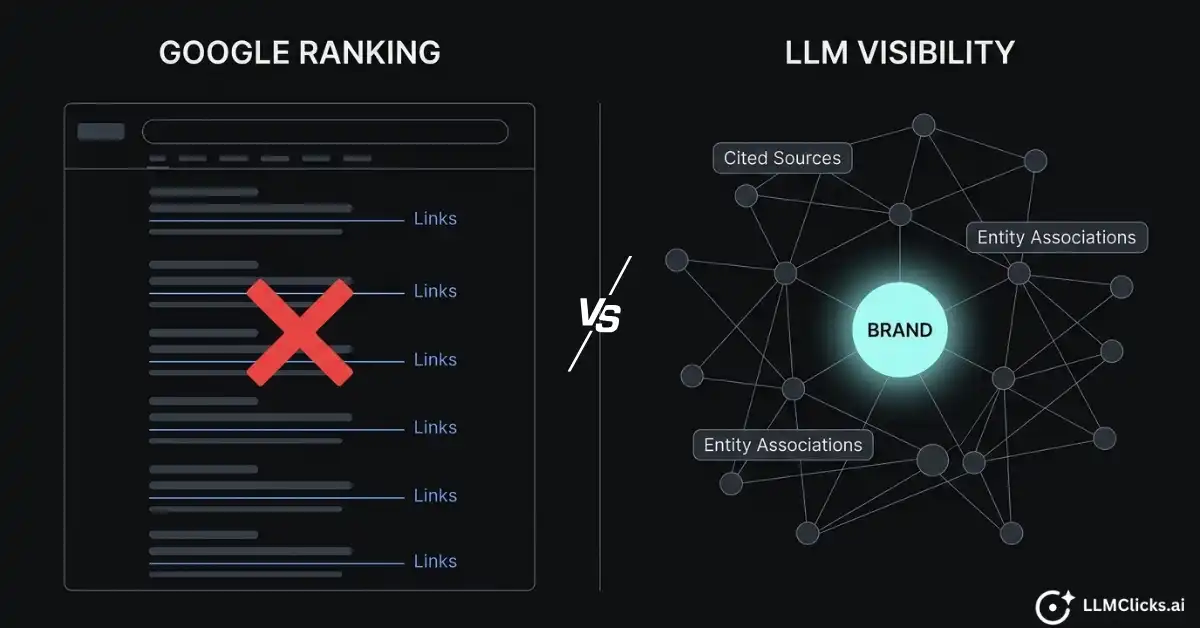
The rules of the game have changed. Optimizing for a web crawler is not the same as optimizing for a neural network’s training weights.
Traditional SEO Signal
LLM Visibility Signal
Google ranking position
Mention frequency across prompts
Organic click-through rate
Presence in AI-cited source domains
Backlink profile
Semantic co-occurrence in training data
Page authority
Brand entity encoding in model weights
Keyword density
Narrative clarity and structural data quality
Monthly search traffic
AI referral traffic and citation rate
This shift is not theoretical. It is measurable, and analysts are already sounding the alarm. Gartner predicts a potential 50% or greater decrease in organic search traffic by 2028 as generative AI search engines become the primary way users find recommendations. That 50% decline is not a future threat. It is a current, active migration. Brands measuring their performance exclusively through Google Search Console are flying blind for a rapidly growing share of their buyer pipeline.
The 63/37 Rule: Why Most of Your AI Visibility Is Already Determined
This is the framework no one else is talking about. It is the single most actionable data point in the entire AI search conversation.
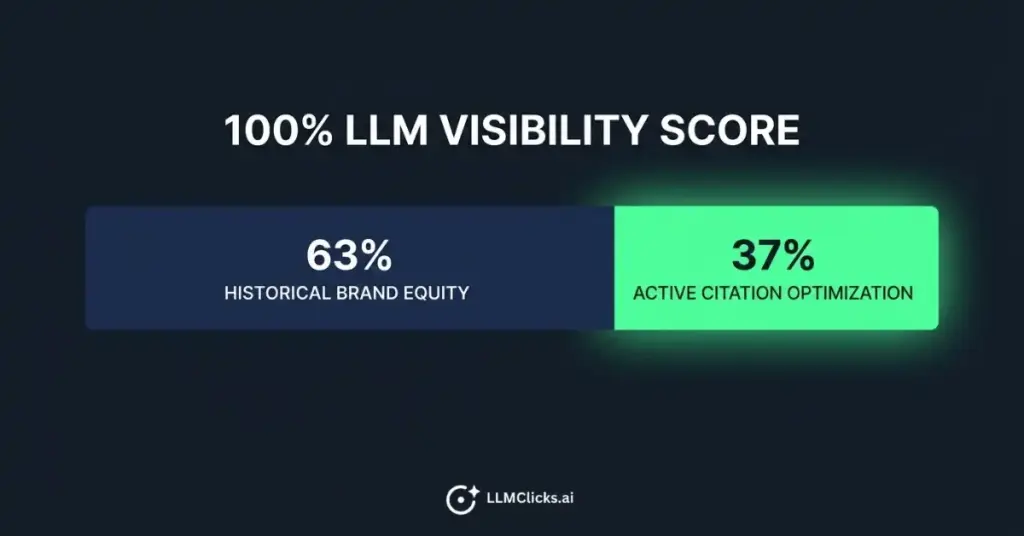
Research shows that 63% of your LLM visibility is driven by historical brand equity. This refers to the accumulated digital footprint your brand has built over time, which has already been ingested into model training data. The remaining 37% is controlled by active citation optimization. This involves the structured content, schema, listicle placements, and authoritative source coverage that brands build deliberately right now.
This framework has two critical implications for your marketing strategy.
Implication 1: The baseline is already set.
If your brand has published consistent, high-quality content in authoritative sources for the past five years, you are starting with a massive advantage. If you were late to content marketing or have a thin digital footprint, you cannot simply wait for AI models to find you. Catching up requires deliberate active optimization.
Implication 2: The 37% is your leverage point.
Active citation optimization is the only part of LLM visibility you can move quickly. This is where you apply Generative Engine Optimization (GEO) strategies. Targeting listicle placements, utilizing structured data, and building RAG-optimized content contribute to measurable visibility improvements within weeks rather than years.
What Makes Up the 63% Brand Equity Component?
This foundational component cannot be changed overnight. It is built from:
The volume and quality of pre-training data referencing your brand across independent sources.
The consistency of your brand-to-category associations across the indexed web before the model’s training cutoff date.
The depth of entity encoding built from years of brand mentions in highly trusted domains.
The frequency with which your brand appeared in “Top 10” and “Best of” lists that were indexed before model training.
This equity compounds over time. Brands that understand this dynamic invest heavily in building training signals consistently rather than sprinting just before a major product launch.
What the 37% Active Optimization Controls
The active component responds to the tactics you can execute this quarter:
Structured content with FAQPage schema that RAG-powered LLMs retrieve at inference time.
Listicle placements in the exact domains that AI platforms already cite for your category queries.
Citation source coverage across the websites that models reference when answering buyer questions.
Accurate, current brand information that actively corrects the hallucination risk stemming from outdated training data.
This 37% is exactly what we built our infrastructure to optimize. If you need to move the needle immediately, leveraging anAI Listicle Marketplace specifically targets this active component. It places your brand squarely in the AI-cited content that shapes what current retrieval engines cite and what future models learn about your software category.
6 Trends That Will Define LLM Visibility by 2030
The landscape is shifting faster than most marketing teams can adapt. Here are the six irreversible trends that will dictate how buyers find your software by the end of the decade.
Trend 1: Agentic Search Will Make Recommendations Transactional
By 2030, AI agents will not just recommend brands. They will act on behalf of buyers. These agents will book demos, compare pricing tiers, and shortlist vendors without the buyer ever touching a browser. Analysts already project massive financial impacts for companies that ignore this shift. Gartner predicts that software vendors failing to redesign their applications for agentic execution could face margin compression of up to 80% by 2030.
For SaaS brands, this means your pricing page, your demo booking flow, and your feature documentation must be entirely machine-readable. An AI agent that cannot parse your pricing or extract your key differentiators from your product pages cannot recommend you.
You need to take action today:
Build clean, structured pricing pages with explicit comparison data.
Ensure demo booking systems have API-accessible availability.
Format feature documentation in structured, extractable formats.
Apply schema markup that expresses your product as an actionable entity rather than just a web page.
By 2030, the question is not whether your page contains the right keywords. The question is whether your brand is encoded as a trusted authority in the semantic space of the model’s embedding layer.
This is what “semantic clarity” means in practice. When an LLM processes the term “AI visibility platform”, the brands that appear in the response are the ones whose names consistently co-occur with that term across authoritative, independent sources in the training data. Keyword-heavy pages that lack semantic coherence across independent sources will no longer build this authority. The entire SEO investment will shift from on-page keyword density to cross-domain entity association.
Trend 3: Personalized AI Will Fragment Visibility Metrics
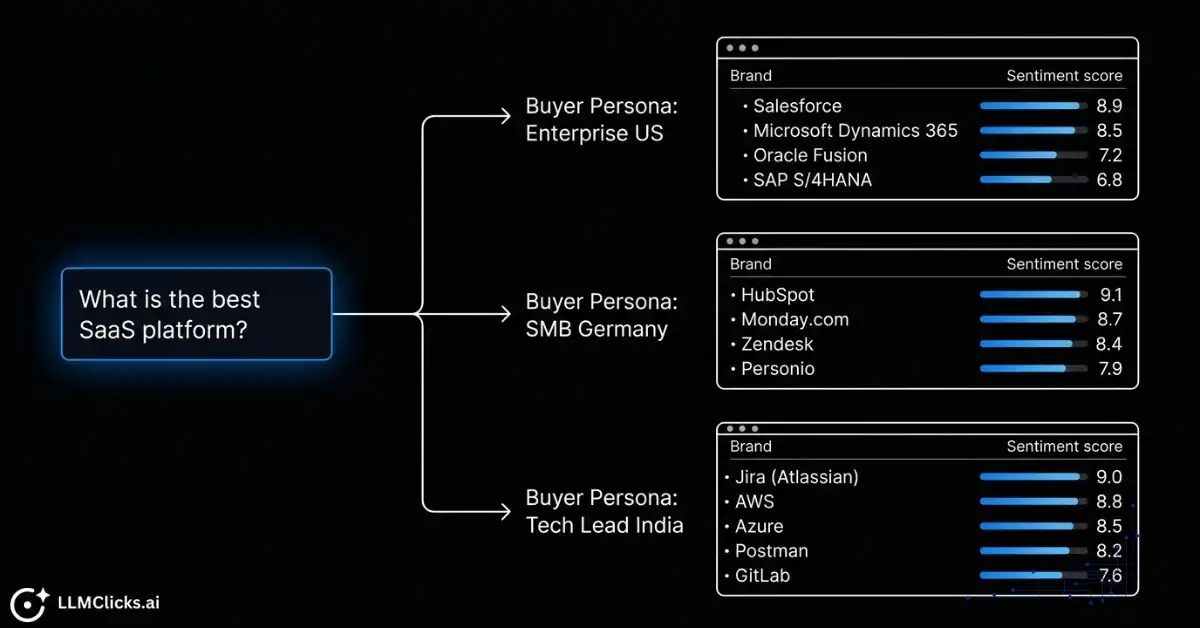
By 2030, AI search will not return the same answer to every single user. Responses will be hyper-personalized based on location, behavior history, device context, and prior conversational history. Your brand may appear for a buyer in the United States who has previously shown interest in enterprise tools, but you might vanish for a buyer in Germany asking the exact same question.
This makes aggregate visibility scores completely meaningless. Prompt-level, segmented visibility tracking will become essential. This fragmentation is exactly whythe AI Visibility Tracker runs prompt sets across multiple configurations. It surfaces visibility variation by context so you can see exactly where you are losing ground.
Trend 4: The Rise of the AI Visibility Manager
A brand new job function is emerging. By 2030, mid-to-large SaaS companies will employ dedicated AI Visibility Managers. This role will be responsible for monitoring brand representation across LLMs, coordinating content strategy with training signal objectives, and correcting hallucinations before they compound into permanent brand equity damage.
Today, these responsibilities are scattered across SEO managers, content strategists, and PR teams. This fragmentation causes massive visibility gaps that no single person owns. If you are a marketing leader, you must start defining these responsibilities now. The brands with designated AI visibility ownership will compound their results much faster than the brands treating it as a secondary task.
Trend 5: Hallucination Becomes a Strategic Brand Risk
As AI search becomes the primary discovery channel, inaccurate AI-generated content about your brand becomes a strategic liability rather than a minor nuisance. A confident ChatGPT response quoting your outdated pricing to a buyer costs you a deal before the conversation even starts.
The data on this is alarming. Recent industry studies show that users exposed to AI summaries are 30% more likely to accept incorrect information as fact. Furthermore, in e-commerce and software environments, hallucinations can negatively impact product recommendation accuracy by up to 25%. Even top technology executives recognize the severity of this issue. Dana Rao, Executive Vice President and Chief Trust Officer at Adobe, recently noted that one of the biggest dangers of AI is unintentional harm caused by datasets misrepresenting facts or introducing bias.
By 2030, forward-thinking brands will treat hallucination monitoring as a standard part of brand management. The question will not be “do you monitor your Google reviews” but “do you monitor what AI says about your pricing and features”.
Trend 6: LLM Visibility Becomes the Primary KPI for Digital Marketers
By 2030, organic search traffic as a primary KPI will be replaced by AI visibility metrics. Marketing teams will measure visibility scores, response positions, sentiment accuracy, and citation rates. Teams that are already tracking these dimensions will have years of historical trend data that later-moving competitors simply will not possess.
The measurement infrastructure needs to be built right now. Recent analysis indicates that generative AI features are actively intercepting the commercial and transactional stages of the buying journey. AI Overviews are currently appearing on over 18% of commercial queries and nearly 14% of transactional queries. Waiting until 2028 to start tracking LLM visibility means starting entirely from scratch while your competitors operate on years of optimization feedback loops.
5 Strategies to Improve Brand Visibility in AI Search Engines Starting Today
Predicting the future is useless if you do not know what to execute this quarter. Here are the five active citation optimization strategies that move the needle right now.
Strategy 1: Audit Your Current LLM Visibility Baseline
Before you optimize anything, you need to know exactly where you stand across visibility score, position, and sentiment accuracy. You cannot measure progress without a starting point.
The fastest way to get this baseline is to run ourfree AI Visibility Checker. It returns your exact status across ChatGPT, Perplexity, and Gemini in two minutes. If you want to dig deeper into specific pipeline risks, a comprehensive120-point AI Brand Audit will surface accuracy issues at the level of specific pricing and feature claims. Start with the measurement infrastructure before you spend a dime on optimization.
Strategy 2: Build Active Citation Coverage in AI-Cited Sources
The 37% active optimization component is directly influenced by which specific sources cite your brand. You need to find the exact domains that ChatGPT and Perplexity already cite when answering category queries in your space.
This is not a generic SEO link-building strategy. It is a targeted citation-building strategy. You can use aCitation Source Analyzer to identify the exact domains shaping AI responses for your category. Once you have that list, your sole objective is to get your brand featured on those specific websites.
Strategy 3: Structure Your Content for RAG Retrieval
For LLMs that use retrieval augmentation like Perplexity, ChatGPT with browsing, and Gemini, structured content always wins. Pages that answer specific questions directly are significantly more likely to be retrieved and cited than promotional prose.
Here is the practical implementation checklist:
Add FAQPage schema to every single page that answers a specific buyer question.
Write with an answer-first structure. Put the most important information in the first 100 words.
Use structured comparison tables for all pricing and feature information.
Implement SpeakableSpecification schema on pages you want cited in voice and AI responses.
Keep key brand facts cleanly formatted near the top of relevant landing pages.
Strategy 4: Place Your Brand in AI-Cited Listicles
The 63% brand equity component takes years to build. However, the 37% active component can be moved quickly through deliberate listicle placement. “Top 10” and “Best of” listicles in your category are the specific content structures that generative engines use to build category recommendation models.
Getting placed in the listicles that AI platforms already cite produces a training signal that compounds. A placement in a high-relevance domain today becomes future model training data tomorrow. This is precisely what theAI Listicle Marketplace is designed to do. It connects your brand directly to the AI-cited publishers who own the content that dictates market visibility.
Strategy 5: Monitor, Measure, and Correct Continuously
LLM visibility is not a one-time technical fix. Model training cycles update. Competitor brands build visibility while yours fluctuates. Citation sources change their content. Hallucinations compound.
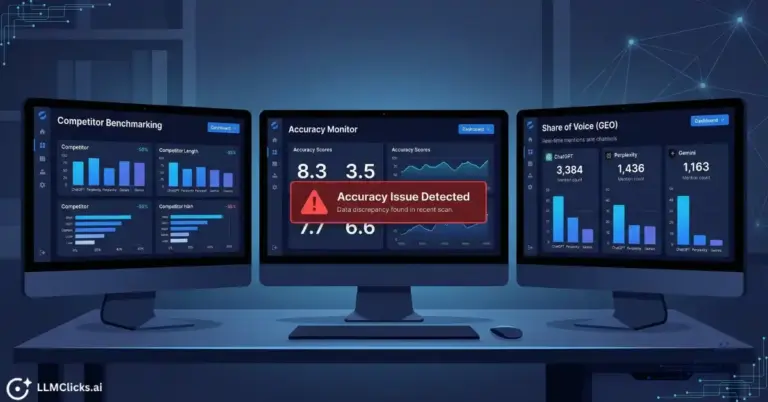
The brands that win the 2030 AI visibility landscape are the ones that build a continuous monitoring loop now. Daily monitoring with automated alerts for visibility drops, hallucination detections, and competitor position changes is exactly what anAI Visibility Tracker handles. The true competitive advantage is not the tool itself. The advantage is the years of trend data the tool accumulates for brands that start tracking early.
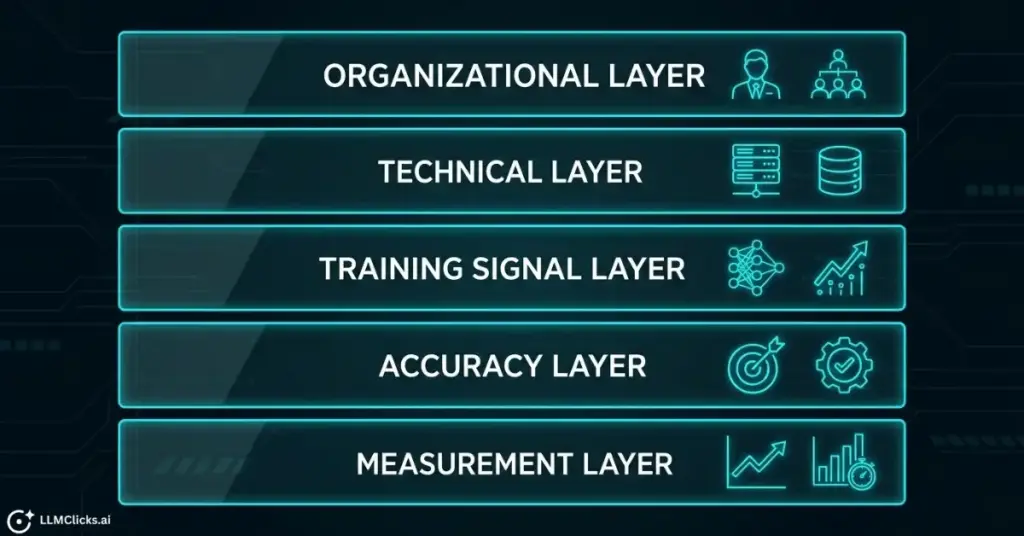
The AI Visibility Stack for 2030: What Forward-Thinking SaaS Teams Are Building Now
To prepare for 2030, you need to transition from ad-hoc tactics to a mature AI visibility practice. Here is what the complete stack looks like for top-tier SaaS teams.
The Measurement Layer
Continuous monitoring of visibility score, position, and sentiment across ChatGPT, Perplexity, Gemini, Claude, and emerging LLMs. This data is segmented by geography, prompt cluster, and buyer persona to account for AI personalization.
The Accuracy Layer
Active hallucination detection and correction workflows. Teams monitor for outdated pricing, misattributed features, and competitive confusion in AI-generated responses. Structured content updates are routinely pushed to correct retrieval systems.
The Training Signal Layer
Systematic placement in AI-cited listicles and comparison content. Consistent brand-to-category association building across independent, authoritative sources. This is the long-term brand equity investment that compounds into your 63% visibility baseline.
The Technical Layer
Structured data implementation across all product and feature pages. Proper llms.txt configuration for AI bot governance. An API-first content architecture built specifically for agentic search readiness.
The Organizational Layer
Designated AI visibility ownership within the marketing team. Defined workflows for hallucination crisis incidents. Quarterly LLM visibility audits benchmarked against competitor baselines.
The Window to Build Your LLM Visibility Moat Is Open Right Now
By 2030, brand visibility in AI search will be determined entirely by decisions made in 2025 and 2026. The 63% of visibility that comes from historical brand equity is being built right now by every brand showing up in authoritative content and structured knowledge sources.
The 37% you can actively control is available to move today. You can build citation coverage in AI-cited sources, structure your content for RAG retrieval, correct hallucinations, and establish systematic monitoring.
The brands sitting on this will not lose ground slowly. AI search does not decline gradually. It completely replaces the prior channel as buyers shift their discovery behavior. The transition is already visible in the data.
Run thefree AI Visibility Checker to see exactly where your brand stands across ChatGPT, Perplexity, and Gemini right now. The audit takes two minutes. It shows you your current visibility score, active hallucination issues, and which competitors are currently beating you. That is your 2030 baseline. Start building.
Frequently Asked Questions
Q1. What is LLM visibility?
Ans: LLM visibility is the measure of how frequently and accurately your brand appears in AI-generated responses from large language models including ChatGPT, Perplexity, Gemini, and Claude. It has three core components: visibility score, position, and sentiment accuracy.
Q2. How do I improve brand visibility in AI search engines?
Ans: Start by auditing your current LLM visibility baseline. Then build active citation coverage in the specific domains that AI search engines already cite for your category. Structure your content for RAG retrieval using FAQPage schema and answer-first formatting. Finally, place your brand in AI-cited listicles to build a permanent training signal.
Q3. Why should I track AI brand visibility?
Ans: AI search is rapidly becoming the primary discovery channel for B2B buyers. Analysts project a massive decline in traditional organic search traffic by 2028 as buyers shift to AI-generated answers. If you are not tracking how your brand appears in AI responses, you are completely blind to a growing share of your buyer pipeline.
Q4. What is the difference between AI visibility and traditional SEO?
Ans: Traditional SEO measures your ranking position in Google search results based on crawl signals and backlinks. AI visibility measures whether AI platforms recommend your brand based on training data representation, semantic co-occurrence, and RAG retrieval eligibility.
Q5. What strategies will matter most for LLM visibility by 2030?
Ans: The most critical strategies include building semantic authority across authoritative sources, structuring content for agentic search, placing brands in AI-cited listicles, implementing hallucination monitoring, and establishing continuous LLM visibility measurement.
Q6. How is the 63/37 framework relevant to my AI visibility strategy?
Ans: Research shows 63% of LLM visibility comes from historical brand equity accumulated in model training data. The remaining 37% comes from active citation optimization like structured content, schema, and listicle placements. You must aggressively target the 37% for immediate leverage while consistently building the longer-term brand equity component.
Q7. Which platforms should I track for AI search visibility?
Ans: At a minimum, you must track ChatGPT, Perplexity, Google Gemini, and Claude. These four platforms account for the vast majority of current commercial AI search usage. Multi-platform monitoring with automated alerts is essential for any modern SaaS marketing team.
Shripad Deshmukh
Shripad Deshmukh is a 4x SaaS founder with 15 years of SEO expertise. After building industry-leading platforms like GMB Briefcase and Agency Simplifier, he founded LLMClicks.ai. Today, Shripad pioneers Generative Engine Optimization (GEO) to help brands engineer technical visibility across AI search engines like ChatGPT, Perplexity, and Gemini.