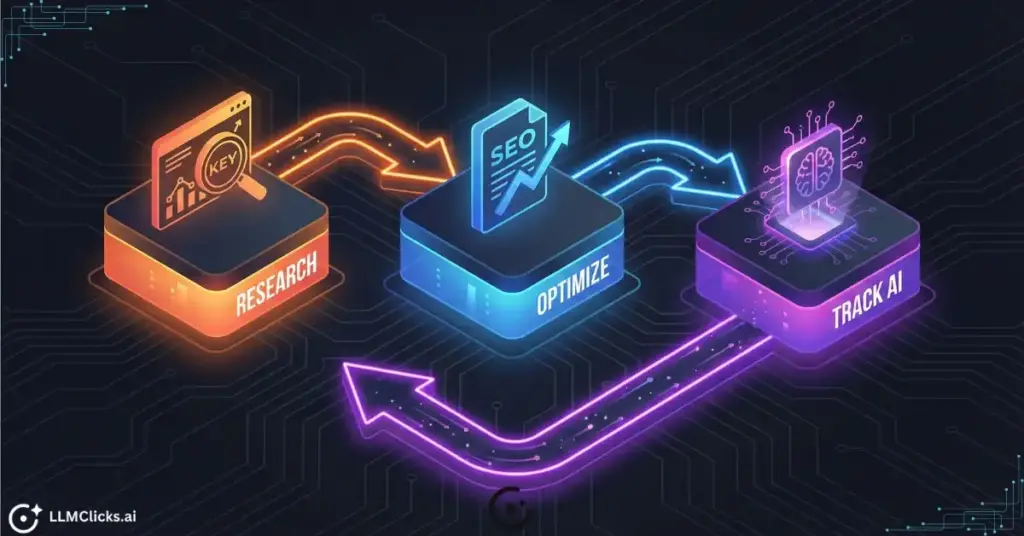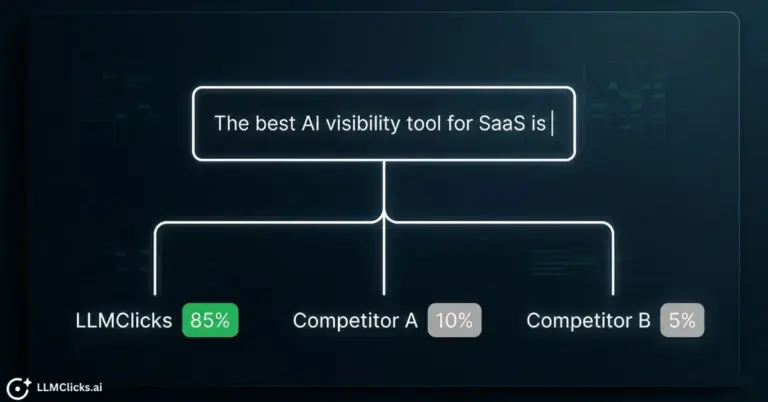
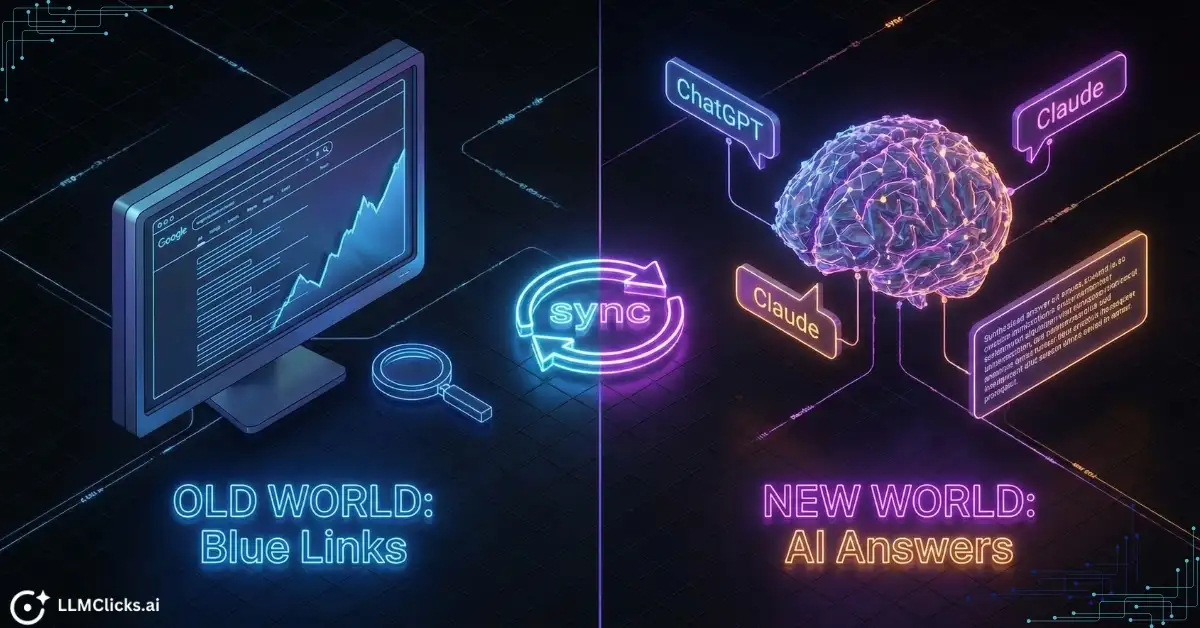
The software selected below represents the new standard for digital visibility. We prioritized tools that offer unique data, accurate analytics, and the ability to track your performance across the entire search landscape.
1. LLMClicks.ai
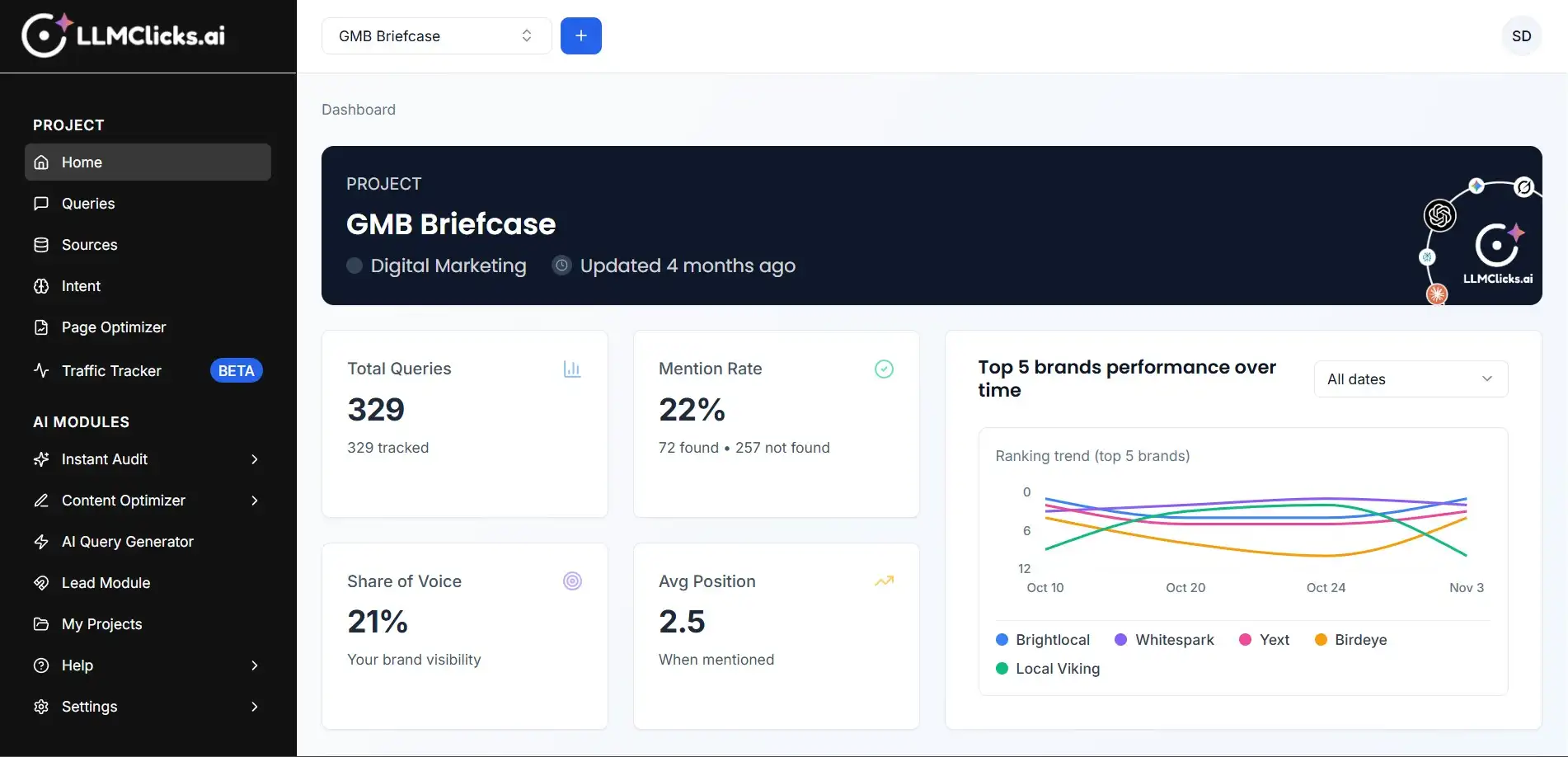
Most marketers have no idea what ChatGPT or Perplexity is saying about their brand. They manually type prompts into a chat window and hope that one personalized answer represents reality. LLMClicks.ai solves this massive blind spot. If Google Search Console is your dashboard for the open web, LLMClicks is your dashboard for the black box of AI. It is the premier LLM SEO tracking software on the market.
- Best For: Enterprise SaaS companies, SEO agencies, and marketing teams looking for the best AEO tools for enterprises to measure AI search visibility and track their true Share of Voice.
- Key Features:
- LLM SEO Checking Tools: The dashboard provides a clear Mention Rate and Share of Voice across platforms like ChatGPT, Claude, Gemini, and Perplexity.
- Hallucination & Sentiment Tracking: It analyzes responses as Positive, Neutral, or Negative to provide critical AI Brand Reputation Management.
- Source Citation Rankings: It identifies exactly which third-party websites the AI is citing to form its answer.
- Pros:
- Tracks real conversational prompts at scale without the severe personalization bias of manual testing.
- Highlights exact competitor gaps so you know exactly when you are losing high-intent pipeline queries.
- Cons:
- Focuses strictly on generative visibility and requires pairing with a traditional tool like Semrush for legacy keyword volume data.
- The advanced query fan-out features require a slight learning curve for marketers new to prompt engineering.
- Pricing: Starts at $49/month.
2. Semrush One
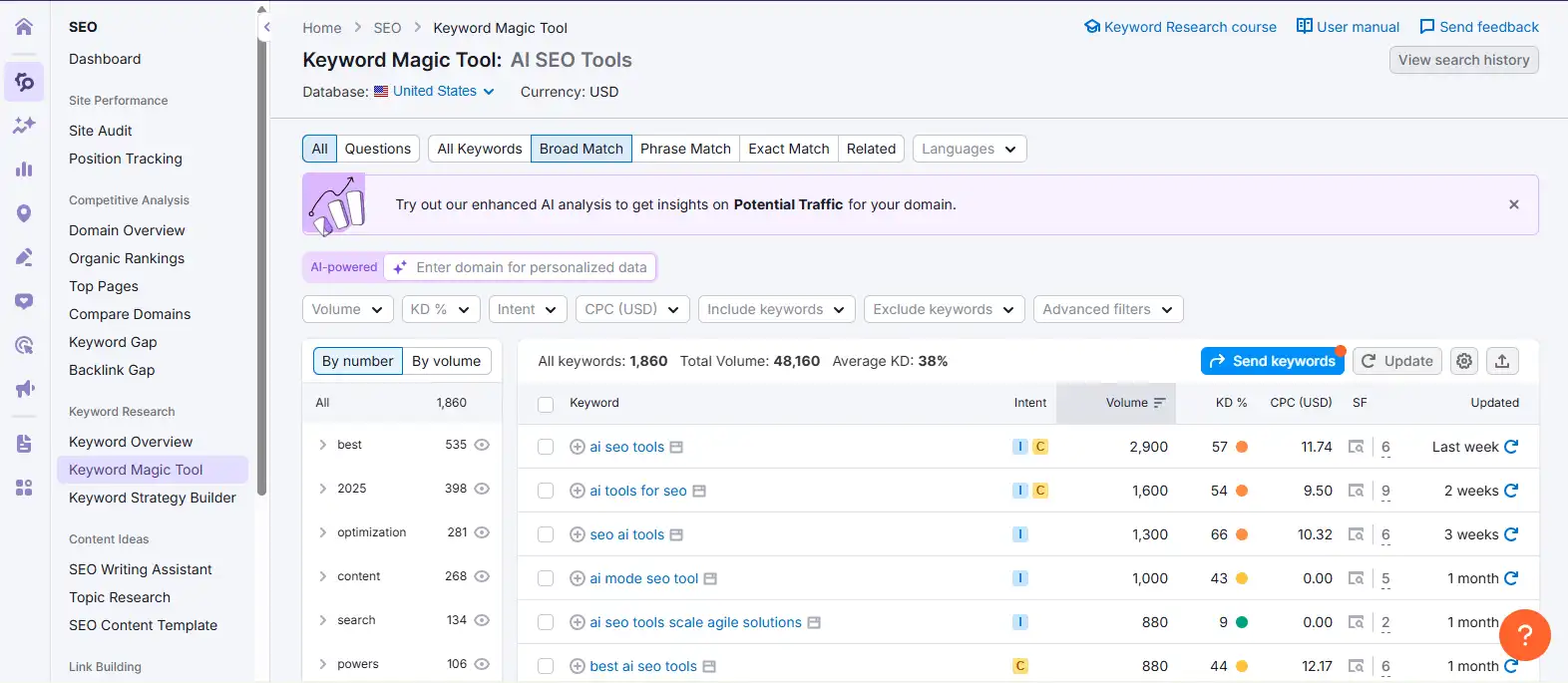
While generative AI is the future, traditional search is not dead. You cannot build a hybrid SEO strategy without foundational data. Semrush remains the undisputed king of traditional market data. To appear in an AI answer, you often need to rank in the traditional search results that feed the model. Semrush provides the raw material needed to inform your broader GEO strategy.
- Best For: Agencies and in-house teams that need a comprehensive hybrid platform for traditional keyword research and deep market data.
- Key Features:
- Keyword Magic Tool: The industry standard for finding high-volume search terms before you optimize for how AI answers them.
- Semrush Copilot: An AI-powered assistant that automatically monitors your website and sends personalized recommendations about technical issues or traffic drops.
- Personal Keyword Difficulty: Uses AI to show exactly how hard it will be for your specific domain to rank in the top 10, replacing generic difficulty scores.
- Pros:
- Data accuracy matches Google Search Console closely.
- The Copilot feature saves hours of manual monitoring by catching technical errors automatically.
- Cons:
- The interface can feel overwhelming due to the massive number of tools and toolkits.
- Does not offer real-time content optimization suggestions during the writing process.
- Pricing: Starts at $165.17/month.
3. Ahrefs
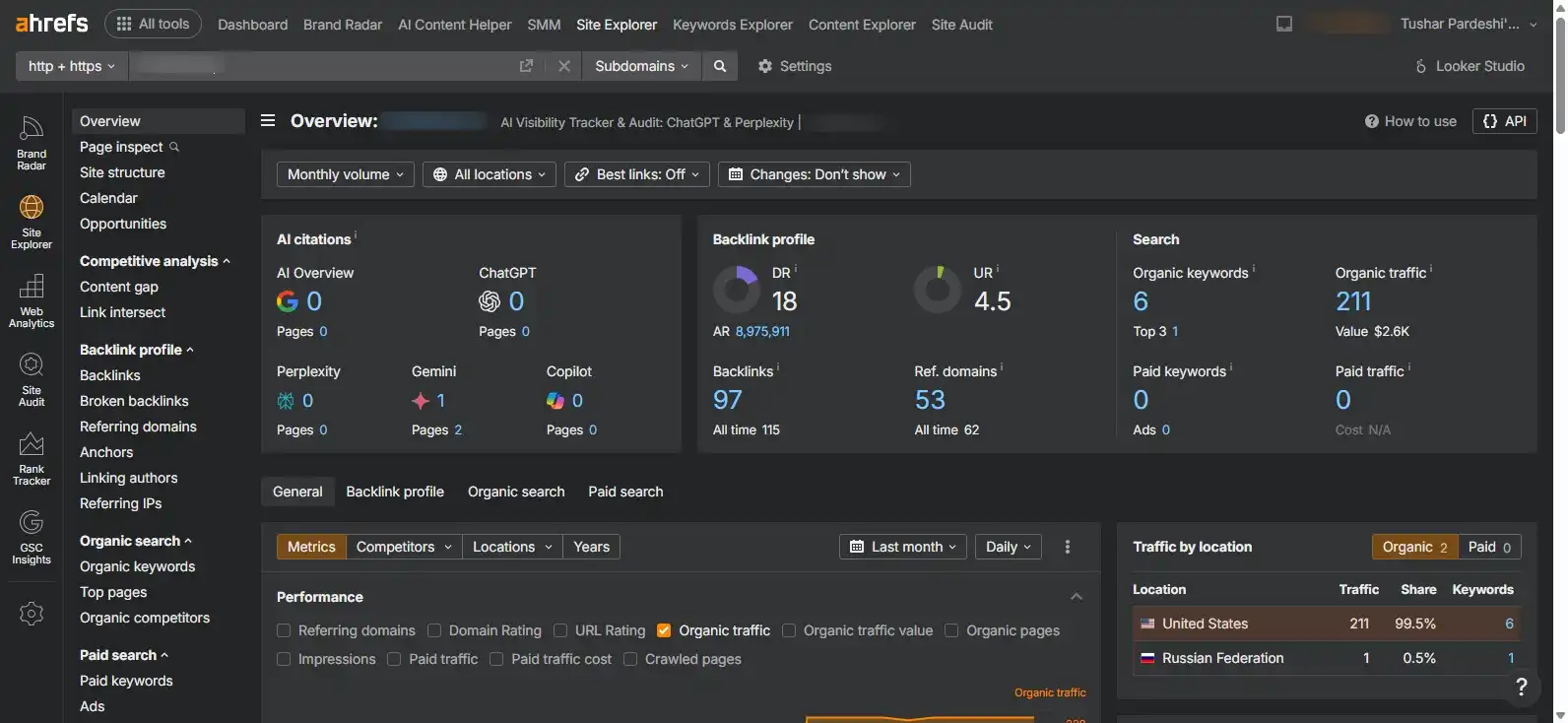
Ahrefs has long been the gold standard for backlink intelligence and competitor analysis. In the era of Generative Engine Optimization, citations are critical. AI models frequently look to highly authoritative, heavily linked domains to synthesize their answers. If you want the AI to trust you, you must build the backlink profile to prove your authority. Furthermore, Ahrefs is actively adapting to the new search ecosystem.
- Best For: SEO professionals and agencies focused on building undeniable domain authority and reverse-engineering competitor link profiles.
- Key Features:
- Site Explorer: Provides the most accurate look into any domain’s organic traffic, ranking keywords, and complete backlink profile.
- Content Gap Analysis: Identifies the exact keywords and topics your competitors cover that you are currently missing.
- Brand Radar (Add-On): A newly introduced AI visibility tool designed to monitor brand mentions across the generative landscape.
- Pros:
- Boasts the most powerful and active backlink database on the market.
- Exceptional competitor analysis tools allow you to perfectly mimic successful content strategies.
- Cons:
- No free plan is available, making it a serious investment for smaller teams.
- The new Brand Radar AI tracking add-on carries a very steep premium price tag.
- Pricing: Starts at $129/month.
4. Surfer SEO
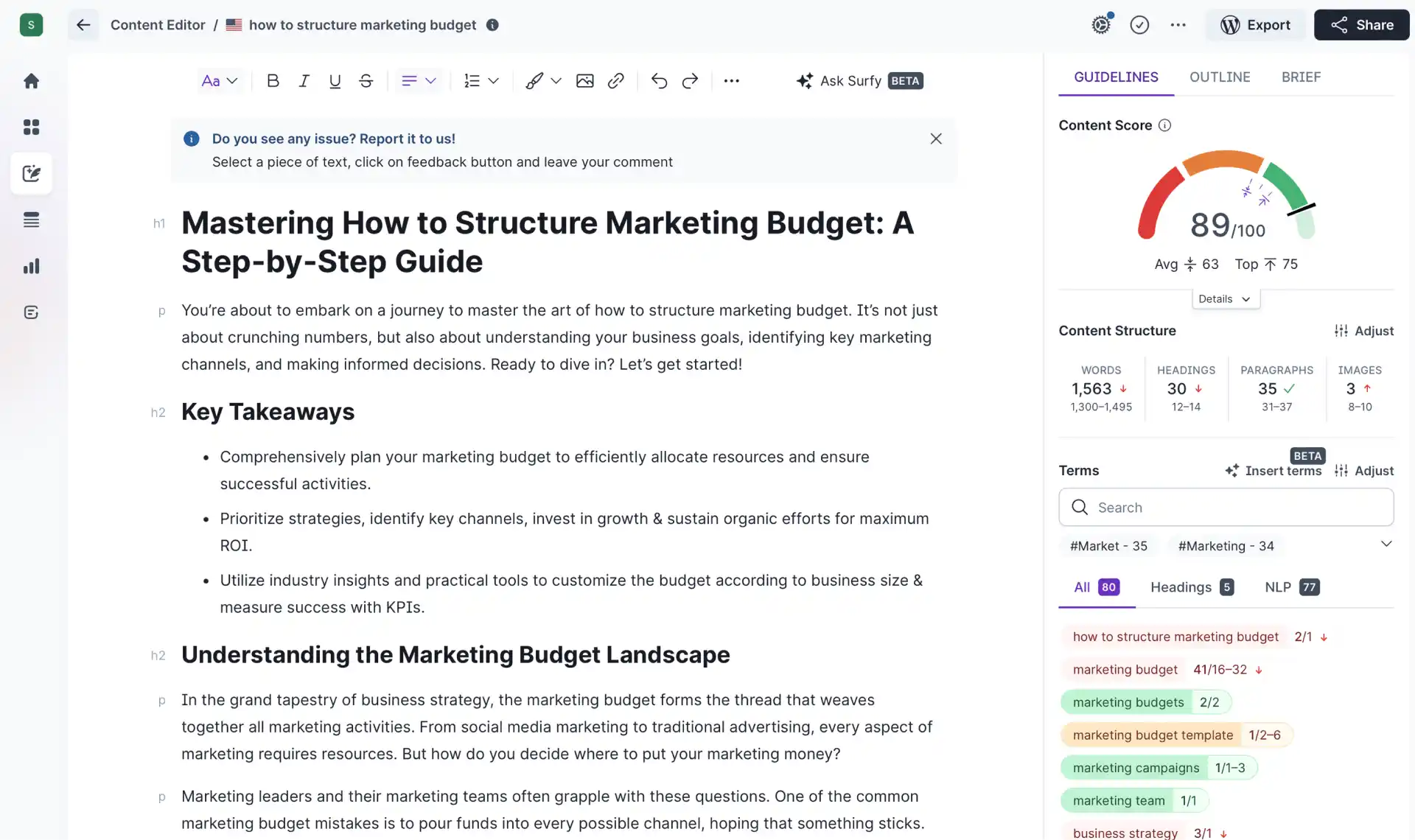
Ranking in 2026 requires more than just repeating a keyword five times. It requires comprehensive entity coverage. AI models like Google Gemini and OpenAI’s GPT-4 do not just read words. They understand concepts. Surfer SEO uses Natural Language Processing to analyze top-ranking pages and tell you exactly which entities you must cover to be seen as a topical expert.
- Best For: Content teams, SEO writers, and agencies publishing at scale that need to ensure their content is semantically optimized for both Google and AI bots.
- Key Features:
- Content Editor: Analyzes top-ranking pages in real-time and suggests related keywords, optimal word counts, and internal linking opportunities.
- Surfer AI: Generates long-form content optimized for your target keyword in minutes.
- Auto-Optimize: Allows you to update underperforming content with one click by automatically adding missing keywords and improving structure.
- Pros:
- The proprietary Content Score is a highly reliable indicator of ranking potential.
- Reduces the time spent on manual SERP analysis from hours to minutes.
- Cons:
- The interface can feel cluttered with too many suggestions for beginner writers.
- Does not include a built-in plagiarism checker.
Pricing: Starts at $79/month.
5. Screaming Frog
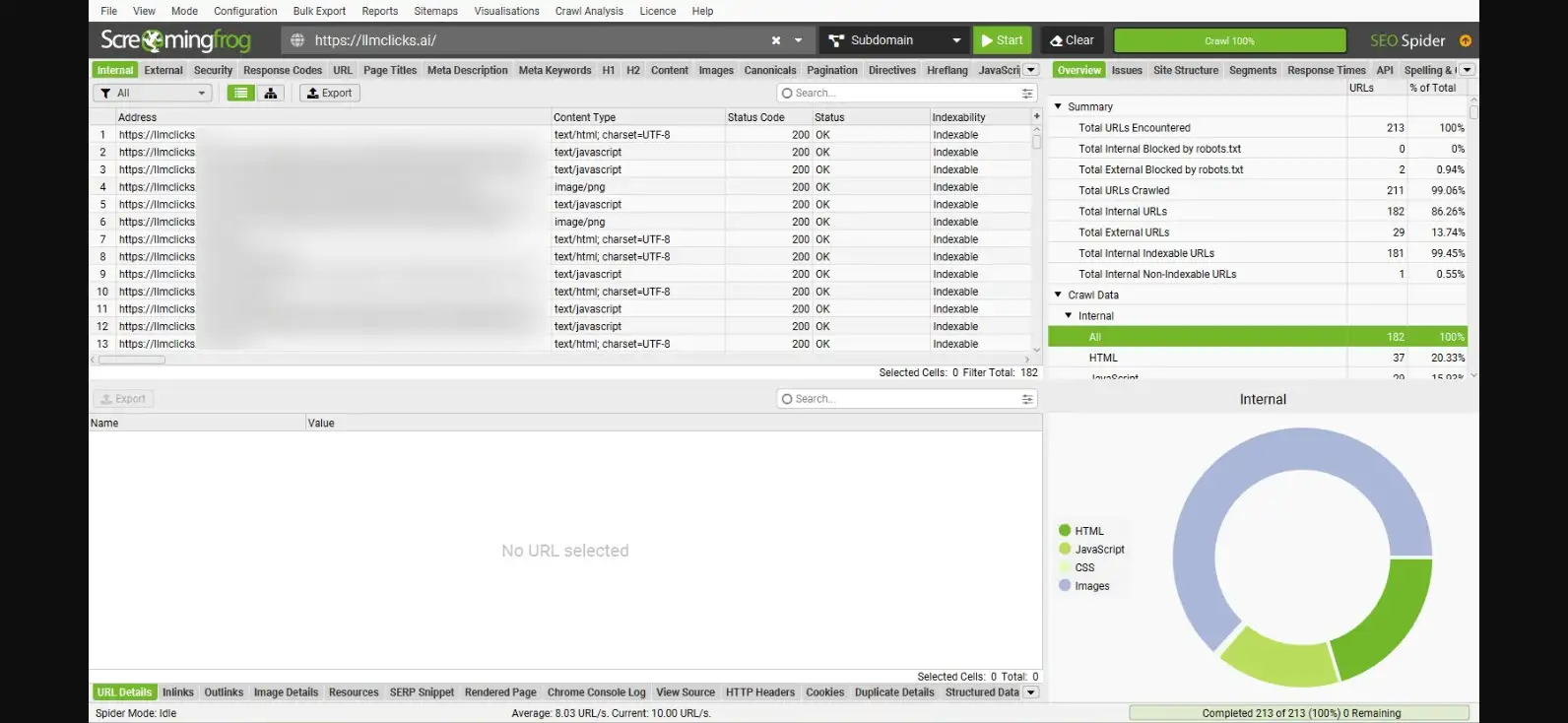
You cannot be cited if you cannot be crawled. Screaming Frog is not a generative AI tool itself, but it is the most critical piece of infrastructure for AI search visibility. AI bots like GPTBot and ClaudeBot are voracious crawlers, but they are often stricter than Googlebot. If your website relies heavily on JavaScript or blocks bots via a messy robots.txt file, you are effectively invisible to the AI.
- Best For: Technical SEO professionals and agencies who need to ensure their website infrastructure is perfectly optimized for AI bot crawling.
- Key Features:
- JavaScript Rendering: Renders pages exactly like a browser to show you exactly what the AI sees or misses.
- Log File Analysis: Verifies exactly which bots are hitting your site so you can confirm if OpenAI or Anthropic are actually crawling your key pages.
- Visual Site Architecture: Visualizes your internal linking to help you create clear pathways for AI models trying to understand your product relationships.
- Pros:
- Unmatched technical depth for identifying the exact roadblocks preventing LLMs from scraping your content.
- Incredibly fast crawling capabilities.
- Cons:
- The highly technical interface presents a steep learning curve for beginners.
- Can produce false positives that require an expert eye to filter through.
Pricing: Starts at $279/year (limited free version available).
6. Perplexity Pro
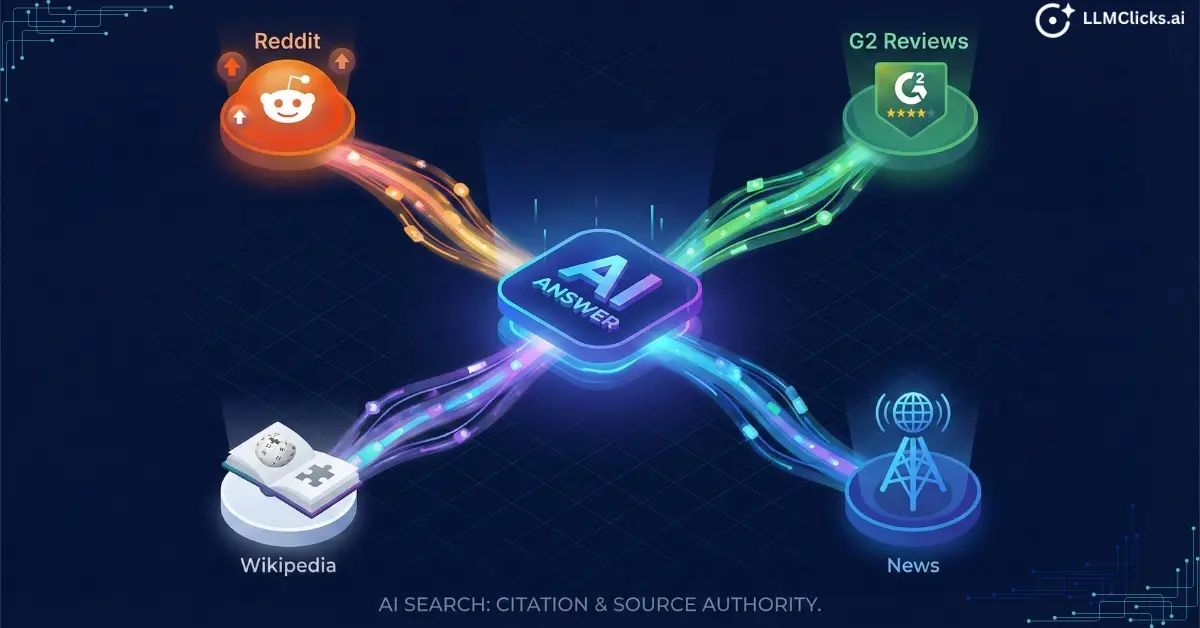
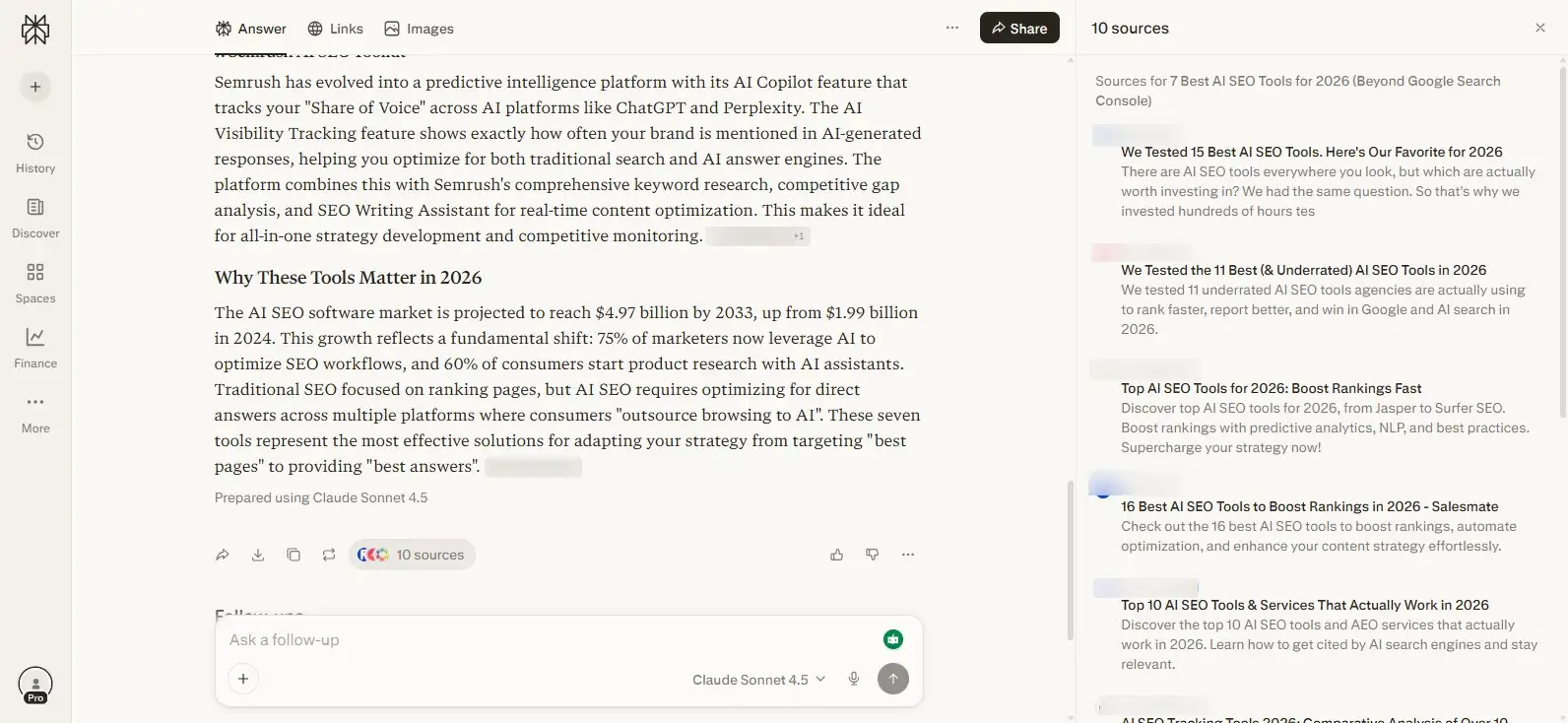
Stop thinking of Perplexity as just a search engine. Think of it as the ultimate competitor research tool. Perplexity is essentially a citation engine that reads live data from the web and synthesizes it into an answer with footnotes. By analyzing these answers, you can reverse-engineer exactly why a competitor is being recommended over you.
- Best For: Content strategists and SEO professionals executing Generative Engine Optimization campaigns who need to uncover the exact authority signals feeding AI answers.
- Key Features:
- Real-Time Web Search: Searches the current web for every query to ensure responses include the most recent information available.
- Automatic Source Citations: Every response includes numbered citations with direct links to sources.
- Pro Search: Allows you to dive deep into specific verticals like academic databases or social media to find niche citations you might miss on Google.
- Pros:
- Source citations completely eliminate manual fact-checking work.
- Reveals the exact platforms (like Reddit or G2) that AI models trust, telling you exactly where to build your presence.
- Cons:
- Optimized for research and synthesis rather than creative content generation.
- The free version has severe usage limits for professional searchers.
- Pricing: Starts at $20/month.
7. Frase
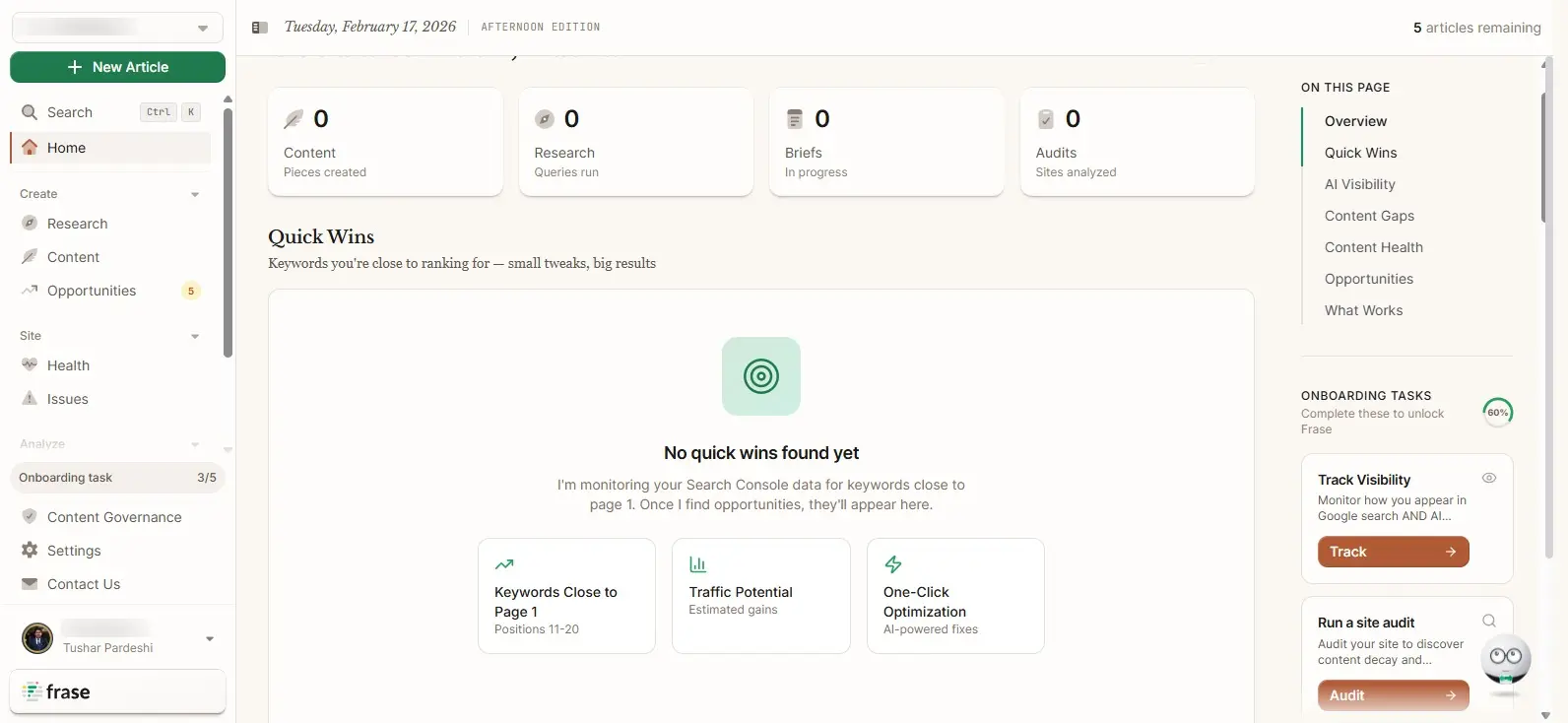
Answer engines like ChatGPT and Google AI Overviews love structure. They crave clear definitions, bulleted lists, and direct answers to specific questions. Frase is the perfect architect for this exact requirement. It scrapes forums and search features to find the exact questions your customers are asking, helping you format your content into modular blocks that AI bots can easily extract and cite.
- Best For: Content writers and marketing teams building highly structured content briefs for Answer Engine Optimization.
- Key Features:
- Answer Engine: Aggregates questions from Google People Also Ask, Reddit, Quora, and other sources to show what people actually want to know.
- Content Brief Generator: Analyzes top-ranking pages and automatically creates a comprehensive brief including required topics and suggested headings.
- SERP Research: Provides a highly scannable analysis of the top 20 Google results.
- Pros:
- Generates comprehensive content briefs in under 10 minutes.
- Uncovers real user questions that your competitors frequently miss.
- Cons:
- Keyword research capabilities are limited to analyzing a single keyword at a time.
- Lacks native CMS integration for direct publishing.
Pricing: Starts at $38/month.
8. Originality.ai

In a world flooded with AI-generated content, being identified as human is a premium ranking signal. Google and other search platforms are aggressively filtering out low-quality, mass-produced AI content. To rank in this hybrid era, you must demonstrate Experience, Expertise, Authoritativeness, and Trustworthiness (E-E-A-T). Originality.ai acts as your quality control department to ensure your content passes the algorithmic Turing test.
- Best For: Content managers and agencies who need to enforce strict quality standards and protect their domain reputation from algorithm penalties.
- Key Features:
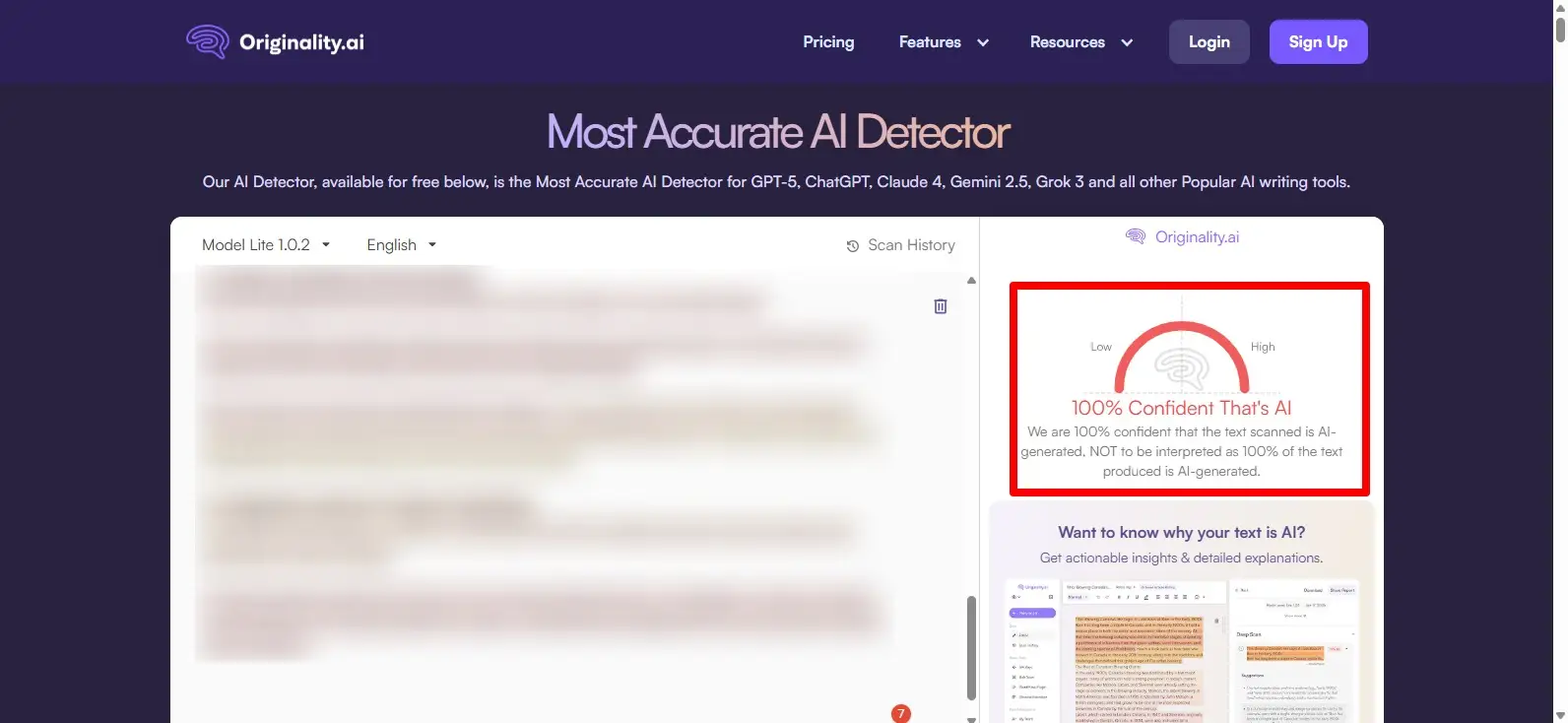
- AI Content Detection: Scans your content and provides a precise probability score of whether it was written by a human or an AI model.
- Fact-Checking: Verifies specific claims within your content against live web sources to reduce the risk of publishing hallucinations.
- Plagiarism Checking: Ensures your content is entirely unique and not just a rehashed version of existing articles.
- Pros:
- Recognized as the most accurate AI content detector currently on the market.
- Prevents your writers or external agencies from taking unauthorized shortcuts with generative tools.
- Cons:
- False positives can occasionally happen, requiring human review to make the final call.
- Focuses strictly on quality control rather than content ideation or structural optimization.
Pricing: Starts at $14.95/month.
9. ChatGPT Plus
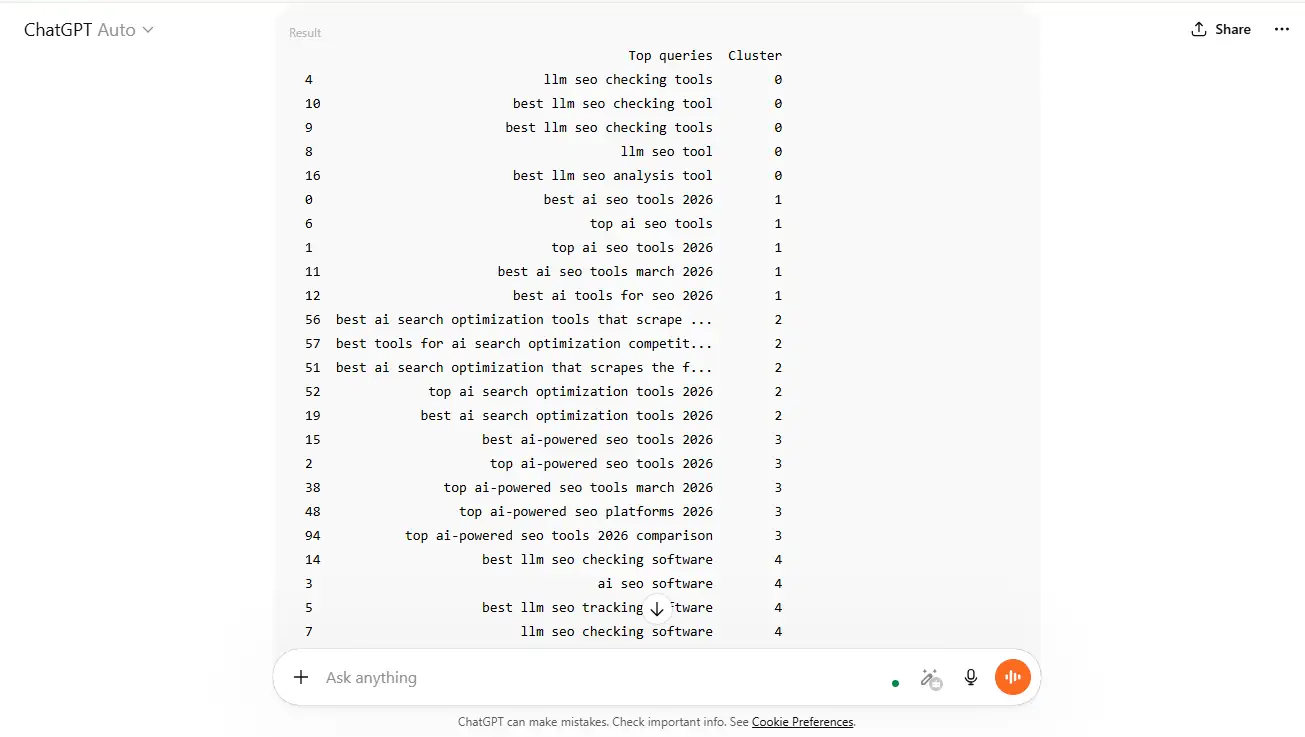
While not built specifically as an SEO tool, ChatGPT Plus has become the ultimate versatile assistant for digital marketers. Instead of being limited to one single function like keyword research or content optimization, you can deploy it for hundreds of daily tasks. It excels at brainstorming, writing code, analyzing massive datasets, and executing rapid Answer Engine Optimization formatting.
- Best For: Everyone in SEO who wants a highly versatile AI assistant to speed up research, data analysis, and technical problem-solving.
- Key Features:
- Advanced AI Models: Provides priority access to GPT-4 and GPT-4o for complex reasoning and superior content generation.
- Custom GPTs: Allows you to build specialized, pre-prompted versions of ChatGPT trained for your specific SEO tasks.
- Data Analysis: Upload spreadsheets or CSV files and let the AI instantly identify trends, cluster keywords, and extract insights.
- Pros:
- Saves hours on repetitive daily tasks like writing meta descriptions and generating schema markup.
- Custom GPTs eliminate the need to rewrite complex prompts for your writing team.
- Cons:
- It cannot provide live keyword difficulty scores, track real-time rankings, or execute technical site crawls.
- Requires strict fact-checking because the model can fabricate sources and hallucinate data.
- Pricing: $20/month.
10. Keywordly
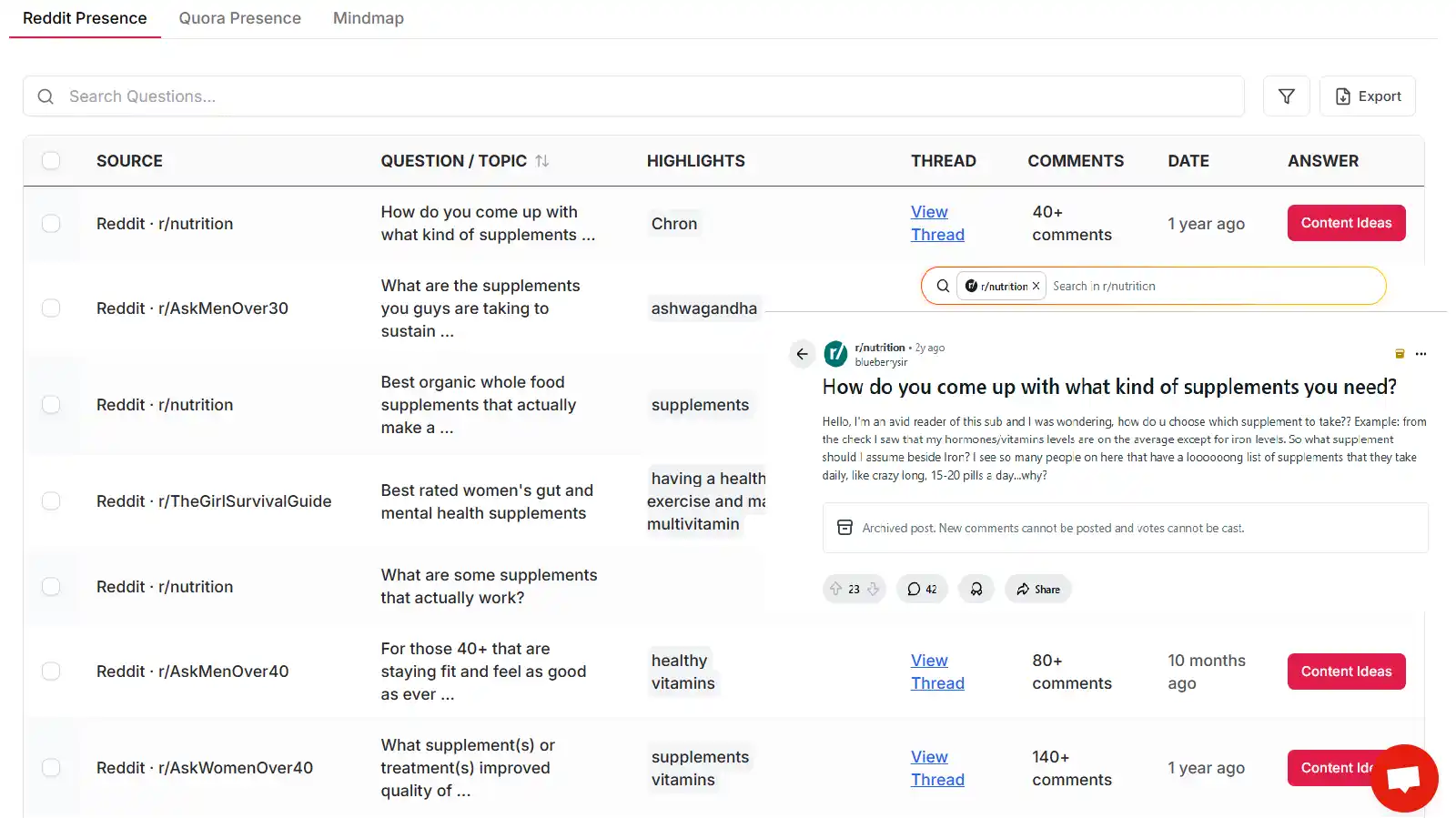
Keywordly is a highly efficient content workflow tool designed for teams operating on a tight budget. What makes Keywordly unique is its ability to bypass standard Google data and pull keyword ideas directly from real conversations on platforms like Reddit and Quora. This allows you to target the exact pain points your customers are discussing. It also features built-in clustering to help you build comprehensive topic authority rapidly.
- Best For: Content strategists and marketers who need rapid keyword clustering and deep conversational research without paying enterprise prices.
- Key Features:
- Keyword Clustering: Automatically groups thousands of keywords into semantic clusters based on search intent and SERP overlap.
- Reddit & Quora Research: Finds highly relevant discussions and questions that real people are asking about your industry.
- GEO/LLM Visibility Tracking: Offers basic monitoring of your brand’s visibility across language models like ChatGPT and Perplexity.
- Pros:
- The clustering algorithm is incredibly fast and surprisingly accurate.
- Uncovering hidden conversational opportunities on Reddit helps you secure natural backlinks from highly engaged communities.
- Cons:
- Search volume data is pulled from third-party sources, meaning accuracy can sometimes vary compared to direct Google data.
- Does not include rank tracking or long-term SERP monitoring features.
Pricing: Starts at $14/month.